Introduction
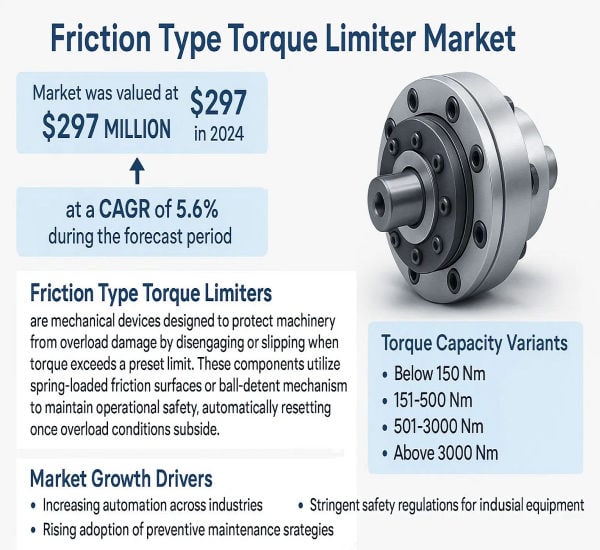
The global Friction Type Torque Limiter Market, valued at US$297 million in 2024, is projected to reach USD 433 million by 2032 at a CAGR of 5.6%. This Semiconductor Insight report explores how friction-type torque limiters vital mechanical safety devices that prevent overload damage are gaining prominence across industrial machinery, robotics, and renewable-energy systems. Rising industrial automation and demand for reliable protective components are driving steady adoption worldwide.
𝐃𝐨𝐰𝐧𝐥𝐨𝐚𝐝 𝐅𝐑𝐄𝐄 𝐒𝐚𝐦𝐩𝐥𝐞 𝐑𝐞𝐩𝐨𝐫𝐭: https://semiconductorinsight.com/download-sample-report/?product_id=117652
Emerging Trends Shaping the Market
Industry 4.0 & Connected Protection
Smart torque limiters with embedded sensing and IIoT connectivity enable condition-based monitoring and predictive maintenance, reducing unplanned downtime.
Robotics & Compact Precision Designs
Demand for compact, high-precision torque limiters is growing with increased robot deployments, cobots, and AGVs in logistics and manufacturing.
Renewable Energy Applications
Wind-turbine pitch and yaw systems, plus other renewable installations, are creating demand for high-torque, corrosion-resistant limiters designed for harsh environments.
Customization & Application-Specific Solutions
OEMs and end-users increasingly require tailored torque settings and integration options for specialized machinery such as packaging lines and processing equipment.
Hybrid & Low-Maintenance Mechanisms
Materials and coating innovations improve wear resistance and allow friction limiters to compete more effectively with alternative torque-protection mechanisms in medium-duty applications.
Key Market Drivers and Growth Factors
- Industrial automation growth: Approximately 68% of applications are in industrial machinery, driving base demand as factories modernize.
- Preventive safety needs: Torque limiters protect high-value assets and reduce repair costs and production losses from overload events.
- Regional manufacturing concentration: Asia-Pacific consumes roughly 62% of global supply, supported by dense manufacturing hubs and automation adoption.
- Retrofit and OEM replacement cycles: Aging machinery and new equipment purchases create continuous replacement and aftermarket opportunities.
- Innovation in smart features: Sensor integration and connectivity enable new service offerings and value-added maintenance contracts.
𝐃𝐨𝐰𝐧𝐥𝐨𝐚𝐝 𝐅𝐑𝐄𝐄 𝐒𝐚𝐦𝐩𝐥𝐞 𝐑𝐞𝐩𝐨𝐫𝐭: https://semiconductorinsight.com/download-sample-report/?product_id=117652
Strategic Developments by Key Players
Chr. Mayr GmbH — Broad product range and focus on smart integration for OEMs.
R+W Antriebselemente GmbH — Modular designs and application-specific couplings.
KTR Systems GmbH — Expansion into hybrid torque solutions and global distribution.
Nexen Group, Inc. — Emphasis on heavy-duty and industrial clutching systems.
Howdon Power Transmission Ltd. & Cross & Morse — UK-based specialists targeting aftermarket and retrofit markets.
Altra Industrial Motion Corp. & Tsubakimoto Chain — Portfolio diversification and service networks for global customers.
RINGSPANN GmbH & Industrial Clutch Parts — Cost-competitive offerings and regional aftermarket support.
Manufacturers are prioritizing ruggedization, sensorization, and close partnerships with OEMs and service providers to capture both new-install and aftermarket revenue streams.
Segment Analysis: Who Leads the Market?
By Type — Friction-type torque limiters dominate the market for general-purpose applications; ball-type systems address precision disengagement requirements.
By Torque Range — 151–500 Nm and 501–3000 Nm ranges cover a large share of industrial use-cases; specialized high-torque segments serve heavy industries and renewable-energy platforms.
By Application — Industrial machinery (~68%) is the largest application segment, followed by automotive, agricultural machinery, and aerospace.
By End-User — Automotive manufacturers and industrial equipment producers drive demand, while agricultural and aerospace sectors represent niche but growing markets.
By Region — Asia-Pacific leads adoption due to concentrated manufacturing activity; North America and Europe focus on modernization and safety upgrades.
𝐆𝐞𝐭 𝐅𝐮𝐥𝐥 𝐑𝐞𝐩𝐨𝐫𝐭 𝐇𝐞𝐫𝐞: https://semiconductorinsight.com/report/friction-type-torque-limiter-market/
Technological Advancements Impacting Growth
Embedded Sensing & Predictive Analytics
Torque limiters equipped with torque sensors and condition-monitoring telemetry provide early warnings of wear and overload trends.
Wear-Resistant Materials & Coatings
Advanced materials improve lifespan and reduce maintenance frequency in abrasive or high-cycle environments.
Modular Designs & Rapid Integration
Plug-and-play torque modules simplify replacement and reduce machine downtime during service events.
Standards & Certification
Growing emphasis on safety standards and machine directives encourages adoption of certified torque-protection solutions across regulated industries.
Why This Report Matters
This Semiconductor Insight report delivers practical insights by providing:
- Market sizing and forecasts (2024–2032)
- Competitive landscape and supplier strategies
- Application- and torque-range-specific opportunity mapping
- Guidance for OEMs, integrators, and aftermarket service providers
𝐆𝐞𝐭 𝐅𝐮𝐥𝐥 𝐑𝐞𝐩𝐨𝐫𝐭 𝐇𝐞𝐫𝐞: https://semiconductorinsight.com/report/friction-type-torque-limiter-market/
Conclusion
As factories and machines become smarter and more automated, friction-type torque limiters will remain a key protective element — evolving from simple mechanical safeguards to connected components within predictive-maintenance ecosystems.
Contact Us:
🌐 Website: https://semiconductorinsight.com/
📞 International: +91 8087 99 2013
🔗 LinkedIn: Follow Us