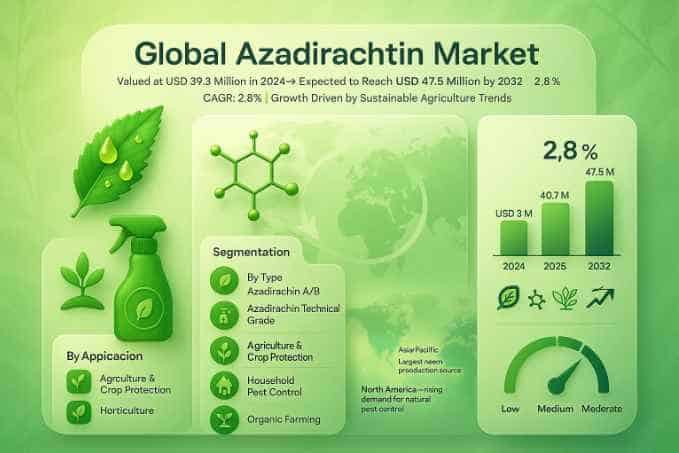
Global Azadirachtin market, a cornerstone of the biopesticide and natural ingredients sector, is projected to experience steady growth driven by the global shift toward sustainable agriculture and natural products. Valued at USD 39.3 million in 2024, the market is expected to reach USD 40.7 million in 2025 and grow to USD 47.5 million by 2032, exhibiting a Compound Annual Growth Rate (CAGR) of 2.8% during the forecast period.
This growth is primarily fueled by increasing regulatory pressures against synthetic chemicals and a rising consumer preference for organic and naturally derived solutions in both agriculture and personal care. As a potent bioactive compound extracted from neem seeds, Azadirachtin offers an effective, biodegradable alternative for pest control and is gaining traction in innovative pharmaceutical and cosmetic formulations.
Download FREE Sample Report PDF: https://www.24chemicalresearch.com/download-sample/298681/azadirachtin-market
➤ Regional Analysis
The Azadirachtin market exhibits distinct geographic dynamics, with production and demand heavily influenced by regional agricultural practices, regulatory environments, and consumer trends.
⥤ Asia-Pacific (India, China, Southeast Asia)
Asia-Pacific is the undisputed leader in the global Azadirachtin market, with India alone accounting for a dominant 34% of global revenue. The region benefits from abundant neem tree cultivation, deep-rooted traditional use of neem-based products, and supportive government policies promoting bio-pesticides. China and emerging Southeast Asian markets like Thailand and Vietnam are also contributing to growth through expanding organic farming sectors.
⥤ North America (U.S., Canada)
Holding approximately 14% of the global market, North America’s demand is driven by stringent environmental regulations and a well-established market for organic produce. Regulatory approval from bodies like the U.S. Environmental Protection Agency (EPA) for Azadirachtin-based biopesticides has been a key factor in its adoption by farmers seeking compliant, sustainable alternatives.
⥤ Europe (Germany, France, U.K.)
Europe accounts for about 13% of market share, with demand strongly supported by the EU’s strict regulatory framework (REACH, biocidal product directives) that favors eco-friendly solutions. The region’s advanced organic farming sector and consumer demand for natural personal care ingredients continue to provide a stable market for high-quality Azadirachtin extracts.
⥤ South America & Middle East & Africa (Brazil, South Africa)
These regions represent emerging but growing markets. Brazil leads in South America, driven by its large-scale agriculture, particularly in organic coffee and fruit cultivation. In the Middle East & Africa, growth is nascent, with countries like South Africa and Turkey showing increasing interest in sustainable agriculture and premium natural personal care products, though market development is challenged by awareness and infrastructure.
➤ Key Market Drivers and Opportunities
The expansion of the Azadirachtin market is underpinned by several powerful, interconnected trends. The global shift toward sustainable agriculture and organic farming is a primary engine, as growers worldwide seek effective alternatives to synthetic pesticides that are facing increasing regulatory restrictions. Azadirachtin’s broad-spectrum efficacy against over 200 insect species, coupled with its non-toxicity to beneficial organisms and shorter environmental persistence, makes it a cornerstone of modern Integrated Pest Management (IPM) strategies.
Beyond agriculture, significant opportunities are emerging from the rapidly growing natural personal care and pharmaceutical industries. Azadirachtin’s proven antimicrobial and anti-inflammatory properties are being leveraged in acne treatments, anti-aging formulations, and veterinary deworming products, opening lucrative new commercial pathways and moving the compound up the value chain.
➤ Challenges & Restraints
Despite strong demand drivers, the market faces notable hurdles that moderate its growth potential. High production costs and complex extraction processes present a significant barrier; producing 1kg of Azadirachtin can require up to 2,000 neem seeds, contributing to a cost that is 30-40% higher than conventional synthetic pesticides, limiting adoption in price-sensitive markets.
Furthermore, supply chain vulnerabilities exist due to the geographic concentration of neem cultivation, with over 80% of production reliant on India, making global supplies susceptible to monsoon variability and export policies. Regulatory heterogeneity across different countries also slows market penetration, as approval timelines can vary dramatically, from 6 months in India to 3 years in the European Union.
Download FREE Sample Report: https://www.24chemicalresearch.com/download-sample/298681/azadirachtin-market
Market Segmentation by Type
- Solvent Extraction (Dominant segment, favored for cost-efficiency)
- Supercritical Fluid Extraction (Growing method for high-purity demand)
- Microwave Extraction
Market Segmentation by Application
- Pesticides/Biopesticides (Largest application segment)
- Personal Care Products (Fast-growing segment)
- Deworming Products
- Pharmaceuticals
➤ List of Key Market Players:
The competitive landscape is fragmented with strong regional players, particularly in India. Innovation in extraction technology and vertical integration are key competitive strategies.
- Ozone Biotech (India) – Market leader with approximately 8% revenue share
- The Himalaya Drug Company (India)
- Agro (India)
- Vanashree (India)
- Yash Chemicals (India)
- Yu Rong Chang (China)
- Green Gold (India)
➤ Recent Market Developments
The market is evolving through technological advancements and strategic vertical integration. Leading producers are investing in advanced extraction technologies like supercritical fluid and microwave extraction to improve yield, purity, and meet stringent pharmaceutical-grade standards. To counter raw material volatility, companies are increasingly securing long-term neem seed supplies through farmer cooperatives. Furthermore, innovative formulation technologies, such as microencapsulation, are being commercialized to enhance the field persistence and efficacy of Azadirachtin products, directly addressing a key limitation and improving competitiveness against synthetic alternatives.
➤ Report Scope
This comprehensive report provides a detailed analysis of the global Azadirachtin market from 2024 to 2032. It offers precise market sizing, CAGR projections, and in-depth segmentation by extraction type, application, and region. The analysis includes competitive benchmarking, detailed company profiles, and an evaluation of strategic initiatives. The research methodology combines primary interviews with industry executives, supply chain analysis, and assessment of regulatory, agricultural, and consumer trends to deliver authoritative market intelligence.
Get Full Report Here: https://www.24chemicalresearch.com/reports/298681/azadirachtin-market
Contact:
International: +1(332) 2424 294 | Asia: +91 9169162030
Website: https://www.24chemicalresearch.com/
Follow us on LinkedIn: https://www.linkedin.com/company/24chemicalresearch/