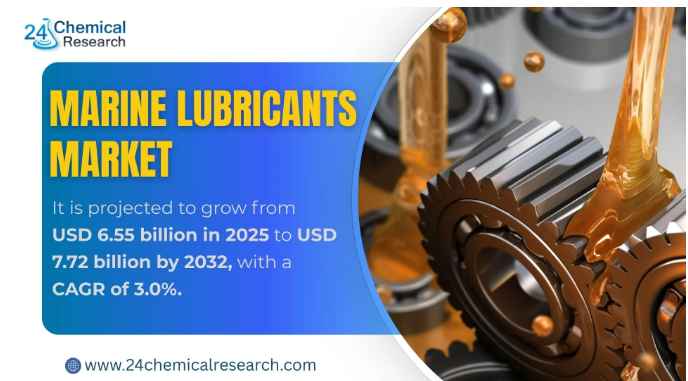
Global marine lubricants market, valued at USD 6.34 billion in 2024, is charting a steady course for growth, navigating the dual forces of expanding global trade and a profound industry shift towards environmental sustainability. The market is projected to reach USD 9.08 billion by 2032, expanding at a Compound Annual Growth Rate (CAGR) of 4.6% during the forecast period.
This growth is underpinned by the critical role of maritime transport, which carries approximately 90% of world trade, and is increasingly shaped by stringent regulations like the IMO 2020 sulfur cap. The market is transitioning from a focus on volume to one of value, driven by demand for advanced, high-performance lubricants compatible with new fuel types and environmental standards.
Download FREE Sample Report PDF: https://www.24chemicalresearch.com/download-sample/298584/marine-lubricants-market
➤ Regional Analysis
The market dynamics are distinctly influenced by regional maritime activity, regulatory frameworks, and industrial capabilities.
⥤ Asia-Pacific (China, Singapore, South Korea)
Asia-Pacific is the undisputed global leader, accounting for the largest share of consumption and production. The region’s dominance is anchored by the world’s busiest ports, its position as the global shipbuilding hub, and booming intra-regional trade. China, Singapore, and South Korea are pivotal, driving demand for both newbuild initial fills and operational top-ups.
⥤ Europe (Germany, U.K., France)
Europe is a large, mature market characterized by technological leadership and the strictest environmental regulations. The EU’s regulatory framework, including REACH and specific maritime directives, creates strong demand for high-performance synthetic and biodegradable Environmentally Acceptable Lubricants (EALs), particularly in the Baltic and North Sea ECAs.
⥤ North America (U.S., Canada)
North America is a substantial and stable market, with growth driven by significant coastal and international trade. A defining feature is the regulatory impact of the U.S. Environmental Protection Agency’s Vessel General Permit (VGP), which mandates the use of EALs in oil-to-sea interfaces, creating a high-value niche for compliant products.
⥤ Rest of the World (Middle East, South America)
These regions present moderate but steady growth opportunities. The Middle East benefits from strategic positioning along major shipping lanes, while South America’s market is led by Brazil’s coastal shipping and offshore activities. Growth is often tempered by economic volatility and evolving regulatory landscapes.
➤ Key Market Drivers and Opportunities
Market expansion is propelled by the sustained growth in global seaborne trade, which directly increases vessel operating hours and lubricant consumption. Concurrently, stringent and evolving environmental regulations (IMO 2020, regional ECA rules, VGP) are the most powerful force, compelling continuous R&D and premiumization of lubricant formulations.
Significant opportunities are emerging from the shipping industry’s decarbonization journey. The development of specialized lubricants for alternative fuels like LNG, methanol, and future solutions such as ammonia and hydrogen represents a major frontier for innovation and value creation. Furthermore, the digitalization of lubricant management through IoT sensors and condition-based monitoring opens avenues for value-added services and deeper customer partnerships.
➤ Challenges & Restraints
The market faces significant headwinds from high volatility in crude oil and base stock prices, which directly impact production costs and create pricing uncertainty for both manufacturers and buyers. The technical complexity and massive R&D investment required to develop next-generation lubricants for new engine designs and future fuels also pose a substantial barrier.
Furthermore, trends toward operational efficiency, including extended oil drain intervals enabled by better oils and condition monitoring, are moderating volume growth even as value increases. The prevalence of counterfeit products in certain regions also undermines brand integrity and poses operational risks.
Download FREE Sample Report: https://www.24chemicalresearch.com/download-sample/298584/marine-lubricants-market
🔬 Segmentation Analysis
Segment Category | Key Sub-Segments | Market Insights |
By Product Type | Engine Oil, Cylinder Oil, System Oil, Hydraulic Fluid | Engine oils dominate in value, critical for main and auxiliary engine performance. Cylinder oils for large two-stroke engines are a high-value segment, especially with new low-sulfur fuels. |
By Ship Type | Bulk Carriers, Container Ships, Tankers, Offshore Vessels | Bulk carriers account for the largest volume share due to the vast size of the global fleet. Offshore support vessels are the fastest-growing segment, fueled by offshore wind farm development. |
By Oil Type | Mineral Oil, Synthetic Oil, Bio-Based Oil | Mineral oil retains the largest share due to cost-effectiveness and wide availability. Bio-based lubricants are the fastest-growing type, driven by EAL mandates in North America and Europe. |
➤ Competitive Landscape and Key Players
The global marine lubricants market is characterized by an oligopolistic structure, with a few multinational oil majors holding dominant positions.
Shell plc, ExxonMobil Corporation, TotalEnergies SE, and BP plc are the established market leaders, collectively commanding a significant share. Their dominance is reinforced by global supply and bunkering networks, strong technical service capabilities, and deep R&D resources necessary for product innovation.
Competitive strategies are increasingly focused on sustainability and digital services. Leaders are investing heavily in developing EALs and lubricants for dual-fuel engines, while also integrating digital tools for condition monitoring and predictive maintenance. Regional players like China Petroleum & Chemical Corporation (Sinopec) and ENEOS Corporation compete effectively in the Asia-Pacific market through localized production and cost advantages.
➤ Report Scope
This comprehensive report provides a detailed analysis of the global marine lubricants market from 2024 to 2032. It offers precise market sizing, CAGR projections, and in-depth segmentation by product type, oil type, ship type, application, and region. The analysis includes competitive benchmarking, detailed company profiles, and an evaluation of strategic initiatives such as R&D investments and sustainability programs. The research methodology combines primary interviews with industry executives, supply chain analysis, and assessment of regulatory, technological, and economic trends to deliver authoritative market intelligence.
Get Full Report Here: https://www.24chemicalresearch.com/reports/298584/marine-lubricants-market
Contact:
International: +1(332) 2424 294 | Asia: +91 9169162030
Website: https://www.24chemicalresearch.com/
Follow us on LinkedIn: https://www.linkedin.com/company/24chemicalresearch/