𝐈𝐧𝐭𝐫𝐨𝐝𝐮𝐜𝐭𝐢𝐨𝐧
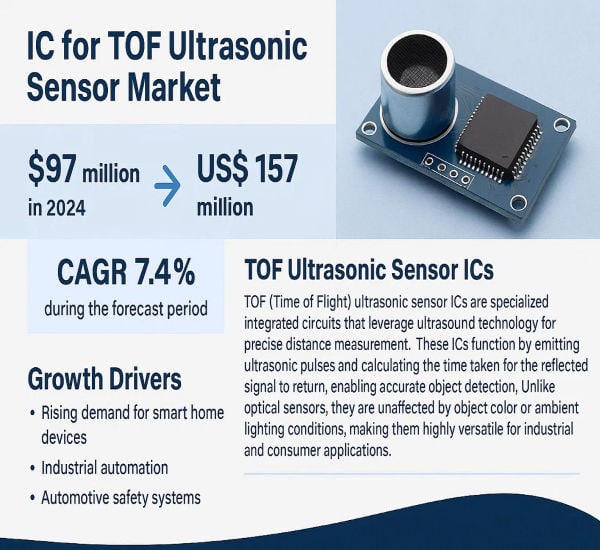
The global market for integrated circuits (ICs) that power Time-of-Flight (TOF) ultrasonic sensors is forecast to grow from USD 97 million in 2024 to USD 157 million by 2032, representing a 7.4% CAGR. These analog and mixed-signal ICs are increasingly critical for precise short-range distance measurement and object detection across automotive, industrial and consumer segments, enabling reliable sensing where optical systems struggle.
𝐃𝐨𝐰𝐧𝐥𝐨𝐚𝐝 𝐅𝐑𝐄𝐄 𝐒𝐚𝐦𝐩𝐥𝐞 𝐑𝐞𝐩𝐨𝐫𝐭: https://semiconductorinsight.com/download-sample-report/?product_id=117645
Emerging Trends Shaping the Market
- AI-assisted signal processing
Embedded machine-learning algorithms at the IC level are improving echo discrimination and multi-target resolution, reducing false positives in cluttered environments and enabling deployment in complex industrial and automotive scenarios. - Higher integration and miniaturization
Convergence of AFE (Analog Front-End) components with digital processing is shrinking module footprints and lowering bill-of-materials, allowing ultrasonic sensing to be embedded in space-constrained consumer devices and compact automotive arrays. - Ultra-low-power architectures
Power-optimized designs and aggressive duty-cycling extend battery life for IoT endpoints, AR/VR peripherals and mobile robotics, unlocking new low-power applications. - MEMS and sensor–IC co-design
Tighter partnerships between MEMS manufacturers and IC vendors deliver improved SNR, faster response and easier manufacturability through optimized packaging and interface design. - Robustness for adverse environments
Design emphasis on immunity to dust, smoke and variable lighting positions ultrasonic ICs as preferred alternatives to optical sensors in both factory automation and harsh outdoor applications.
Key Market Drivers and Growth Factors
- Automotive electrification & ADAS growth: Increased sensor density for parking assistance, low-speed collision avoidance and occupant detection is a primary revenue driver.
- Industry 4.0 adoption: Non-contact proximity sensing and object detection for smart factories favor ultrasonic solutions that tolerate particulates and changing light.
- Smart consumer devices: Touchless controls, presence detection and occupancy sensing in smart homes and wearables create large-volume opportunities for compact, low-power ICs.
- Immersive interfaces: AR/VR systems demand precise short-range tracking and gesture recognition that ultrasonic TOF can deliver with low latency.
𝐆𝐞𝐭 𝐅𝐮𝐥𝐥 𝐑𝐞𝐩𝐨𝐫𝐭 𝐇𝐞𝐫𝐞: https://semiconductorinsight.com/report/ic-for-tof-ultrasonic-sensor-market/
Strategic Developments by Key Players
Leading vendors are advancing mixed-signal performance, integration and power efficiency through targeted R&D, M&A and strategic partnerships. Notable participants pushing the technology frontier include Texas Instruments, Analog Devices (including Maxim), Elmos Semiconductor, CHIRP Microsystems, Microchip Technology, STMicroelectronics, NXP Semiconductors, Maocheng Technology and ROHM Semiconductor. Their activity ranges from AFE innovations and SoC integration to collaborations with module makers to accelerate automotive and consumer rollouts.
Segment Analysis: Who Leads the Market?
- By Type: AFE ICs currently dominate due to the critical role of analog front-end performance in accurate TOF measurement; SoCs are gaining where system simplification and integration are prioritized.
- By Application: Automotive and industrial automation account for the largest revenue pools, while consumer electronics and smart home markets represent the fastest growth potential.
- By End User: OEMs drive adoption in vehicles and factories; component suppliers and system integrators push innovation into bundled modules and turnkey sensor solutions.
- Regional Outlook: Asia-Pacific leads on manufacturing scale and volume adoption; North America and Europe focus on high-performance, safety-critical deployments.
𝐃𝐨𝐰𝐧𝐥𝐨𝐚𝐝 𝐅𝐑𝐄𝐄 𝐒𝐚𝐦𝐩𝐥𝐞 𝐑𝐞𝐩𝐨𝐫𝐭: https://semiconductorinsight.com/download-sample-report/?product_id=117645
Technological Advancements Impacting Growth
Can algorithmic IC design narrow the performance gap between optical and ultrasonic sensing? Advances in embedded DSPs, adaptive filtering and multi-echo processing are improving resolution and latency while preserving ultrasonic advantages in adverse conditions. Packaging and nanofabrication refinements reduce parasitics and expand operating ranges, enabling smaller, faster and more power-efficient ICs.
Why This Report Matters
This analysis provides market estimations for 2024–2032, segmented forecasts by type and application, and a competitive landscape highlighting strategic moves and technology roadmaps. Product planners, investors and systems engineers will find actionable insights on where integration, power efficiency and signal processing will determine winners in both high-volume automotive programs and emerging consumer applications.
𝐆𝐞𝐭 𝐅𝐮𝐥𝐥 𝐑𝐞𝐩𝐨𝐫𝐭 𝐇𝐞𝐫𝐞: https://semiconductorinsight.com/report/ic-for-tof-ultrasonic-sensor-market/
Conclusion
As vehicles, factories and consumer devices demand reliable non-optical sensing, TOF ultrasonic ICs are set to move from niche enabler to mainstream system component. Companies that prioritize integrated, low-power designs and close sensor–IC co-engineering stand to capture the largest market share going forward.
Contact Us:
🌐 Website: https://semiconductorinsight.com/
📞 International: +91 8087 99 2013
🔗 LinkedIn: Follow Us