Introduction
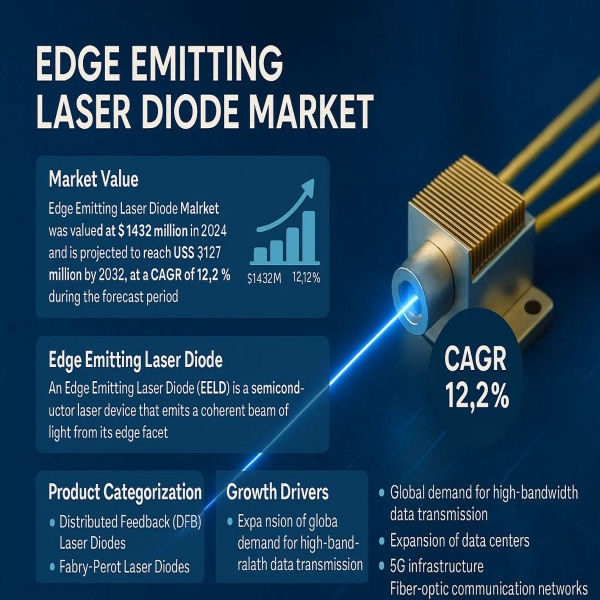
The global edge-emitting laser diode (EELD) market is projected to expand from USD 1,432 million in 2024 to USD 3,127 million by 2032, reflecting a 12.2% CAGR. With high output power, excellent beam quality and strong modulation capability, EELDs are central to high-speed optical communications, data-center transceivers, LiDAR and precision sensing. Their role in enabling next-generation 400G/800G networks and advanced sensing platforms positions them as a critical component of digital infrastructure growth.
Power line: High-performance EELDs are becoming the workhorse light source for converging communications and sensing technologies.
𝐃𝐨𝐰𝐧𝐥𝐨𝐚𝐝 𝐅𝐑𝐄𝐄 𝐒𝐚𝐦𝐩𝐥𝐞 𝐑𝐞𝐩𝐨𝐫𝐭: https://semiconductorinsight.com/download-sample-report/?product_id=117565
Emerging Trends Shaping the Market
- 400G/800G and coherent transceiver demand
The move to higher data rates is driving adoption of advanced DFB and EML designs that deliver higher modulation bandwidth and improved noise performance for long-haul and hyperscale interconnects. - Photonic integrated circuits (PIC) integration
Monolithically integrated EELDs with modulators and other photonic elements are reducing system power and footprint—accelerating adoption in hyperscale data centers and compact telecom modules. - LiDAR and 3D sensing adoption
Autonomous vehicles and industrial automation require EELDs with precise, high-power pulsing for long-range LiDAR, boosting demand for ruggedized, high-reliability diode designs. - Wall-plug efficiency and thermal optimization
Improvements in semiconductor materials and packaging are increasing wall-plug efficiency, easing thermal management and lowering operating costs in high-density deployments. - Wavelength diversification into SWIR/MWIR
Expansion into short- and mid-wavelength infrared bands supports specialized industrial, medical and defense sensing applications that require unique absorption and penetration properties.
Key Market Drivers and Growth Factors
- Data-communication infrastructure: Communications account for roughly 65% of market demand; hyperscale data-center expansion and 5G backhaul are primary drivers.
- Hyperscale investments: Massive capital expenditure in data centers and optical backbone upgrades is directly translating into increased EELD purchases for transceivers and amplifiers.
- Automotive and industrial sensing: Growing LiDAR deployments and precision industrial sensing broaden addressable markets beyond traditional telecom use cases.
- Asia-Pacific manufacturing concentration: Regional production and network buildouts—consuming about 45% of global EELD volumes—accelerate scale and supply-chain dynamics.
𝐆𝐞𝐭 𝐅𝐮𝐥𝐥 𝐑𝐞𝐩𝐨𝐫𝐭 𝐇𝐞𝐫𝐞: https://semiconductorinsight.com/report/edge-emitting-laser-diode-market/
Strategic Developments by Key Players
Industry leaders are prioritizing higher modulation speed, improved efficiency and integrated photonics. Established and specialist companies—ranging from Coherent and Lumentum to Sony, ams OSRAM, Jenoptik and Hamamatsu—are advancing product roadmaps through wafer-scale integration, co-packaging with electronics, and targeted M&A. Strategic partnerships with transceiver OEMs and cloud operators are shortening qualification cycles and securing design wins for next-generation optical modules.
Segment Analysis: Who Leads the Market?
- By Type: DFB lasers lead demand for communication-grade performance; Fabry–Pérot and other EELD variants serve lower-cost and niche sensing roles.
- By Application: Communications dominate, followed by industrial manufacturing, medical and specialized sensing. LiDAR and data-center interconnects are fastest-growing end uses.
- By Wavelength & Power: NIR remains core for telecom; SWIR/MWIR segments grow for sensing. Medium-to-high-power devices capture value in LiDAR and industrial cutting/measurement.
- Regional Outlook: Asia-Pacific sustains volume leadership; North America and Europe focus on high-spec, safety-critical and medical deployments.
𝐃𝐨𝐰𝐧𝐥𝐨𝐚𝐝 𝐅𝐑𝐄𝐄 𝐒𝐚𝐦𝐩𝐥𝐞 𝐑𝐞𝐩𝐨𝐫𝐭: https://semiconductorinsight.com/download-sample-report/?product_id=117565
Technological Advancements Impacting Growth
Can integrated photonics and improved diode architectures redefine system-level efficiency? Advances in DFB/EML design, thermal interface materials, and co-packaging with modulators and drivers are reducing link power-per-bit while increasing modulation speed. These improvements—paired with PIC integration—enable smaller, lower-power transceivers and more capable LiDAR transmitters.
Why This Report Matters
The analysis provides segmented forecasts for 2025–2032, supplier benchmarking and technology roadmaps that reveal where investment will yield competitive advantage. For transceiver manufacturers, data-center operators and sensor OEMs, the report clarifies which diode characteristics—modulation bandwidth, efficiency, wavelength stability and packaging robustness—will determine commercial success.
𝐆𝐞𝐭 𝐅𝐮𝐥𝐥 𝐑𝐞𝐩𝐨𝐫𝐭 𝐇𝐞𝐫𝐞: https://semiconductorinsight.com/report/edge-emitting-laser-diode-market/
𝐂𝐨𝐧𝐜𝐥𝐮𝐬𝐢𝐨𝐧
As data volumes surge and sensing applications proliferate, edge-emitting laser diodes will move from component to system enabler. Companies that combine high-speed diode architectures with PIC integration, thermal-smart packaging and close collaboration with module OEMs will capture the largest share of a rapidly expanding market.
Contact Us:
🌐 Website: https://semiconductorinsight.com/
📞 International: +91 8087 99 2013
🔗 LinkedIn: Follow Us