Introduction
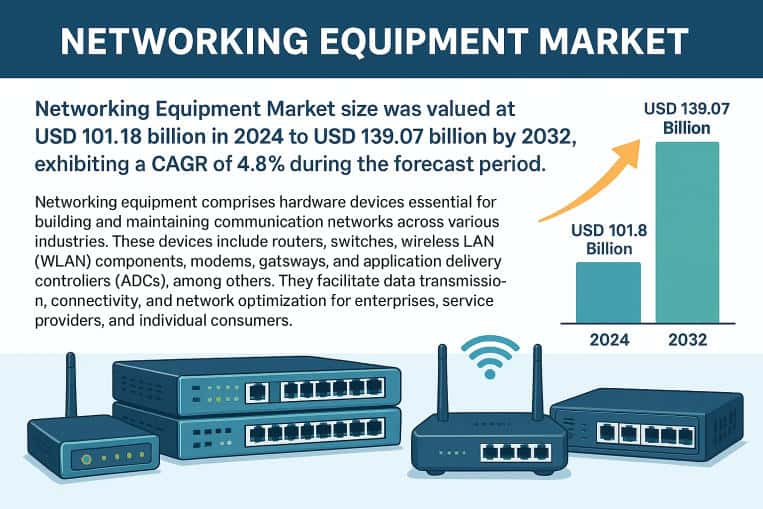
According to semiconductorinsight, the global Networking Equipment Market continues to play a foundational role in the semiconductor-driven digital economy. Valued at USD 101.18 billion in 2024, the market is projected to reach USD 139.07 billion by 2032, expanding at a CAGR of 4.8% during the forecast period. The semiconductor industry continues to redefine global innovation, with this market showing robust expansion and technological disruption as data traffic, cloud infrastructure, and intelligent connectivity reshape enterprise and consumer networks worldwide.
Download Sample Report PDF https://semiconductorinsight.com/download-sample-report/?product_id=122729
Emerging Trends Shaping the Networking Equipment Market
The networking equipment landscape is evolving rapidly as semiconductor innovation intersects with next-generation connectivity demands.
One of the most influential trends is the integration of AI-driven network management. Intelligent routers and switches increasingly embed AI-enabled chipsets to optimize traffic routing, reduce latency, and enhance predictive maintenance. This capability is becoming essential for large-scale data centers and telecom networks handling exponential data growth.
Another defining trend is the global transition toward 5G and early-stage 6G infrastructure. High-performance networking equipment, powered by advanced semiconductors, is required to support ultra-low latency and high bandwidth. This shift is driving upgrades across base stations, core networks, and enterprise backhaul systems.
The rise of cloud-native and edge computing architectures is also reshaping demand. Networking equipment designed for edge deployments enables faster data processing closer to end users, supporting applications such as smart manufacturing, autonomous systems, and real-time analytics.
Finally, energy-efficient and sustainable network hardware is gaining prominence. Vendors are prioritizing power-optimized semiconductor components to reduce operational costs and align with global sustainability goals.
Key Market Drivers and Growth Factors
Several structural drivers are supporting consistent growth in the networking equipment market:
- Rapid expansion of global data centers to support cloud services and AI workloads
- Increasing enterprise adoption of software-defined networking (SDN) and network virtualization
- Rising internet penetration and mobile data consumption across emerging economies
- Continuous semiconductor advancements enabling higher-speed and more reliable connectivity
Together, these factors are reinforcing long-term demand for advanced networking equipment across industries.
Strategic Developments by Key Players
Leading companies are actively strengthening their positions through innovation and strategic investments. Cisco Systems continues to focus on AI-powered networking platforms that enhance security and automation across enterprise networks. Huawei Technologies is expanding its high-capacity switching and optical networking portfolio to support carrier-grade infrastructure.
Juniper Networks is investing in cloud-native networking solutions that integrate AI-driven operations, while Arista Networks is gaining traction in hyperscale data centers with high-performance Ethernet switches. Nokia remains focused on next-generation IP routing and optical transport solutions for telecom operators, and Ericsson is advancing network equipment aligned with 5G evolution and virtualization.
These strategic moves highlight how competition increasingly centers on intelligent, software-integrated hardware platforms.
Our comprehensive report is ready with the latest trends, growth opportunities, and strategic analysis https://semiconductorinsight.com/report/networking-equipment-market/
Segment Analysis: Who Leads the Market?
By equipment type, routers and switches continue to dominate due to their essential role in enterprise and telecom networks. High-speed Ethernet switches, in particular, are experiencing steady adoption within data centers.
From an application perspective, telecom service providers represent a leading segment, driven by network modernization and mobile data growth. Enterprise networking follows closely, supported by digital transformation initiatives across industries.
Regionally, Asia-Pacific dominates the networking equipment market, supported by large-scale infrastructure investments and robust semiconductor ecosystems in China, Japan, South Korea, and Taiwan. North America remains a key innovation hub, while Europe continues to emphasize secure and sustainable networking deployments.
Technological Advancements Impacting Growth
Technological progress remains tightly linked to semiconductor innovation. Advanced chipsets enable higher port densities, faster data throughput, and enhanced network intelligence.
Can AI-Driven Networking Redefine Performance and Reliability?
AI integration into networking equipment is improving real-time traffic analysis and fault detection, significantly enhancing network uptime. Meanwhile, automation in network configuration is reducing operational complexity for enterprises managing hybrid and multi-cloud environments.
Innovations in nanofabrication and advanced packaging are also enabling compact, power-efficient hardware designs that meet growing performance demands without increasing energy consumption.
Why This Report Matters
This networking equipment market report offers actionable intelligence for stakeholders navigating a complex and competitive environment. It delivers market size estimations from 2024 to 2032, detailed growth forecasts, and competitive intelligence covering strategic initiatives by leading players.
Additionally, the report supports opportunity mapping across equipment types, applications, and regions, helping technology providers, investors, and system integrators align strategies with long-term market trends.
For broader semiconductor context, readers can explore related insights on the Semiconductor Insights platform at [internal link: https://www.semiconductorinsight.com]. For industry-wide standards and developments, reference materials from SEMI.org provide additional perspective on semiconductor manufacturing trends.
Download Sample Report PDF https://semiconductorinsight.com/download-sample-report/?product_id=122729
Forward Outlook
As the networking equipment market advances toward 2032, innovation will increasingly hinge on intelligent semiconductor integration, energy efficiency, and scalable architectures. As the semiconductor landscape evolves at record speed, stakeholders must align innovation with sustainability and strategic foresight to remain competitive.
Explore Related Outgoing Coverage in semicoductorinsight Domain
https://semiconductorinsight.com/report/remote-control-systems-kits-market/
https://semiconductorinsight.com/report/wire-marking-labels-market/
https://semiconductorinsight.com/report/slot-type-optical-interruptor-market/
https://semiconductorinsight.com/report/single-ended-triode-set-amplifiers-market/
https://semiconductorinsight.com/report/redundant-array-of-independent-disks-raid-market/
https://semiconductorinsight.com/report/led-display-screen-market/
https://semiconductorinsight.com/report/global-appliance-extension-cords-market/
Call-to-Action
Explore the full Networking Equipment Market report for in-depth forecasts, segment analysis, and competitive insights at Semiconductor Insights