Introduction
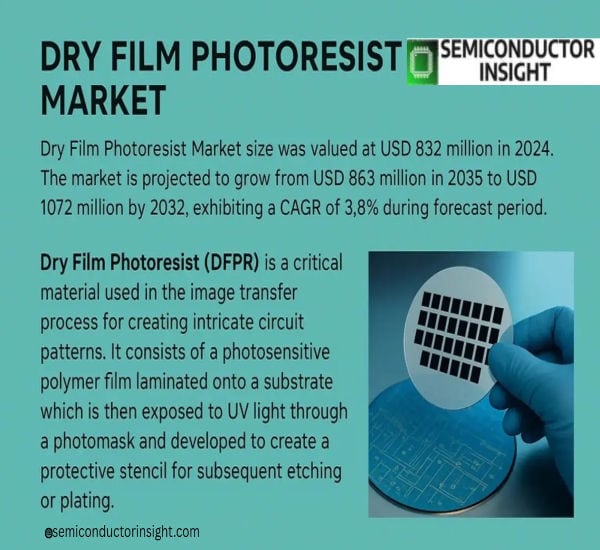
The global Dry Film Photoresist Market was valued at USD 832 million in 2024 and is projected to reach USD 1,072 million by 2032, growing at a 3.8% CAGR. The semiconductor and electronics boom—together with a shift to higher-density PCBs and advanced packaging—has pushed dry film photoresists into a central role for sub-micron patterning and reliable production. The materials that pattern tomorrow’s circuitry are now strategic inputs for OEMs, EMS providers and board fabricators alike.
𝐃𝐨𝐰𝐧𝐥𝐨𝐚𝐝 𝐅𝐑𝐄𝐄 𝐒𝐚𝐦𝐩𝐥𝐞 𝐑𝐞𝐩𝐨𝐫𝐭: https://semiconductorinsight.com/download-sample-report/?product_id=127108
Emerging Trends Shaping the Market
Higher-resolution formulations for HDI and IC substrates
As printed circuit boards migrate to High-Density Interconnect (HDI) designs and semiconductor packaging demands finer traces, photoresist chemistries that deliver sub-micron resolution and minimal line-edge roughness are gaining urgency. Suppliers focused on ultra-fine pattern fidelity will capture design-win opportunities across consumer, automotive and industrial segments.
Thermal- and chemical-resistant grades for advanced packaging
Fan-out wafer-level packaging, 2.5D/3D integration and lead-free soldering require photoresists with superior thermal stability and chemical resistance. These characteristics reduce defectivity during reflow and assembly, making specialized dry films essential for next-generation package manufacturing.
Regional capacity shifts toward Asia-Pacific
Asia-Pacific remains the largest consumer due to concentrated electronics manufacturing. Localized capacity expansions and partnerships with regional fabricators lower supply risk and shorten qualification cycles—critical in markets with fast product lifecycles.
Sustainability and processing efficiency
Manufacturers are prioritizing reduced solvent usage, lower waste streams and easier recycling in resist formulation and processing. Incremental gains in lamination and stripping efficiency improve yield and lower total cost of ownership for fabricators.
Custom co-development with major OEMs and EMS partners
Deeper collaboration between material suppliers and electronics manufacturers—co-developing tailor-made resists for specific process flows—is accelerating time-to-production and reducing qualification barriers for novel board and substrate architectures.
Key Market Drivers and Growth Factors
- Semiconductor and electronics expansion—increased fab and PCB plant investments fuel baseline demand.
• Advanced packaging adoption—fan-out and 3D integration create markets for high-performance dry films.
• Automotive electrification—higher electronic content per vehicle increases requirements for robust PCBs.
• Miniaturization trends—smaller form factors and denser routing elevate the need for superior resolution resists.
• Asia-Pacific manufacturing concentration—regional OEMs and EMS investments sustain long-term consumption.
𝐆𝐞𝐭 𝐅𝐮𝐥𝐥 𝐑𝐞𝐩𝐨𝐫𝐭 𝐇𝐞𝐫𝐞: https://semiconductorinsight.com/report/dry-film-photoresist-market/
Strategic Developments by Key Players
Industry incumbents are pursuing capacity, formulation and partnership plays to stay ahead. Notable companies shaping the competitive landscape include Asahi Kasei, DuPont, JSR Corporation, Fujifilm Electronic Materials, TOK (Tokyo Ohka Kogyo), Chang Chun Group and LG Chem. These firms are expanding production footprints in high-growth regions, investing in R&D for high-temperature and high-resolution formulations, and deepening collaborative agreements with leading OEMs and PCB fabricators to accelerate adoption of customized photoresist solutions.
Segment Analysis: Who Leads the Market?
By Type — Positive dry film resists dominate because of their process flexibility and resolution benefits; negative types retain roles in niche chemical-milling and thick-film applications.
By Application — PCBs are the largest volume driver today, while semiconductor packaging represents the fastest technical upcycle.
By End User — PCB fabricators and EMS providers consume the bulk of volumes; OEMs and advanced substrate makers drive demand for premium grades.
By Region — Asia-Pacific leads in both manufacturing and consumption; North America and Europe focus on premium, high-performance grades for specialized applications.
𝐃𝐨𝐰𝐧𝐥𝐨𝐚𝐝 𝐅𝐑𝐄𝐄 𝐒𝐚𝐦𝐩𝐥𝐞 𝐑𝐞𝐩𝐨𝐫𝐭: https://semiconductorinsight.com/download-sample-report/?product_id=127108
Technological Advancements Impacting Growth
Can formulation science enable sub-micron repeatability at scale? Advances in polymer chemistry, photoacid generator systems and lamination technology are improving process windows and stripability, enabling consistent sub-micron results across large panels. Concurrent improvements in inline metrology and process control are reducing scrap and accelerating qualifications for new materials.
Why This Report Matters
This analysis provides:
• Market sizing and growth forecasts (2024–2032) with application-level granularity.
• Competitive benchmarking across leading material suppliers.
• Technology trend mapping for HDI, advanced packaging and automotive electronics.
• Opportunity matrices for regional capacity and co-development strategies.
𝐆𝐞𝐭 𝐅𝐮𝐥𝐥 𝐑𝐞𝐩𝐨𝐫𝐭 𝐇𝐞𝐫𝐞: https://semiconductorinsight.com/report/dry-film-photoresist-market/
Conclusion
The dry film photoresist market will remain a quietly strategic segment: suppliers who pair advanced chemistries with localized supply, co-development pathways and greener processing will unlock the most valuable industry partnerships. As packaging and PCB complexity rise, the materials that enable reliable patterning will increasingly determine who wins in high-precision electronics manufacturing.
Contact Us:
🌐 Website: https://semiconductorinsight.com/
📞 International: +91 8087 99 2013
🔗 LinkedIn: Follow Us