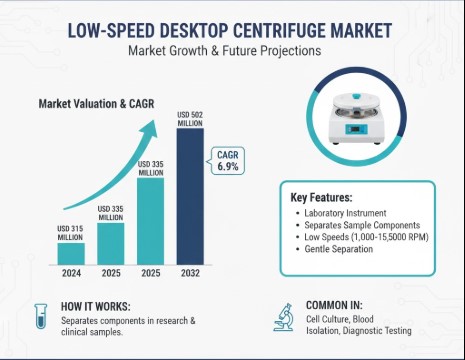
According to a new report from Intel Market Research, the global Low-speed Desktop Centrifuge market was valued at USD 315 million in 2024 and is projected to reach USD 502 million by 2032, growing at a CAGR of 6.9% during the forecast period (2025-2032). This growth is driven by increasing laboratory automation, expanding life sciences research investments, and rising clinical diagnostic applications across healthcare facilities worldwide.
📥 Download FREE Sample Report: Low-speed Desktop Centrifuge Market – View in Detailed Research Report
What are Low-speed Desktop Centrifuges?
Low-speed desktop centrifuges are essential laboratory instruments operating at speeds between 1,000 to 15,000 RPM, designed for gentle separation of biological samples. These compact systems have become workhorses in clinical and research settings, offering precise separation of blood components, cell cultures, and other biological specimens without damaging sensitive samples. Their versatility makes them indispensable in applications ranging from routine diagnostics to specialized research protocols requiring careful sample handling.
This comprehensive report offers a complete analysis of the Low-speed Desktop Centrifuge market ecosystem, covering everything from market size and competitive dynamics to technological trends and regional adoption patterns. Our research methodology combines primary interviews with industry experts and rigorous secondary validation to provide actionable intelligence for laboratory managers, procurement specialists, and corporate decision-makers.
Key Market Drivers
1. Expansion of Diagnostic Testing Infrastructure
The global push for improved healthcare access has significantly increased demand for diagnostic centrifuges. The World Health Organization reports that basic diagnostic services remain unavailable to nearly half the global population, creating massive potential for market expansion. Automated low-speed centrifuges are becoming essential tools in new laboratories being established across developing nations as they balance performance with affordability.
2. Advancements in Biopharmaceutical Research
Biopharma companies are increasingly adopting low-speed centrifuges for cell line development and vaccine production. Unlike high-speed models, these systems maintain cell viability during separation processes – a critical requirement for biotherapeutic development. Recent breakthroughs in cell therapies and mRNA vaccines have further accelerated adoption in research and production environments.
- Stem cell research requires gentle centrifugation to preserve cell integrity
- Vaccine development processes utilize low-speed models for antigen purification
- Biologics manufacturing demands reproducible separation protocols
Market Challenges
- Pricing Pressure in Emerging Markets – Cost sensitivity in developing regions limits adoption of advanced features, forcing manufacturers to compromise on margins
- Regulatory Compliance Complexity – Varying international standards for medical devices create additional certification burdens
- Competition from Refurbished Equipment – Secondary markets for used laboratory equipment provide budget alternatives that constrain new system sales
Emerging Opportunities
The integration of digital technologies with centrifugation systems opens new possibilities for quality control and process optimization. Smart centrifuges equipped with IoT connectivity enable remote monitoring and predictive maintenance, significantly improving laboratory workflow efficiency.
Key innovation areas include:
- Automated rotor recognition systems reducing setup errors
- Cloud-based data logging for regulatory compliance
- Energy-efficient designs lowering operational costs
📥 Download Sample PDF: Low-speed Desktop Centrifuge Market – View in Detailed Research Report
Regional Market Insights
- North America: Maintains leadership with 38% market share, driven by strong biotech sector and premium product adoption
- Europe: Shows steady growth with stringent quality standards pushing demand for compliant systems
- Asia-Pacific: Fastest-growing region at 8.2% CAGR, with China and India leading expansion
- Latin America: Increasing healthcare investments creating opportunities in Brazil and Mexico
- Middle East & Africa: Emerging market with demand concentrated in Gulf Cooperation Council countries
Market Segmentation
By Product Type
- Open Rotor Centrifuges
- Closed Rotor Centrifuges
By Application
- Clinical Diagnostics
- Biotechnology Research
- Pharmaceutical Development
- Academic Research
By End User
- Hospital Laboratories
- Biopharma Companies
- Research Institutes
- Diagnostic Centers
📘 Get Full Report Here: Low-speed Desktop Centrifuge Market – View Detailed Research Report
Competitive Landscape
The market features a mix of multinational corporations and specialized manufacturers. Thermo Fisher Scientific and Beckman Coulter lead through comprehensive product portfolios and global service networks, while regional players compete on price and localized support.
Key strategies observed:
- Product differentiation through specialized rotors and accessories
- Expansion of distribution channels in emerging markets
- Strategic acquisitions to enhance technological capabilities
About Intel Market Research
Intel Market Research is a leading provider of strategic intelligence, offering actionable insights in biotechnology, pharmaceuticals, and healthcare infrastructure. Our research capabilities include:
- Real-time competitive benchmarking
- Global clinical trial pipeline monitoring
- Country-specific regulatory and pricing analysis
- Over 500+ healthcare reports annually
Trusted by Fortune 500 companies, our insights empower decision-makers to drive innovation with confidence.
🌐 Website: https://www.intelmarketresearch.com
📞 Asia-Pacific: +91 9169164321
🔗 LinkedIn: Follow Us