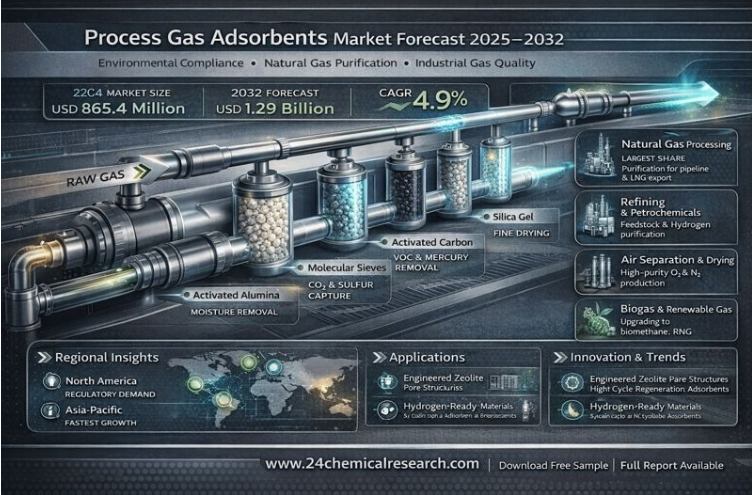
Global process gas adsorbents market is demonstrating steady growth, with its valuation reaching USD 865.4 million in 2024. According to comprehensive industry analysis, the market is projected to expand from USD 905.3 million in 2025 to USD 1.29 billion by 2032, exhibiting a CAGR of 4.9% during the forecast period. This growth trajectory is primarily driven by tightening environmental regulations globally, rising demand from the oil and gas sector for natural gas purification, and the continuous need for high-purity industrial gases in chemical processing and manufacturing.
Process gas adsorbents are advanced industrial materials, including activated alumina, molecular sieves, and activated carbon, designed with high surface areas and selective adsorption properties. They are critical for gas separation, drying, and the removal of contaminants like water, CO2, and sulfur compounds from industrial gas streams. These materials are indispensable in ensuring operational efficiency, product quality, and environmental compliance across sectors such as oil and gas, petrochemicals, and air separation.
Download FREE Sample Report: https://www.24chemicalresearch.com/download-sample/281048/global-process-gas-adsorbents-market
Market Overview & Regional Analysis
North America is a dominant and well-established market for process gas adsorbents, driven by stringent environmental regulations such as the U.S. Clean Air Act, a mature and technologically advanced oil and gas industry, and significant investments in emission control technologies. The region’s focus on clean energy and carbon capture initiatives further supports sustained demand.
Asia-Pacific is a high-growth market, fueled by rapid industrialization, expanding natural gas infrastructure, and increasing environmental awareness in major economies like China and India. Europe represents another key market, characterized by rigorous EU regulations like the Industrial Emissions Directive, which mandate advanced gas purification solutions across the chemical and manufacturing sectors. Latin America, the Middle East, and Africa are emerging markets with growth potential linked to their oil and gas production activities and gradual implementation of stricter environmental standards.
Key Market Drivers and Opportunities
The market’s expansion is underpinned by several key factors. The expanding global oil and gas industry, particularly the rise in natural gas production and liquefied natural gas (LNG) exports, creates sustained demand for adsorbents to purify gas streams to meet pipeline and processing specifications. Concurrently, increasingly stringent environmental regulations worldwide compel industries to adopt advanced adsorbents for emission control and pollution mitigation, particularly for capturing volatile organic compounds (VOCs) and mercury.
Significant new opportunities are emerging from technological advancements in adsorbent materials, such as the development of zeolite-based molecular sieves with engineered pore structures and new silica gel-based products for biogas upgrading. These innovations offer higher selectivity, faster regeneration, and greater durability. Furthermore, the growing focus on hydrogen economy and carbon capture, utilization, and storage (CCUS) initiatives presents a substantial future growth avenue for specialized, high-performance adsorbents.
Challenges & Restraints
The Process Gas Adsorbents market faces several headwinds. High production costs associated with sophisticated manufacturing processes and volatility in the prices of key raw materials (e.g., alumina, carbon precursors) can limit accessibility, especially for small and medium-sized enterprises and in price-sensitive markets. The market also contends with technical limitations of certain adsorbents under extreme operating conditions, such as degradation in humid or corrosive environments, which can lead to reduced efficiency and higher replacement frequency.
Additionally, the industry must navigate complex and diverse regulatory compliance burdens across different regions, which can delay product launches and increase operational overheads. Supply chain vulnerabilities and dependencies on imported raw materials also pose risks, potentially leading to disruptions and escalated costs. Finally, competition from alternative gas separation technologies, such as membrane systems, presents a restraint in applications where lower energy use is a primary concern.
Market Segmentation by Type
- Activated Alumina
- Molecular Sieves (Zeolites)
- Activated Carbon
- Silica Gel
- Others
Market Segmentation by Application
- Natural Gas Processing (Largest segment)
- Air Separation & Drying
- Refining & Petrochemicals
- Biogas & Renewable Gas Upgrading
- Others
Download FREE Sample Report: https://www.24chemicalresearch.com/download-sample/281048/global-process-gas-adsorbents-market
Competitive Landscape and Key Players
The global market features a mix of large, diversified chemical corporations and specialized material science companies. Competition is based on product performance (selectivity, capacity), technological innovation, global supply chain reliability, and the ability to provide customized solutions for specific industrial gas challenges.
List of Key Companies Profiled:
- BASF SE
- Honeywell International Inc.
- Axens
- Cabot Corporation
- Clariant AG
- UOP LLC (Honeywell)
- Zeochem AG
- Sorbead India
Recent Developments
The market is characterized by continuous R&D focused on developing next-generation adsorbents with higher thermal stability, improved regeneration cycles, and tailored selectivity for emerging applications like hydrogen purification. There is a strong industry trend toward sustainability, including efforts to recycle and regenerate spent adsorbents to reduce waste and operational costs. Strategic partnerships between key manufacturers and research institutions are accelerating the commercialization of advanced materials. Furthermore, leading players are introducing new product lines specifically for growing sectors such as biogas upgrading and carbon capture.
Report Scope
This report provides a comprehensive analysis of the global Process Gas Adsorbents market, covering the period from 2025 to 2032. It offers detailed insights into current market conditions and future projections across all major regions, with particular focus on:
- Market size estimations and growth forecasts
- Detailed segmentation by type, application, and end-user industry
The report also includes extensive profiles of leading industry participants, featuring:
- Company backgrounds and operational overviews
- Product portfolios and technological capabilities
- Production capacities and market positioning
- Strategic initiatives
A thorough examination of the competitive environment identifies key vendors and analyzes potential barriers to market expansion. The research methodology included direct engagement with industry stakeholders through:
- Primary interviews with adsorbent manufacturers, gas processing operators, and industry experts
- Analysis of raw material supply chains, pricing trends, and regulatory landscapes
- Evaluation of technological advancements and adoption rates across different applications
- Assessment of demand drivers from the energy, chemical, and environmental sectors
Get Full Report Here: https://www.24chemicalresearch.com/reports/281048/global-process-gas-adsorbents-market
CONTACT US :
International: +1(332) 2424 294 | Asia: +91 9169162030
Website: https://www.24chemicalresearch.com/
Follow us on LinkedIn: https://www.linkedin.com/company/24chemicalresearch
➤See Related Report :
Global Pyrazole market
China 3C Coating market
Global Phosphorus Pentasulfide (P4S10) market
Global Geotechnical Grating Network market
Global Tetrakis(dimethylamido)titanium (TDMAT) market