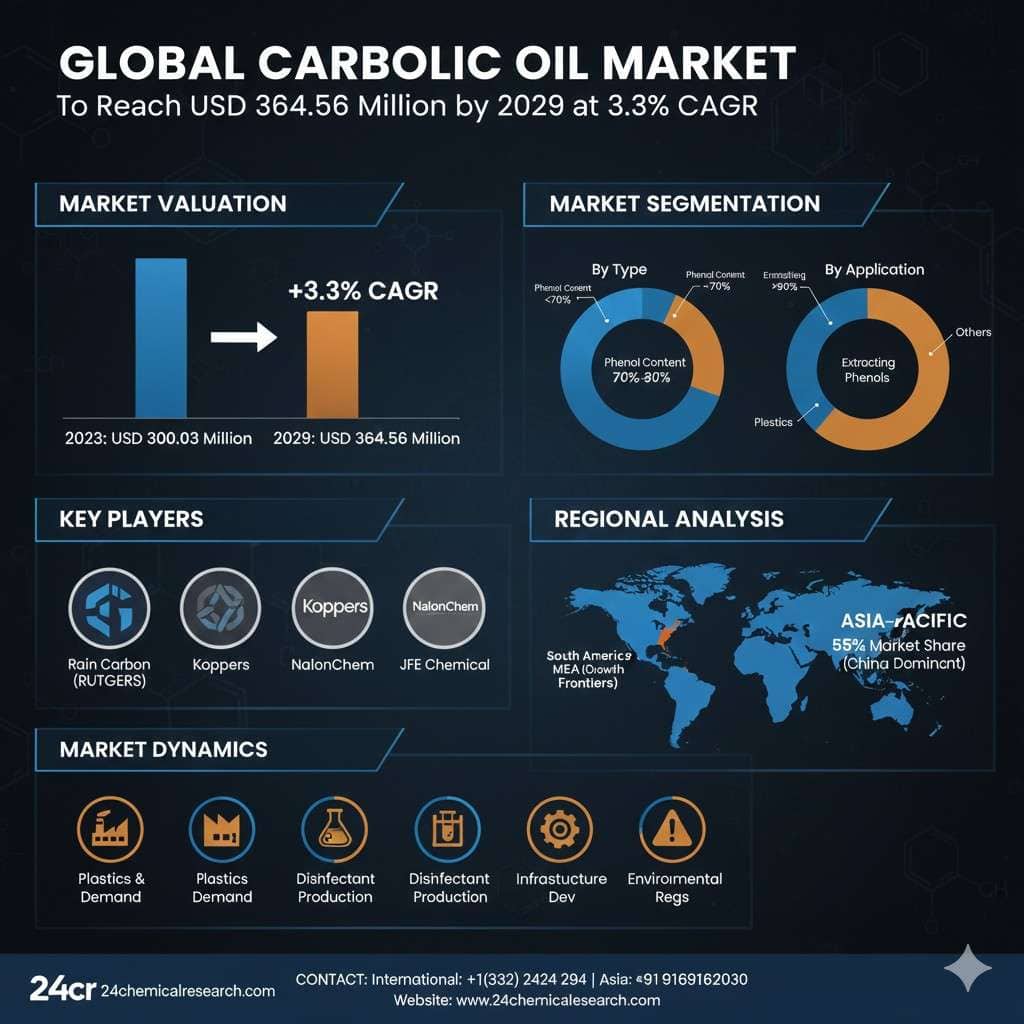
Global Carbolic Oil Market was valued at USD 300.03 million in 2023 and is projected to reach USD 364.56 million by 2029, exhibiting a steady CAGR of 3.30% during the forecast period.
Carbolic oil, or crude carbolic oil, is a complex combination of hydrocarbons obtained by the fractional distillation of coal tar. It is a flammable liquid with a distinct aromatic odour, ranging in colour from yellow to dark brown. Characterized by its significant content of phenolic compounds, aromatic hydrocarbons, and nitrogen bases, carbolic oil is a critical intermediate in the chemical industry. Its utility stems from its role as a primary source for the extraction of phenols, cresols, and xylenols, which are essential building blocks for a wide array of downstream products, from plastics to disinfectants. While a mature market, it remains fundamentally tied to the steel and coking industries, yet its growth is increasingly influenced by demand dynamics in the plastics and resin sectors.
Get Full Report Here: https://www.24chemicalresearch.com/reports/258624/global-carbolic-oil-market-2024-991
Market Dynamics:
The trajectory of the Carbolic Oil market is shaped by a combination of steady demand from established applications, significant operational restraints inherent to its production, and emerging opportunities in value-added derivatives.
Powerful Market Drivers Propelling Expansion
- Sustained Demand from the Plastics and Resins Industry: The most significant driver for carbolic oil is its role as a feedstock for phenol, a cornerstone chemical in producing phenolic resins, bisphenol-A (BPA), and caprolactam. Phenolic resins are extensively used in wood adhesives, molding compounds, and abrasives, with the global construction and automotive sectors providing consistent demand. The BPA segment, crucial for polycarbonate plastics and epoxy resins, remains a major consumer. Despite facing scrutiny and some substitution pressures, the sheer volume of demand from packaging, electronics, and automotive applications ensures a stable, long-term pull for phenol, and by extension, for carbolic oil as a key raw material.
- Growth in Disinfectant and Sanitizer Production: The heightened global focus on hygiene, accelerated by the COVID-19 pandemic, has led to a structural increase in the demand for disinfectants and sanitizers. Phenolic compounds derived from carbolic oil are effective active ingredients in many industrial and household disinfectant formulations. This sector has demonstrated resilience and is expected to maintain higher-than-historical baseline levels, providing a reliable secondary demand stream for carbolic oil, especially for grades with higher phenol content.
Download FREE Sample Report: https://www.24chemicalresearch.com/download-sample/258624/global-carbolic-oil-market-2024-991
Significant Market Restraints Challenging Adoption
Despite its entrenched position, the market faces significant headwinds that cap its growth potential and necessitate strategic adaptation from industry players.
- Environmental and Health Regulations: Carbolic oil and its derivatives are subject to increasingly stringent environmental, health, and safety regulations worldwide. The handling, storage, and transportation of this flammable and potentially hazardous material require strict compliance with protocols, increasing operational costs. Furthermore, regulations concerning specific phenolic compounds, such as BPA in food-contact applications, can limit market segments and drive substitution efforts, indirectly impacting demand for carbolic oil feedstocks.
- Volatility in Raw Material Supply and Pricing: The production of carbolic oil is inextricably linked to the steel industry, as it is a by-product of coal tar distillation from coke oven gas. Fluctuations in global steel production, which are tied to economic cycles, directly impact the availability and price volatility of coal tar. A downturn in steel production can constrain the supply of carbolic oil, while an oversupply can depress prices, creating an unpredictable cost environment for both producers and consumers.
Vast Market Opportunities on the Horizon
- Development of High-Purity and Specialty Derivatives: The most promising opportunity lies in moving up the value chain. Instead of solely selling crude carbolic oil or standard-grade phenol, producers can capture greater value by investing in capabilities to produce high-purity meta-cresol, para-cresol, and other specialty phenolics. These high-value derivatives are essential for manufacturing advanced agrochemicals (pesticides, herbicides), pharmaceuticals (antiseptics, drug intermediates), and specialty polymers, where they command significant price premiums and are less susceptible to commoditization.
- Circular Economy and Sustainability Initiatives: The inherent nature of carbolic oil as a by-product aligns well with the principles of the circular economy. There is a growing opportunity to market carbolic oil and its derivatives as sustainable alternatives to petroleum-based aromatic chemicals. Emphasizing the role of the industry in valorizing a waste stream from steel production can enhance its environmental profile and appeal to downstream customers with strong sustainability mandates. Research into novel applications for carbolic oil components in green technologies, such as bio-derived solvents or carbon fiber precursors, could open entirely new market frontiers.
In-Depth Segment Analysis: Where is the Growth Concentrated?
By Type:
The market is segmented by phenol content into Phenol Content <70%, Phenol Content 70%-90%, and Phenol Content >90%. The Phenol Content 70%-90% segment is often considered the industry workhorse, offering a balanced profile suitable for a wide range of phenol extraction processes. It provides a cost-effective feedstock for many standard applications. The high-purity >90% segment is niche but growing, catering to applications requiring superior quality and fewer impurities, often commanding a higher price.
By Application:
Application segments are dominated by Extracting Phenols, which is the primary use case for carbolic oil. The extracted phenols are then further processed into a vast array of chemicals. The Plastic application segment represents the downstream consumption of these phenols, particularly in the form of phenolic resins and polycarbonates. The “Other” segment includes direct uses in disinfectants, solvents, and wood preservatives, which, while smaller, provide important diversified demand.
Download FREE Sample Report: https://www.24chemicalresearch.com/download-sample/258624/global-carbolic-oil-market-2024-991
List of Key Carbolic Oil Companies Profiled:
- Rain Carbon (RUTGERS) (Global)
- DEZA (Czech Republic)
- Koppers (U.S.)
- NalonChem (China)
- Metinvest (Ukraine)
- JFE Chemical Corporation (Japan)
- Nippon Steel and Sumikin Chemical (Japan)
Regional Analysis: A Global Footprint with Distinct Leaders
- Asia-Pacific: This region is the undeniable powerhouse of the Carbolic Oil market, dominated by China. China’s massive steel production capacity makes it the world’s largest producer and consumer of carbolic oil. The country’s robust chemical industry, particularly its phenol and phenolic resin sectors, drives immense domestic demand. Other Asia-Pacific nations like Japan and India also represent significant markets, supported by their established steel and chemical industries.
- Europe and North America: These are mature markets characterized by stringent environmental regulations and stable, though slower-growing, demand. Production in these regions is often tied to integrated steel plants, and the focus is on high-quality products and technological innovation. While absolute production volumes may be lower than in Asia-Pacific, the emphasis on specialty derivatives and value-added applications is strong.
Get Full Report Here: https://www.24chemicalresearch.com/reports/258624/global-carbolic-oil-market-2024-991
Download FREE Sample Report: https://www.24chemicalresearch.com/download-sample/258624/global-carbolic-oil-market-2024-991
Other related reports:
Sodium Benzenesulfinate Market, Global Outlook and Forecast 2023-2029
Southeast Asia 2-Nitroaniline Market Outlook and Forecast 2025-2032
Smart Nanomaterials Market, Global Outlook and Forecast 2025-2031
Southeast Asia Brominated Flame Retardants Market Outlook and Forecast 2025-2032
Middle East Lead Vinyl Sheets Market Research Report 2024-2030
Southeast Asia Fumaric Acid Monoethyl Ester (MEF) Market Outlook and Forecast 2024-2030
Dinotefuran Market, Global Outlook and Forecast 2025-2032
Monoethanolamine Market Research Report 2025,Global Forecast to 2032
Contact us
International: +1(332) 2424 294 | Asia: +91 9169162030
Website: https://www.24chemicalresearch.com/
Follow us on LinkedIn: https://www.linkedin.com/company/24chemicalresearch