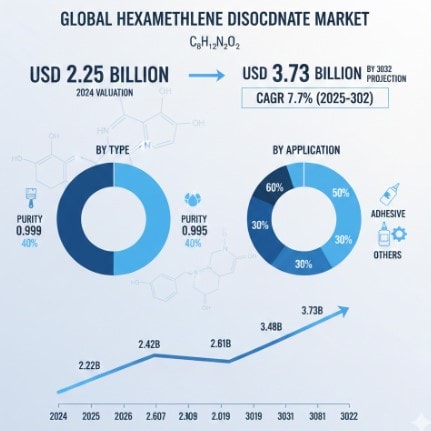
According to a new report from Intel Market Research, the global Hexamethylene Diisocyanate (HDI) market was valued at USD 2.25 billion in 2024 and is projected to reach USD 3.73 billion by 2032, growing at a robust CAGR of 7.7% during the forecast period (2025–2032). This significant growth trajectory is powered by surging demand for high-performance polyurethane coatings across the automotive, construction, and industrial maintenance sectors, coupled with rapid industrialization in emerging economies and stringent environmental regulations favoring advanced coating technologies.
📥 Download Sample Report: Hexamethylene Diisocyanate Market – View in Detailed Research Report
What is Hexamethylene Diisocyanate?
Hexamethylene Diisocyanate (HDI) is an aliphatic diisocyanate, a crucial organic compound primarily utilized in manufacturing high-performance polyurethane coatings, adhesives, sealants, and elastomers. Noted for its exceptional resistance to abrasion, chemicals, and ultraviolet (UV) degradation, HDI-based products prevent yellowing and maintain gloss, making them indispensable for demanding applications such as automotive OEM and refinish paints, industrial coatings, and various adhesive formulations.
This report delivers an in-depth analysis of the global Hexamethylene Diisocyanate market, covering all essential facets. It spans from a macro overview of market dynamics to micro details like market size, competitive landscape, development trends, niche markets, key drivers and challenges, SWOT and value chain analysis. The analysis not only elucidates competitive forces within the industry and tactics for boosting profitability but also offers a strategic framework for evaluating the market position of business entities. The report emphasizes the competitive landscape of the Global Hexamethylene Diisocyanate Market, detailing market share, product performance, strategic positioning, and operational insights of key market players.
In essence, this report is an essential resource for industry players, investors, researchers, consultants, business strategists, and all stakeholders with an interest or planned entry into the Hexamethylene Diisocyanate market.
📘 Get Full Report: Hexamethylene Diisocyanate Market – View Detailed Research Report
Key Market Drivers
1. Booming Automotive and Construction Industries
The relentless expansion of the global automotive industry serves as a primary catalyst for HDI market growth. The automotive coatings segment alone commands approximately 66% of the total HDI market share, underscoring the material’s critical role in providing durable, high-gloss finishes resistant to environmental wear. Concurrently, the global construction boom, especially in emerging economies, fuels demand for robust protective coatings and high-strength adhesives in building materials and infrastructure projects. The polyurethane dispersions market, a key consumer of HDI, is experiencing steady annual growth of 5% to 6%, further propelling consumption.
2. Stringent Environmental Regulations and Shift to Sustainable Solutions
Increasingly strict global regulations on Volatile Organic Compound (VOC) emissions are compelling manufacturers to transition from traditional solvent-borne coatings to high-solid and waterborne alternatives. HDI-based polyisocyanates are fundamental components in these eco-friendlier formulations. This regulatory push not only accelerates the adoption of HDI-based products but also encourages innovation in low-VOC and sustainable coating technologies. The superior weatherability and durability of HDI-based coatings make them a preferred choice for applications requiring long-term performance, aligning with global sustainability goals.
Market Challenges
- High Production Costs and Raw Material Volatility – Manufacturing HDI involves a complex process including phosgenation, requiring substantial capital investment. Furthermore, the prices of key raw materials like hydrogen cyanide and butadiene are subject to significant fluctuations, often influenced by geopolitical factors and supply chain disruptions. This volatility creates unpredictable production costs and challenges in maintaining consistent profit margins.
- Health, Safety, and Environmental Handling Concerns – HDI is a known respiratory sensitizer, necessitating stringent handling protocols, specialized storage, and transportation measures. Adherence to stringent regulations such as REACH in Europe and TSCA in the US adds operational complexity and cost, potentially deterring smaller market entrants and necessitating continuous investment in safety infrastructure.
- High Competition from Aromatic Isocyanates – Despite its superior UV resistance, HDI’s significantly higher cost compared to aromatic alternatives like TDI and MDI limits its penetration in price-sensitive applications and markets where extreme weatherability is not a decisive factor.
Emerging Opportunities
The global industrial landscape is witnessing a pivot towards high-performance, sustainable materials, creating fertile ground for HDI market expansion. This is particularly evident in the Asia-Pacific region, but opportunities are burgeoning worldwide. Key growth catalysts include:
- Advancements in Bio-based and Sustainable Production Routes – Research into non-phosgene production methods and bio-based HDI derivatives promises to reduce environmental impact and open new market segments focused on green chemistry.
- Expansion into High-Value Niche Applications – Emerging uses in advanced elastomers for aerospace, high-performance adhesives for electronics, and specialized sealants for renewable energy infrastructure (e.g., wind turbine blades) present significant growth avenues.
- Infrastructure Development in Emerging Economies – Rapid urbanization and industrialization in regions like Asia-Pacific, Latin America, and the Middle East are driving massive demand for durable coatings and construction materials, creating vast new markets for HDI-based products.
Collectively, these dynamics are set to enhance product accessibility, spur technological advancements, and drive the adoption of HDI across novel applications and geographic markets.
📥 Download Sample Report: Hexamethylene Diisocyanate Market – View in Detailed Research Report
Regional Market Insights
- Asia-Pacific: This region dominates the global HDI market, accounting for nearly 49% of consumption. This leadership is anchored in its status as a global manufacturing hub, with massive demand from the automotive, construction, and industrial sectors in China and India.
- Europe: Europe is the second-largest market with a share of approximately 27%, characterized by a strong automotive manufacturing base, stringent environmental standards driving adoption of high-performance coatings, and a mature industrial sector.
- North America: The market in North America is mature and innovation-driven, with steady demand from the automotive and aerospace industries, alongside a strong focus on developing eco-friendly and high-solids coating technologies.
- Latin America and Middle East & Africa: These regions represent high-growth potential markets, fueled by ongoing industrialization, infrastructure development, and a growing automotive aftermarket, though they currently have smaller market shares.
Market Segmentation
By Application
- Coatings
- Adhesives & Sealants
- Elastomers
- Others
By End User
- Automotive Industry
- Construction Industry
- Industrial Manufacturing
- Furniture & Footwear
By Product Form
- Monomer
- Pre-polymer/Oligomer
- Modified/Blended
By Region
- North America
- Europe
- Asia-Pacific
- Latin America
- Middle East & Africa
📘 Get Full Report: Hexamethylene Diisocyanate Market – View Detailed Research Report
Competitive Landscape
The global HDI market is highly consolidated, dominated by a few major multinational chemical corporations. Covestro AG, Vencorex, and Tosoh Corporation collectively command a significant portion of the market, leveraging their extensive production capacities, robust R&D capabilities, and global distribution networks.
The report provides an in-depth competitive profiling of key players, including:
- Covestro AG
- Vencorex
- Tosoh Corporation
- Wanhua Chemical Group
- BASF SE
- Asahi Kasei Corporation
- Other established chemical manufacturers competing on technology and regional presence
Report Deliverables
- Global and regional market forecasts from 2025 to 2032
- Strategic insights into technological developments, capacity expansions, and regulatory landscapes
- Market share analysis and comprehensive SWOT assessments
- Pricing trend analysis and raw material dynamics
- Detailed segmentation by application, end-user industry, product form, and geography
📘 Get Full Report: Hexamethylene Diisocyanate Market – View Detailed Research Report
📥 Download Sample Report: Hexamethylene Diisocyanate Market – View in Detailed Research Report
About Intel Market Research
Intel Market Research is a leading provider of strategic intelligence, offering actionable insights in chemicals, advanced materials, and industrial automation. Our research capabilities include:
- Real-time competitive benchmarking
- Global supply chain and capacity analysis
- Country-specific regulatory and pricing analysis
- Over 500+ industrial and chemical reports annually
Trusted by Fortune 500 companies, our insights empower decision-makers to drive innovation with confidence.
🌐 Website: https://www.intelmarketresearch.com
📞 International: +1 (332) 2424 294
📞 Asia-Pacific: +91 9169164321
🔗 LinkedIn: Follow Us