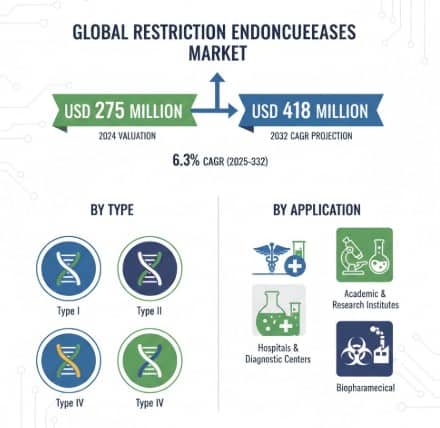
According to a new report from Intel Market Research, the global Restriction Endonucleases market was valued at USD 275 million in 2024 and is projected to reach USD 418 million by 2032, growing at a CAGR of 6.3% during the forecast period (2025–2032). This expansion is driven by escalating applications in genomics, surging R&D in pharmaceuticals and biotechnology, and the rising demand for precise molecular diagnostic tools.
📥 Download Sample Report: Restriction Endonucleases Market – View in Detailed Research Report
What are Restriction Endonucleases?
Restriction endonucleases, often referred to as molecular scissors, are enzymes that recognize specific DNA sequences and cleave the DNA at or near these sites. Isolated primarily from bacteria, where they function as a defense mechanism against foreign DNA, these enzymes are foundational to modern molecular biology. They are categorized into four main types (I, II, III, and IV), with Type II enzymes being the most prevalent in research and commercial applications due to their specific cleavage at defined recognition sequences. As indispensable tools in genetic engineering, cloning, and sequencing, they enable the precise manipulation of genetic material that underpins much of today’s biotechnology landscape.
The analysis serves as a vital tool for understanding the competitive environment and formulating strategies to bolster profitability. Moreover, it provides a structured framework for assessing a business organization’s market position. The report meticulously examines the global Restriction Endonucleases Market’s competitive landscape, detailing market share, player performance, product positioning, and operational strategies of the major contributors. This empowers industry participants to identify key competitors and decipher the dynamics of market rivalry effectively.
In essence, this report is essential reading for industry participants, investors, researchers, consultants, business strategists, and anyone with plans to enter the Restriction Endonucleases market.
📘 Get Full Report Here: Restriction Endonucleases Market – View Detailed Research Report
Key Market Drivers
1. Expanding Applications in Genomics and Molecular Diagnostics
The relentless growth of genomics and molecular diagnostics is a primary catalyst for the restriction endonucleases market. These enzymes are the workhorses behind recombinant DNA technology, DNA sequencing, and genotyping techniques. The rising global burden of genetic disorders and infectious diseases necessitates precise diagnostic methodologies. Here, established techniques like Restriction Fragment Length Polymorphism (RFLP) analysis continue to be vital. Furthermore, the surge in personalized medicine and pharmacogenomics is generating a sustained demand for highly reliable enzymes for accurate genetic analysis and companion diagnostics.
2. Robust R&D Investment in Pharmaceuticals and Biotechnology
Continuous and substantial investment in research and development within the pharmaceutical and biotechnology sectors fuels market growth. Restriction endonucleases are non-negotiable in fundamental research areas such as gene cloning, site-directed mutagenesis, and plasmid vector construction. With a robust global biopharmaceutical pipeline, these enzymes are critical for developing thousands of new therapies. Increased funding from government bodies and private entities for life science research worldwide ensures a consistent and growing demand for high-quality molecular biology reagents.
Market Challenges
- Competition from Alternative Gene-Editing Technologies – The emergence and maturation of technologies like CRISPR-Cas9 pose a significant challenge. While restriction enzymes remain crucial for specific applications, the programmability and versatility of CRISPR for targeted DNA cleavage are displacing traditional methods in certain research areas, potentially restraining market growth.
- Price Sensitivity in a Mature Market – The market for many standard restriction enzymes is highly mature, leading to intense price competition among suppliers. This price pressure erodes profit margins and compels manufacturers to continuously innovate with higher-value, specialized enzyme formulations to maintain revenue growth.
- Stringent Storage and Handling Requirements – Maintaining the enzymatic activity of restriction endonucleases requires stringent cold-chain logistics and specific storage conditions, which adds complexity and cost to their distribution and usage, especially in resource-limited settings.
Emerging Opportunities
The global life sciences landscape is ripe with opportunities for the restriction endonucleases market. The push towards point-of-care diagnostics and the expansion of biomanufacturing for biologics and cell and gene therapies present new frontiers. Key growth enablers include:
- Development of novel and engineered enzymes with enhanced properties like longer recognition sequences and thermostability.
- Growth in emerging markets across Asia-Pacific and Latin America, where biotech infrastructure is rapidly advancing.
- Increasing application in quality control processes within biopharmaceutical manufacturing, such as verifying plasmid DNA used in vaccines and gene therapies.
These factors are anticipated to open new application avenues, stimulate innovation in product offerings, and drive the adoption of restriction endonucleases in novel geographic and industrial sectors.
📥 Download Sample PDF: Restriction Endonucleases Market – View in Detailed Research Report
Regional Market Insights
- North America: North America, spearheaded by the United States, holds the largest market share, supported by a mature biotechnology and pharmaceutical sector, substantial R&D funding from organizations like the NIH, and the presence of major market players.
- Europe: Europe is a well-established market characterized by strong collaborative research networks and significant investment in genomics and personalized medicine, with countries like Germany, the UK, and France being key contributors.
- Asia-Pacific: This region represents the fastest-growing market, driven by rapidly expanding biotechnology sectors in China, India, and South Korea, increasing government initiatives, and growing local manufacturing capabilities.
- Latin America, Middle East, and Africa: These regions are emerging markets with growing biotech research infrastructure and increasing investments in healthcare, though they currently represent smaller shares of the global market.
Market Segmentation
By Type
- Type I
- Type II
- Type III
- Type IV
- Others
By Application
- Academic & Research Institutes
- Hospitals & Diagnostic Centers
- Biopharmaceutical Companies
- Others
By End User
- Academic & Research Institutes
- Pharmaceutical & Biotechnology Companies
- Diagnostic Laboratories
By Region
- North America
- Europe
- Asia-Pacific
- Latin America
- Middle East & Africa
📘 Get Full Report Here: Restriction Endonucleases Market – View Detailed Research Report
Competitive Landscape
The global restriction endonucleases market is relatively concentrated, with a few established life science giants dominating the landscape. New England Biolabs is widely regarded as a market leader, renowned for its extensive and high-quality portfolio. However, the competitive field includes other significant players vying for market share through innovation and strategic positioning.
The report provides in-depth competitive profiling of key players, including:
- New England Biolabs
- Thermo Fisher Scientific Inc.
- Takara Bio Inc.
- Merck KGaA
- Promega Corporation
- Others specializing in molecular biology reagents and enzymes
Report Deliverables
- Global and regional market forecasts from 2025 to 2032
- Strategic insights into technological developments, pipeline products, and regulatory approvals
- Market share analysis and SWOT assessments of key players
- Pricing trend analysis and supply chain dynamics
- Comprehensive segmentation by type, application, end user, and geography
📘 Get Full Report Here: Restriction Endonucleases Market – View Detailed Research Report
📥 Download Sample Report: Restriction Endonucleases Market – View in Detailed Research Report
About Intel Market Research
Intel Market Research is a leading provider of strategic intelligence, offering actionable insights in biotechnology, pharmaceuticals, and healthcare infrastructure. Our research capabilities include:
- Real-time competitive benchmarking
- Global clinical trial pipeline monitoring
- Country-specific regulatory and pricing analysis
- Over 500+ healthcare reports annually
Trusted by Fortune 500 companies, our insights empower decision-makers to drive innovation with confidence.
🌐 Website: https://www.intelmarketresearch.com
📞 International: +1 (332) 2424 294
📞 Asia-Pacific: +91 9169164321
🔗 LinkedIn: Follow Us