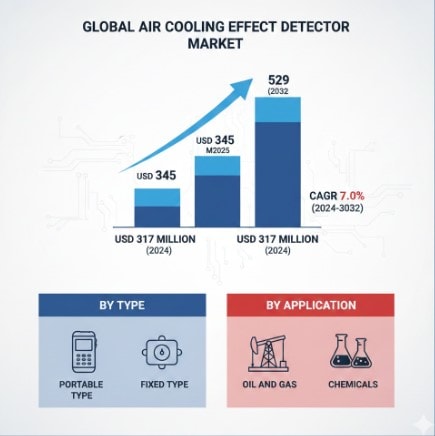
According to a new report from Intel Market Research, the global Air Cooling Effect Detector market was valued at USD 317 million in 2024 and is projected to reach USD 529 million by 2032, growing at a robust CAGR of 7.0% during the forecast period (2025–2032). This growth is propelled by increasing demand for energy-efficient cooling solutions, stringent environmental regulations, and advancements in thermal monitoring technologies across industrial and commercial sectors.
📥 Download Sample Report: https://www.intelmarketresearch.com/download-free-sample/6686/air-cooling-effect-detector-market
What is an Air Cooling Effect Detector?
Air Cooling Effect Detectors are specialized precision instruments designed to measure and optimize the performance of cooling systems by analyzing critical parameters such as temperature gradients, airflow velocity, and thermal distribution. These devices play a crucial role in enhancing energy efficiency across applications including HVAC systems, industrial processes, data centers, and commercial building management. The market encompasses both portable and fixed-type detectors, catering to diverse operational needs from field inspections to continuous monitoring in critical environments.
📘 Get Full Report: https://www.intelmarketresearch.com/machines/6686/air-cooling-effect-detector-market
Key Market Drivers
1. Increasing Demand for Energy Efficiency
The global push toward energy-efficient solutions represents the primary growth driver for air cooling effect detectors. With industrial facilities and commercial buildings accounting for approximately 40% of global energy consumption, corporations and regulators are increasingly mandating monitoring solutions to optimize HVAC performance. These detectors enable real-time measurement of cooling system efficiency, helping reduce operational costs by 15-30% while supporting sustainability targets. The integration of IoT capabilities in modern detectors further enhances their value proposition by enabling remote monitoring and data-driven optimization.
2. Stringent Regulatory Standards
Governments worldwide are implementing stricter regulations regarding thermal management and environmental controls, particularly in sensitive industries like pharmaceuticals and food processing. Recent updates to Good Manufacturing Practices (GMP) now require temperature variance documentation within ±0.5°C for critical processes, creating substantial demand for precision detection technology. The European Union’s revised Ecodesign Directive (EU) 2021/341 mandates cooling system efficiency monitoring in all industrial equipment by 2025, further accelerating market adoption across regulated industries.
Market Challenges
- High implementation costs: Premium-grade detectors with multi-point sensing and IoT connectivity carry significant price premiums, with industrial-grade units often exceeding $5,000 per installation point, creating adoption barriers for small and medium enterprises
- Technical complexity: Integration challenges with legacy HVAC systems prevent seamless adoption in older facilities, requiring supplementary control interfaces and calibration services that add 20-35% to implementation costs
- Maintenance requirements: Regular recalibration (typically quarterly) and sensor drift issues necessitate ongoing maintenance contracts, creating operational overhead that some facilities find burdensome
- Standardization gaps: The absence of universal calibration protocols complicates cross-manufacturer compatibility, forcing end-users into single-vendor ecosystems that limit future flexibility
Opportunities Ahead
The global shift toward smart building automation and industrial digitalization presents significant growth opportunities for advanced cooling detectors. The rapid adoption of IoT-enabled building automation systems creates new revenue streams, with modern detectors featuring Modbus and BACnet compatibility that seamlessly integrate with energy management platforms. The global smart building market is projected to reach $328 billion by 2030, with HVAC optimization solutions representing 28% of this value.
Emerging economies across Southeast Asia and Africa are creating substantial demand for cooling monitoring solutions as new manufacturing facilities implement modern environmental controls. Countries like Vietnam and Indonesia are witnessing 12-15% annual growth in industrial cooling system installations, with regulatory bodies gradually adopting international equipment standards that require precision monitoring solutions.
Notably, leading manufacturers including Teledyne FLIR and Fluke Corporation have announced expansion strategies focusing on:
- Development of enhanced portable detectors with improved battery life and connectivity
- Integration of AI and machine learning for predictive maintenance capabilities
- Expansion into emerging markets through local partnerships and distribution networks
- Development of industry-specific solutions for pharmaceuticals, data centers, and food processing
📥 Download Sample PDF: https://www.intelmarketresearch.com/download-free-sample/6686/air-cooling-effect-detector-market
Regional Market Insights
- North America: Leads global market share owing to stringent energy efficiency standards, advanced manufacturing infrastructure, and significant HVAC industry investments. The United States accounts for approximately 60% of regional demand, with major applications spanning commercial building management, data center cooling optimization, and industrial process control.
- Europe: Represents a mature market characterized by stringent environmental regulations and high adoption of energy-efficient technologies. Germany leads regional adoption with its strong manufacturing sector, while countries like France and the UK show growing demand in commercial building management.
- Asia-Pacific: Emerges as the fastest-growing region, propelled by rapid industrialization and infrastructure development. China dominates regional consumption due to massive manufacturing expansion and growing data center investments, while Japan and South Korea contribute significantly with technologically advanced manufacturing sectors.
- Latin America: Shows gradual growth primarily driven by industrial sector requirements in Brazil and Argentina, with increasing awareness about energy conservation presenting long-term opportunities.
- Middle East & Africa: Demonstrates potential growth driven by infrastructure development and extreme climate conditions requiring efficient cooling systems, with the UAE and Saudi Arabia leading adoption through commercial building projects and industrial investments.
Market Segmentation
By Type
- Portable Type
- Fixed Type
By Application
- Oil and Gas
- Chemicals
- Pharmaceuticals
- Food and Beverages
- Other Industrial Applications
By Technology
- Infrared (IR) Sensors
- Thermocouples
- Thermal Imaging
- Airflow Sensors
By End User
- Industrial Facilities
- Commercial Buildings
- Data Centers
- Healthcare Institutions
By Region
- North America
- Europe
- Asia-Pacific
- Latin America
- Middle East & Africa
📘 Get Full Report: https://www.intelmarketresearch.com/machines/6686/air-cooling-effect-detector-market
Competitive Landscape
The global air cooling effect detector market features a competitive yet fragmented landscape, dominated by established players with strong technological capabilities and extensive distribution networks. Teledyne FLIR leads the industry, leveraging its expertise in thermal imaging and sensing technologies to offer highly accurate detection solutions. The company’s global footprint and continuous R&D investments reinforce its market dominance.
Fluke Corporation and Testo SE & Co. KGaA follow closely, capitalizing on their robust product portfolios and widespread customer trust in industrial and commercial applications. Both companies are increasingly integrating IoT and AI capabilities into their detectors to enhance real-time monitoring and data analytics.
The report provides comprehensive competitive profiling of key players, including:
- Teledyne FLIR (U.S.)
- Fluke Corporation (U.S.)
- Testo SE & Co. KGaA (Germany)
- TSI Incorporated (U.S.)
- KIMO Instruments (France)
- Dwyer Instruments (U.S.)
- Thermoteknix Systems Ltd (U.K.)
Report Deliverables
- Global and regional market forecasts from 2025 to 2032
- Strategic insights into technological developments and innovation trends
- Market share analysis and competitive benchmarking
- Pricing analysis and cost structure assessment
- Comprehensive segmentation by type, application, technology, end user, and geography
📘 Get Full Report: https://www.intelmarketresearch.com/machines/6686/air-cooling-effect-detector-market
📥 Download Sample PDF: https://www.intelmarketresearch.com/download-free-sample/6686/air-cooling-effect-detector-market
About Intel Market Research
Intel Market Research is a leading provider of strategic intelligence, offering actionable insights in industrial technology, manufacturing automation, and energy efficiency solutions. Our research capabilities include:
- Real-time competitive benchmarking
- Global technology adoption monitoring
- Country-specific regulatory and standards analysis
- Over 500+ industrial technology reports annually
Trusted by Fortune 500 companies, our insights empower decision-makers to drive innovation with confidence.
🌐 Website: https://www.intelmarketresearch.com
📞 International: +1 (332) 2424 294
📞 Asia-Pacific: +91 9169164321
🔗 LinkedIn: Follow Us