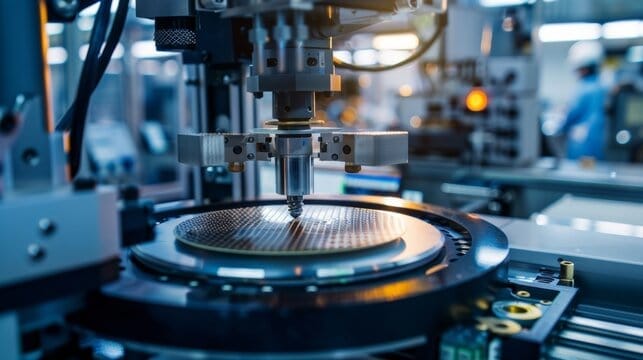
According to Next Move Strategy Consulting, the Japan Wafer Handling Robots Market, is set to experience strong growth, with projections to reach USD 293 million by 2030, reflecting a compound annual growth rate (CAGR) of 9% from 2024 to 2030. This surge in demand is driven by Japan’s growing semiconductor equipment market, technological advancements in wafer handling robots, and the need for enhanced automation in semiconductor manufacturing.
Wafer Handling Robots: A Vital Tool for Semiconductor Manufacturing
Wafer handling robots are specialized automation solutions designed to streamline the delicate processes involved in semiconductor manufacturing. These robots are tasked with performing precise movements and positioning of fragile semiconductor wafers, playing a critical role in the production of integrated circuits and microelectronic devices.
By integrating seamlessly with other fabrication equipment, Japan Wafer Handling Robots Market enhance operational efficiency, minimize errors, and ensure the consistent production of advanced semiconductor technologies.
Click Here for Your FREE Sample!
Key Market Players Drive Growth with Innovations and Strategic Initiatives
The Japan Wafer Handling Robots Market is benefiting from the presence of leading players such as Kawasaki Heavy Industries, Rexxam Co., Ltd., and Yaskawa Electric Corporation. These industry leaders are helping to drive growth by continuously innovating and launching new, cutting-edge products to meet the evolving needs of the semiconductor manufacturing sector.
In May 2020, Yaskawa Electric, a prominent player in the market, introduced the “SEMISTAR-GEKKO MD124D” – a state-of-the-art 5-axis single-arm clean robot designed for handling semiconductor wafers. Capable of transferring 300 mm semiconductor wafers with exceptional precision, this robot enhances wafer transportation efficiency and supports higher productivity in semiconductor fabrication processes. Such product advancements underscore the increasing importance of wafer handling robots as a key automation solution in the semiconductor manufacturing process.
As Japan’s semiconductor industry continues to evolve, the demand for advanced automation, including wafer handling robots, is expected to expand, further bolstering the market.
Semiconductor Equipment Market Growth Fuels Wafer Handling Robot Demand
Japan plays a crucial role in the global semiconductor landscape, ranking as the fourth-largest market for semiconductor manufacturing equipment. This strong growth in the semiconductor equipment market is directly driving the demand for wafer handling robots as manufacturers seek to enhance their production capabilities through automation.
High Initial Costs Impede Market Growth
Despite the promising growth trajectory, the high initial cost associated with wafer handling robots represents a significant barrier to market expansion. The upfront investment required for the procurement, integration, and maintenance of these advanced automation systems can be a financial challenge, particularly for smaller companies with limited budgets.
While the cost of wafer handling robots remains a hurdle, the long-term benefits of these systems – including higher efficiency, reduced error rates, and improved precision – offer significant advantages that may justify the investment. As the semiconductor industry continues to grow and evolve, the adoption of wafer handling robots is expected to become more widespread, especially as technology advancements help reduce costs over time.
Technological Advancements Driving Market Expansion
The integration of advanced technologies such as Artificial Intelligence (AI), computer vision, and the Internet of Things (IoT) is playing a pivotal role in the expansion of the Japan Wafer Handling Robots Market. These technologies are enhancing the performance and capabilities of wafer handling robots, enabling manufacturers to optimize production processes and reduce downtime.
- Artificial Intelligence (AI): AI algorithms help wafer handling robots refine their movements, enabling faster and more accurate wafer handling. Additionally, AI-driven predictive maintenance capabilities help minimize unplanned downtime, leading to more efficient production processes.
- Computer Vision: Computer vision technology is crucial for enabling robots to recognize and accurately handle wafers, even in complex and dynamic environments. This ensures that wafers are manipulated with precision, reducing the risk of contamination or damage.
- Internet of Things (IoT): IoT-enabled wafer handling robots can exchange real-time data with other machines, enabling more synchronized operations. Through IoT connectivity, manufacturers can monitor robot performance, track real-time metrics, and perform predictive maintenance to further improve operational efficiency.
Furthermore, advancements in safety features, energy efficiency, and data analytics are further solidifying the role of wafer handling robots as indispensable tools within the fast-evolving semiconductor manufacturing industry.
Competitive Landscape: Key Players and Market Dynamics
The Japan wafer handling robots industry is home to several leading players that are actively shaping the market through strategic initiatives and innovation. Notable companies in the market include:
- Kawasaki Heavy Industries, Ltd.
- Nidec Instruments Corporation
- Yaskawa Electric Corporation
- RORZE Corporation
- DAIHEN Corporation
- Hirata Corporation
- Rexxam Co., Ltd.
- KUKA AG
- ULVAC, Inc.
- Stäubli International AG
These key players are leveraging their expertise in robotics and automation to develop products that meet the unique demands of the semiconductor industry. As the Japan Wafer Handling Robots Market continues to grow, these companies are expected to remain at the forefront of the market, driving technological innovation and market expansion.
Japan Wafer Handling Robots Market Segmentation
The Japan Wafer Handling Robots Market is segmented across various parameters, allowing for a detailed analysis of the market’s diverse opportunities. Key market segments include:
- By Product Type:
- Vacuum Wafer Handling Robots
- Atmospheric Wafer Handling Robots
- By Number of Arms:
- Single Arm
- Dual Arm
- By Robot Type:
- Linear Robots
- SCARA Robots
- Articulated Robots
- Cylindrical Robots
- Others
- By Operation:
- Motor Driven
- Belt Driven
- Stainless Steel Belts
- Rubber Belts
- Polymer Belts
- By Installation:
- Free Standing
- Integrated
- By Wafer Size:
- Up to 100 mm
- 150 mm
- 200 mm
- 300 mm
- Above 300 mm
- By Semiconductor Process:
- Oxidation (Deposition)
- Lithography
- Etching, Cleaning, Polishing
- Inspection & Testing
- Assembly & Packaging
- By End-Use:
- Integrated Device Manufacturers (IDM)
- Foundries
Conclusion
The Japan Wafer Handling Robots Market is on a strong growth trajectory, driven by a combination of technological advancements, increasing demand for semiconductor manufacturing automation, and substantial investments in the semiconductor sector. While challenges such as high initial costs persist, the long-term benefits of wafer handling robots in improving production efficiency, precision, and safety are clear.
