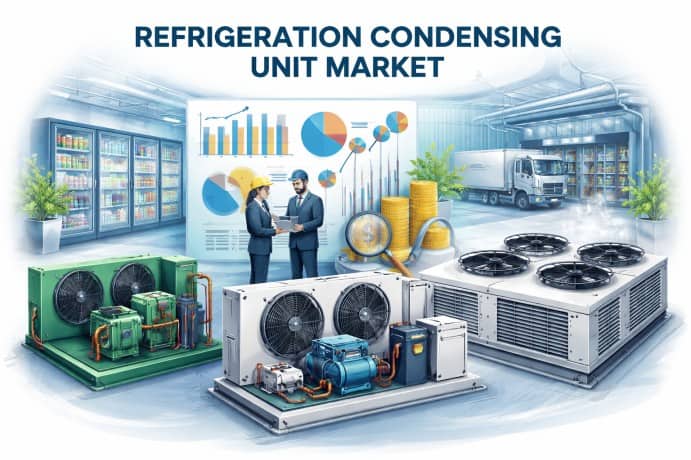
Modern refrigeration infrastructure is becoming increasingly critical across industries that depend on precise temperature control. From supermarkets and cold storage warehouses to pharmaceutical distribution centers, refrigeration systems play a vital role in maintaining product quality and safety. At the core of these systems are condensing units, which enable heat removal and ensure consistent cooling performance in a wide range of applications.
As industries continue to modernize their cooling infrastructure, the Refrigeration Condensing Unit Market is gaining traction across commercial, industrial, and logistics sectors. Businesses are investing in advanced refrigeration technologies that improve operational efficiency, reduce energy consumption, and support sustainability goals. With global demand for cold storage and temperature-controlled supply chains growing rapidly, condensing units have become an essential part of modern refrigeration architecture.
In recent years, manufacturers have been focusing on enhancing the performance and reliability of condensing units through innovative designs and digital technologies. Smart monitoring systems, predictive maintenance capabilities, and automation features are increasingly integrated into modern units, allowing operators to monitor cooling systems in real time and optimize energy usage.
Technological innovation is also transforming the way condensing units are designed and manufactured. Companies are introducing modular designs that simplify installation, reduce maintenance requirements, and improve system flexibility. These solutions are particularly valuable in commercial environments where space optimization and energy efficiency are critical.
Furthermore, the transition toward environmentally friendly refrigerants and low-emission cooling technologies is reshaping product development strategies across the industry. Regulatory bodies worldwide are introducing stricter environmental standards aimed at reducing the carbon footprint of refrigeration equipment. As a result, manufacturers are investing heavily in next-generation refrigerant technologies and advanced heat-exchange systems.
Get a sample PDF of the Report: https://www.theinsightpartners.com/sample/TIPRE00011141
Another important driver of industry growth is the expansion of cold chain logistics. Increasing global demand for fresh food, vaccines, and pharmaceutical products requires reliable refrigeration infrastructure across transportation and storage networks. Condensing units play a crucial role in maintaining stable temperature conditions throughout these supply chains, ensuring product safety and compliance with regulatory standards.
In addition to logistics, the retail and hospitality sectors are also driving demand for modern refrigeration systems. Supermarkets, convenience stores, restaurants, and hotels require efficient refrigeration systems to maintain food quality and minimize energy costs. As businesses seek sustainable solutions that reduce operational expenses, high-efficiency condensing units are becoming a preferred choice.
Updated Industry Developments
Recent developments in the refrigeration industry highlight a strong shift toward digitalization and energy optimization. Several manufacturers have launched smart condensing unit systems equipped with IoT-enabled sensors that allow remote monitoring and predictive maintenance. These systems help operators detect potential failures before they occur, improving reliability and reducing downtime.
Companies are also investing in environmentally responsible refrigeration technologies, including units compatible with low-global-warming-potential refrigerants. These innovations align with global environmental initiatives aimed at reducing greenhouse gas emissions from cooling equipment.
Additionally, many organizations are introducing compact and modular condensing unit solutions designed specifically for urban infrastructure projects and commercial buildings where space constraints are a major concern.
Global and Regional Analysis
The Refrigeration Condensing Unit Market demonstrates diverse growth patterns across different regions based on industrial development, regulatory frameworks, and infrastructure investments.
North America remains one of the most technologically advanced regions for refrigeration equipment. Strong adoption of energy-efficient HVAC and refrigeration systems, along with strict environmental regulations, continues to drive innovation in the region.
Europe is also witnessing increasing adoption of sustainable refrigeration technologies. Government initiatives promoting green buildings and energy-efficient equipment are encouraging businesses to adopt advanced condensing unit systems.
Asia-Pacific is expected to experience significant expansion in the coming years. Rapid urbanization, industrial growth, and rising demand for food preservation infrastructure are creating strong opportunities for refrigeration equipment manufacturers in countries such as China and India.
Meanwhile, Latin America and the Middle East & Africa are emerging markets where increasing investments in retail infrastructure, food processing industries, and cold storage facilities are gradually boosting demand for condensing units.
Get the Premium Research Report @ https://www.theinsightpartners.com/buy/TIPRE00011141
Market Size, Share, Trends, Analysis and Forecast by 2031
- Rising adoption of energy-efficient refrigeration systems across commercial and industrial sectors
- Growing demand for cold chain logistics and temperature-controlled storage facilities
- Increasing integration of IoT-enabled monitoring and predictive maintenance technologies
- Rapid expansion of food processing, retail, and hospitality infrastructure
- Growing shift toward environmentally friendly refrigerants and sustainable cooling solutions
- Increased adoption of modular and compact condensing units for flexible installations
- Expansion of smart building technologies driving intelligent refrigeration systems
Key Players in the Refrigeration Condensing Unit Market
Major companies operating in the industry are focusing on innovation, strategic collaborations, and product launches to strengthen their market presence.
Key players include:
- Emerson Electric Co.
- Danfoss
- Carrier Global Corporation
- Mitsubishi Heavy Industries
- Baltimore Aircoil Company
- Mayekawa Mfg. Co.
- Frigogas
- BITZER Kühlmaschinenbau GmbH
- GEA Group
- Johnson Controls
These companies are investing in advanced refrigeration technologies, digital monitoring platforms, and sustainable cooling solutions to enhance their product portfolios and expand their global footprint.
Future Outlook
The future of the Refrigeration Condensing Unit Market is expected to be shaped by technological innovation, sustainability initiatives, and the rapid expansion of temperature-controlled supply chains. As industries increasingly adopt smart refrigeration technologies, condensing units will evolve into highly connected systems capable of optimizing energy consumption and improving operational efficiency.
Advancements in eco-friendly refrigerants, automation, and digital monitoring will further enhance system reliability and performance. With growing investments in cold storage infrastructure, food logistics, and commercial refrigeration, the industry is likely to witness continuous innovation and global expansion through 2031.
Related Reports
Electric Vehicle Communication Controller Market Expert Analysis by Size and Share
Metal Oxide Varistor Market Expert Analysis by Size and Share and Demand
Hybrid Fiber Coaxial Market Expert Analysis by Size and Share
About Us
The Insight Partners is a leading market research and consulting firm dedicated to delivering accurate and actionable insights. Our reports are designed to help organizations understand industry dynamics, identify opportunities, and make informed business decisions.
Contact Us
For further information or to request a customized report, please contact:
The Insight Partners
Email: sales@theinsightpartners.com
Phone: +1-646-491-9876
