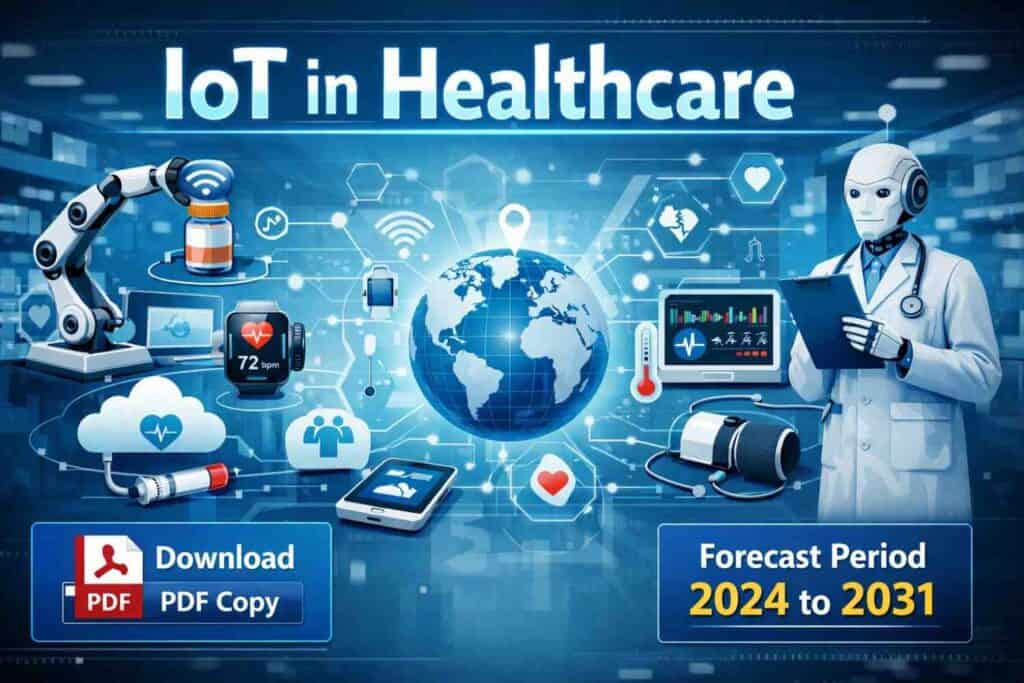
The integration of the Internet of Things (IoT) into the medical sector is fundamental to the digital transformation of modern medicine. As we look toward 2031, the IoT in healthcare market is set to experience monumental growth, driven by the increasing demand for remote patient monitoring, the rise of chronic diseases, and the continuous need for clinical efficiency. This professional analysis explores the market dynamics, technological shifts, and the competitive landscape defining the next decade of healthcare connectivity.
Market Overview and Dynamic Analysis
The IoT in healthcare market Analysis represents a sophisticated ecosystem of connected medical devices, software applications, and health systems that communicate through the internet. By 2031, this market is expected to transition from a collection of isolated smart gadgets to a fully integrated Internet of Medical Things (IoMT) infrastructure.
The IoT in healthcare market size is projected to reach US$ 280.86 billion by 2031 from US$ 75.22 billion in 2023. The market is expected to register a CAGR of 17.90% during 2023 – 2031.
The primary driver for this market is the global shift toward value based care. Healthcare providers are increasingly adopting IoT solutions to reduce the cost of treatment while improving patient outcomes. By utilizing real time data collection, hospitals can move from reactive to proactive care models. Furthermore, the aging global population and the high prevalence of long term conditions like diabetes and cardiovascular diseases necessitate continuous monitoring, which is only feasible through scalable IoT platforms.
Technological advancements in high speed connectivity, particularly the widespread rollout of 5G networks, will act as a catalyst. These networks provide the low latency and high bandwidth required for critical applications such as remote surgery and real time analytics of high resolution medical imaging.
Segmental Insights and Application Scope
The market is segmented based on components, applications, and end users. On the component level, the software segment is expected to witness the highest growth rate. While hardware like sensors and wearable devices forms the physical foundation, it is the sophisticated AI driven software that translates raw data into actionable medical insights.
In terms of application, telemedicine and remote patient monitoring dominate the landscape. These technologies allow for the decentralization of healthcare, moving care from the hospital to the home. This shift not only improves the patient experience but also alleviates the burden on physical healthcare infrastructure.
Other significant applications include medication management, where smart pill bottles track adherence, and clinical operations, where IoT sensors manage hospital assets and staff workflows to minimize wait times and resource wastage.
Download Sample PDF Report@ https://www.theinsightpartners.com/sample/TIPTE100000180
Regional Market Perspectives
North America currently holds a significant share of the IoT in healthcare market, supported by advanced healthcare infrastructure and early adoption of digital health policies. However, the Asia Pacific region is projected to be the fastest growing market through 2031. Rapid urbanization, increasing healthcare expenditure, and government initiatives to digitize national health records in countries like India and China are fueling this expansion.
Europe also maintains a robust position, with a heavy focus on data privacy and the standardization of medical IoT protocols. The integration of IoT in European healthcare systems is largely driven by the need to manage public health resources more effectively amid labor shortages in the nursing and medical sectors.
Competitive Landscape and Top Players
The market is characterized by the presence of both established technology giants and specialized medical device manufacturers. These players are focusing on strategic collaborations, mergers, and product innovations to strengthen their market presence.
Key players driving the IoT in healthcare market include:
- Medtronic plc
- GE Healthcare
- Royal Philips
- Siemens Healthineers
- Cisco Systems Inc.
- IBM Corporation
- Abbott Laboratories
- Boston Scientific Corporation
- Honeywell Life Care Solutions
- Microsoft Corporation
These organizations are investing heavily in R&D to ensure that IoT devices are not only functional but also secure against cyber threats, which remains a primary concern for the industry.
Future Outlook
The trajectory for the IoT in healthcare market through 2031 points toward an era of hyper connectivity and personalization. We anticipate a shift toward edge computing, where data processing happens on the device itself rather than in the cloud, allowing for instantaneous medical alerts.
Interoperability will become the industry standard. Future systems will focus on breaking down data silos, ensuring that information from a wearable device can be seamlessly integrated into a hospital Electronic Health Record (EHR) without manual intervention. Additionally, the convergence of IoT with Artificial Intelligence will enable predictive diagnostics, where algorithms can identify potential health crises before they manifest physically.
As the industry moves forward, the focus will intensify on making these technologies accessible and affordable for developing economies, ensuring that the benefits of the digital health revolution are realized on a global scale. The next decade will define IoT not just as a tool for convenience but as an essential pillar of the global healthcare delivery system.
Get Full Copy of This Report @ https://www.theinsightpartners.com/buy/TIPTE100000180
Frequently Asked Questions
What are the primary benefits of IoT in healthcare?
IoT enhances patient care by providing real time monitoring, reducing the frequency of hospital visits, and improving the accuracy of diagnoses through continuous data collection. For providers, it increases operational efficiency and lowers costs by optimizing resource management and asset tracking within clinical environments.
How does IoT improve patient adherence to treatments?
Through smart medication dispensers and wearable sensors, IoT systems can remind patients to take their medicine at the correct time and notify healthcare providers if a dose is missed. This ensures better management of chronic conditions and reduces the risk of complications resulting from non compliance.
What is the role of 5G in the future of medical IoT?
5G technology provides the high speed and low latency connection necessary for the transmission of large medical data sets. It enables advanced applications such as real time remote monitoring of critical patients, high definition video consultations, and the reliable operation of robotic surgical systems.
About The Insight Partners
The Insight Partners provides comprehensive syndicated and tailored market research services in the healthcare, technology, and industrial domains. Renowned for delivering strategic intelligence and practical insights, the firm empowers businesses to remain competitive in ever-evolving global markets.
Contact Information
- Email: sales@theinsightpartners.com
- Website: theinsightpartners.com
- Phone: +1-646-491-9876
Also Available in: Korean|German|Japanese|French|Chinese|Italian|Spanish

- Pneumatic Conveying Systems Market Set to Reach USD 59.30 Billion by 2034, Growing at a 6.43% CAGR - 2026-07-03
- Paper Making Machine Market Size Worth US$ 31.85 Billion by 2034, Registering a Steady 5.88% CAGR - 2026-07-03
- Road Roller Market Projected to Reach US$ 9.44 Billion by 2034, Registering a Steady 3.78% CAGR - 2026-07-03