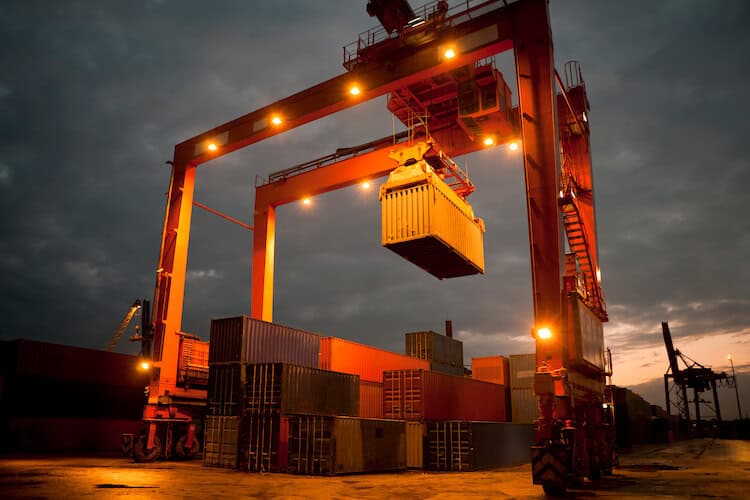
According to Next Move Strategy Consulting, the global Crane and Hoist Market, is set to experience significant growth, with an expected value of USD 46.7 billion by 2030, representing a compound annual growth rate (CAGR) of 5% from 2024 to 2030. This growth underscores the critical role crane and hoist systems play in diverse industrial sectors, ranging from construction to automotive manufacturing and e-commerce logistics.
Crane and hoist systems, vital infrastructure for material handling, are utilized to lift and transport heavy loads in sectors such as manufacturing, construction, and logistics. These systems are crucial for increasing operational efficiency, enhancing safety, and improving productivity across industries. As technology advances, cranes and hoists are becoming more versatile, with products like overhead cranes, gantry cranes, wire rope hoists, and chain hoists, designed to meet the specific needs of various operational environments.
Market Drivers
Several factors are driving the expansion of the Crane and Hoist Market globally. A primary factor is the rapid growth of the automotive industry, which requires highly efficient material handling solutions for smooth production and assembly processes.
Click Here for Your FREE Sample!
Additionally, the exponential growth of e-commerce is another key factor. With the surge in online retail and logistics, high-volume warehouses and distribution centers require advanced crane and hoist solutions to manage the movement of goods and optimize workflow.
As consumer expectations for faster delivery times intensify, the demand for robust and automated lifting equipment has never been higher. Crane and hoist systems are integral to optimizing inventory movement, order fulfillment, and warehouse operations, providing critical support in these fast-paced environments.
Moreover, the increasing emphasis on workplace safety regulations is driving the demand for upgraded lifting systems. Governments and regulatory bodies worldwide are enforcing stricter safety standards, compelling businesses to replace outdated equipment with more advanced, safety-compliant solutions. These modern cranes and hoists offer enhanced features like overload protection, emergency stop systems, and anti-collision sensors, which help mitigate the risk of workplace accidents and injuries.
Challenges
While the crane and hoist market is experiencing rapid growth, challenges remain. Regular maintenance tasks, such as inspections, lubrication, and repairs, are essential to ensure the safe operation of these systems. However, these maintenance activities can be time-consuming and expensive, posing a significant barrier to market growth. As cranes and hoists are often deployed in harsh environments and under heavy usage, ensuring their longevity and performance through effective maintenance becomes increasingly important.
However, advancements in technology are expected to ease these challenges. Augmented reality (AR) applications and digital platforms are revolutionizing crane and hoist maintenance by providing real-time visual overlays, digital instructions, and virtual simulations to operators. These innovations are expected to reduce downtime, improve maintenance efficiency, and lower long-term costs, creating new opportunities in the crane and hoist market.
Segmentation Analysis
The crane and hoist market is segmented into several key categories, including type, lifting capacity, operation, and industry verticals.
- By Type: The market is divided into mobile and fixed cranes. Mobile cranes are further segmented into crawler cranes, rough terrain cranes, all-terrain cranes, and truck loader cranes. Fixed cranes are segmented into industrial cranes, tower cranes, and ship-to-shore cranes.
- By Lifting Capacity: The market is divided into light, medium, and heavy lifting capacity categories, each serving different operational needs.
- By Operation: Crane and hoist systems are classified into hydraulic, electric, and hybrid operations, depending on the power source used for lifting and handling.
- By Industry Vertical: The crane and hoist market serves various industries, including construction, aerospace & defense, mining, automotive, energy & power, and others.
Regional Insights
The Asia Pacific region holds the dominant share in the crane and hoist market and is projected to maintain this position throughout the forecast period. This region’s growth is primarily driven by stringent workplace safety regulations in countries such as China and India, which require advanced lifting equipment to comply with safety standards.
In contrast, North America is witnessing steady growth in the crane and hoist market. The region’s strong export demand, particularly in the U.S. and Canada, is driving the need for efficient material handling systems to streamline logistics and cargo handling at ports and warehouses. Additionally, the automotive industry’s growth in North America is accelerating the demand for lifting equipment used in vehicle manufacturing processes.
Key Players in the Crane and Hoist Market
The crane and hoist market is highly competitive, with key players such as Konecranes, Demag Cranes AG, Gorbel Inc., Brehob Corporation, Zoomlion Heavy Industry Science and Technology Co. Ltd., Stellar Industries, Columbus McKinnon Corporation, Kito Corporation, Hercules Hoists Ltd., and Komatsu Ltd. leading the industry.
These companies are adopting various strategies, including product launches and partnerships, to strengthen their market position and cater to the evolving needs of their customers.
For example, in March 2024, Konecranes launched its X-series smart connected industrial crane, incorporating advanced digital technologies such as predictive maintenance and safety enhancements. In December 2023, Stellar Industries launched a redesigned hydraulic service crane, enhancing its lifting capacity and performance. Meanwhile, in March 2022, Hercules Hoists Ltd partnered with KG International to expand its global presence and boost market penetration.
Conclusion
The global crane and hoist market is set for robust growth, driven by factors such as the expansion of the automotive industry, the surge in e-commerce, and the increasing demand for workplace safety compliance. As industries worldwide continue to adopt advanced material handling solutions, the crane and hoist market is poised to play an even more critical role in improving operational efficiency, safety, and productivity.
