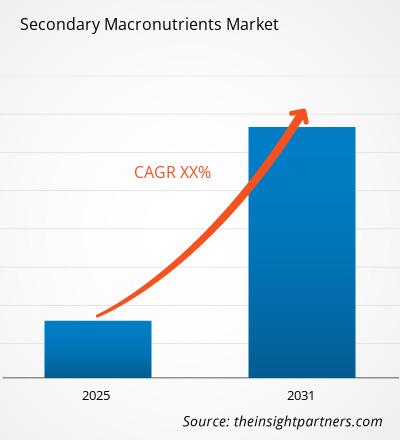
The Secondary Macronutrients Market plays an increasingly vital role in modern agriculture as farmers shift toward balanced fertilization strategies and sustainable crop production.
The secondary macronutrients market size is projected to reach US$ 62.42 billion by 2034 from US$ 37.25 billion in 2025. The market is anticipated to register a CAGR of 5.90% during the forecast period 2026-2034.
Secondary macronutrients primarily calcium, magnesium, and sulfur are essential plant nutrients that fill the gap between primary macronutrient needs (like nitrogen, phosphorus, and potassium) and micronutrient requirements. These nutrients support crop quality, soil health, and environmental resilience, making them integral to modern crop nutrition strategies.
You can easily get a sample PDF of the report – https://www.theinsightpartners.com/sample/TIPRE00004467/
What Are Secondary Macronutrients & Why They Matter
Secondary macronutrients are nutrients required by plants in moderate amounts. Unlike primary nutrients, which are demanded in large quantities, secondary macronutrients are equally important for key physiological processes such as photosynthesis, protein synthesis, and stress tolerance. Calcium strengthens cell walls and helps regulate nutrient uptake. Magnesium plays a central role in chlorophyll synthesis and energy transfer, while sulfur is crucial for protein formation and enzyme activation.
These nutrients are especially important in intensively farmed soils where repeated cropping and heavy use of primary fertilizers have caused depletion of secondary nutrient reserves. Modern farming practices have heightened the focus on nutrient balance, as imbalanced soils can lead to decreased yield, higher susceptibility to disease, and lower crop quality.
Secondary Macronutrients Market Segmentation
Nutrient
- Calcium
- Magnesium
- Sulfur
Formulation
- Dry Formulation
- Liquid Formulation
Application Method
- Liquid Application
- Solid Application
Crop Type
- Cereals and Grains
- Oilseeds and Pulses
- Fruits and Vegetables
Market leaders and key company profiles
- Coromandel International Limited
- Deepak Fertilisers and Petrochemicals Corporation Ltd.
- Haifa Group
- K+S Aktiengesellschaft
- Koch Industries, Inc.
- Kugler Company
- Nufarm Limited
- Nutrien Ltd.
- The Mosaic Company
Key Market Drivers
- Rising Demand for Sustainable Agriculture
The increasing global emphasis on sustainable agriculture is driving farmers and agronomists to adopt balanced fertilization outlooks. Secondary macronutrients contribute to improved soil structure and overall crop resilience, enabling better nutrient use efficiency alongside broader sustainability targets. - Soil Nutrient Depletion & Balanced Fertilization
Long-term reliance on NPK fertilizers can cause soil nutrient imbalances, prompting a greater need for calcium, magnesium, and sulfur inputs to restore soil health and improve crop performance. - Precision Agriculture Integration
Advancements in precision and digital farming technologies are reshaping nutrient application. Tools like IoT soil sensors, AI-based nutrient planning systems, and smart fertigation infrastructure enable efficient secondary nutrient delivery while minimizing waste.
Market Trends Shaping Growth
Crop-Specific Nutrient Blends
Fertilizer producers are innovating beyond generic products to tailor secondary macronutrient blends for specific crop needs. For example, fruit and vegetable growers increasingly adopt calcium-rich formulas for improved fruit firmness, while oilseed farmers leverage sulfur inputs to boost protein synthesis.
Controlled-Release & Smart Delivery Systems
Slow- and controlled-release secondary macronutrient technologies are gaining traction. These formulations match nutrient release with crop uptake rhythms, reducing nutrient leaching and supporting environmentally sustainable practices.
Solid vs. Liquid Formulations
Traditional solid formats remain popular due to ease of application and compatibility with existing mechanical equipment. However, liquid formulations are rising as farmers adopt fertigation and foliar feeding methods, which facilitate uniform distribution and quicker absorption of nutrients.
Regional Adoption & Expansion
Growing awareness of soil nutrient deficiencies and broader adoption of sustainable nutrient management practices are driving uptake across key agricultural regions, especially in grain-producing areas where soil depletion is pronounced. Technological investments in developed regions and expanding cultivation in emerging markets support this expansion.
Get Premium Research Report of Secondary Macronutrients Market Size and Growth Report at- https://www.theinsightpartners.com/buy/TIPRE00004467/
Challenges in the Secondary Macronutrients Market
Despite strong drivers, the market encounters challenges such as diverse regulatory frameworks governing fertilizer composition and environmental concerns around nutrient runoff. These issues require manufacturers to innovate responsibly and adhere to evolving standards while maintaining product performance.
Trending Related Reports:
- Crop Micronutrients Market Size, Share & Forecast by 2034
- Yeast Nutrients Market Size, Share & Growth by 2034
- Acids and Nutrients In Animal Nutrition Market Growth, Trends & Demand by 2034
- Sulfur Based Micronutrients Market Growth, Trends, and Forecast by 2031
About Us:
The Insight Partners is a one stop industry research provider of actionable intelligence. We help our clients in getting solutions to their research requirements through our syndicated and consulting research services. We specialize in industries such as Semiconductor and Electronics, Aerospace and Defense, Automotive and Transportation, Biotechnology, Healthcare IT, Manufacturing and Construction, Medical Device, Technology, Media and Telecommunications, Chemicals and Materials.
Contact Us
If you have any queries regarding this report or require additional information, please contact us:
The Insight Partners
Email: sales@theinsightpartners.com
Phone: +1-646-491-9876
Website: https://www.theinsightpartners.com/
Also Available in : Korean | German | Japanese | French | Chinese | Italian | Spanish
