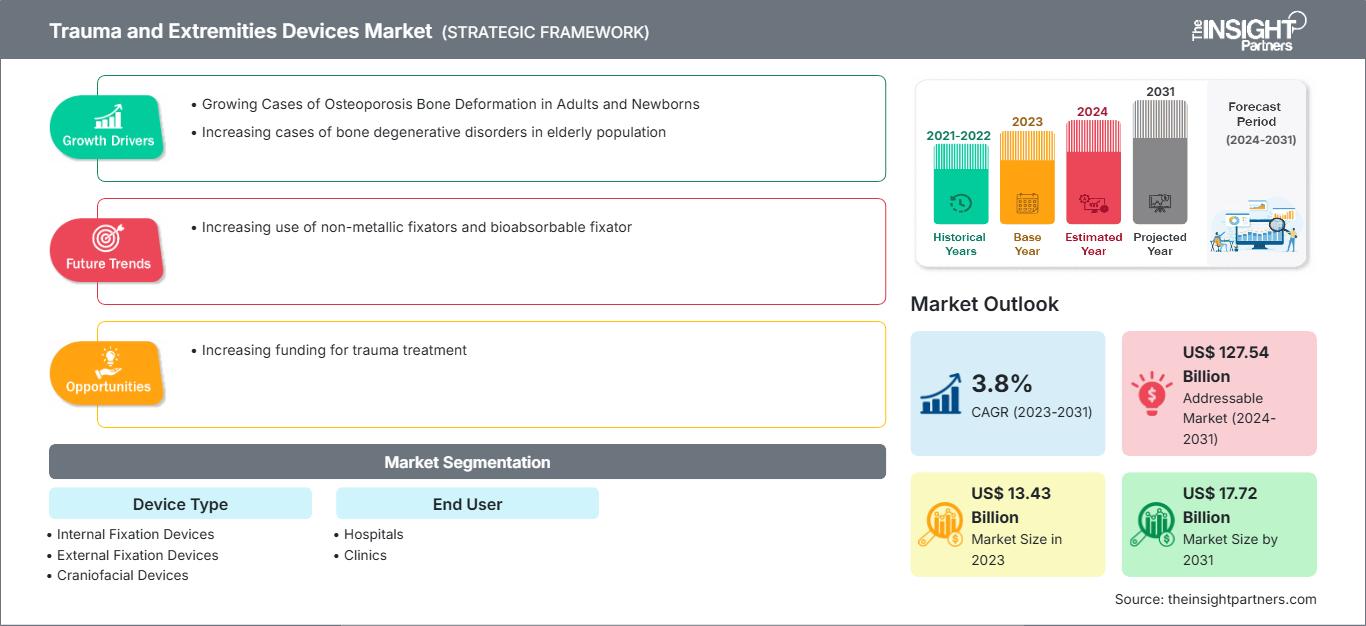
The global trauma and extremities devices market is experiencing steady growth, driven by increasing incidences of trauma injuries, rising demand for orthopedic surgeries, and continuous advancements in surgical technologies. Trauma and extremities devices are essential for the treatment of fractures, bone deformities, and soft tissue injuries, particularly in cases involving the upper and lower extremities such as hands, wrists, ankles, and feet.
According to market insights, the trauma and extremities devices market size is projected to reach US$ 17.72 billion by 2031 from US$ 13.43 billion in 2023. The market is expected to register a CAGR of 3.8% during 2023–2031. This consistent growth reflects increasing medical needs, enhanced surgical outcomes, and wider adoption of advanced orthopedic solutions.
Download Sample PDF @ https://www.theinsightpartners.com/sample/TIPRE00007345
Key Market Drivers
- Rising Incidence of Trauma and Road Accidents
The increasing number of road accidents, sports injuries, and workplace incidents is one of the primary drivers of the trauma and extremities devices market. Fractures and bone injuries require immediate surgical interventions, creating consistent demand for fixation devices such as plates, screws, and rods. The global rise in urbanization and motor vehicle usage is further contributing to trauma cases worldwide.
- Growing Geriatric Population
The aging population is more susceptible to bone-related disorders such as osteoporosis, which significantly increases the risk of fractures. Elderly individuals often require surgical interventions for hip, wrist, and ankle fractures. This demographic trend is driving the demand for trauma and extremities devices globally, ensuring sustained market growth over the forecast period.
- Technological Advancements in Orthopedic Devices
Innovations in orthopedic technologies are transforming trauma care. The development of bioabsorbable implants, anatomically contoured plates, and minimally invasive fixation systems is improving clinical outcomes. Advanced materials such as titanium and stainless steel enhance durability and compatibility, while improved surgical techniques reduce recovery time and complications.
- Increased Adoption of Minimally Invasive Procedures
Minimally invasive orthopedic surgeries are gaining popularity due to their reduced recovery time, lower risk of infection, and improved patient comfort. Surgeons are increasingly adopting advanced fixation systems that support these procedures, boosting the demand for modern trauma devices.
- Expansion of Healthcare Infrastructure
Developing economies are witnessing rapid improvements in healthcare infrastructure, including the establishment of advanced hospitals and trauma care centers. Increased government spending and private investments in healthcare are enhancing access to orthopedic treatments, driving market expansion in regions such as Asia-Pacific and Latin America.
- Rising Awareness and Access to Orthopedic Care
Increasing awareness about early diagnosis and treatment of bone injuries is encouraging patients to seek professional medical care. Improved access to healthcare services and availability of skilled orthopedic surgeons are further supporting market growth.
Get Full Copy @ https://www.theinsightpartners.com/buy/TIPRE00007345
Key Market Players
The trauma and extremities devices market is highly competitive, with major players focusing on product innovation, mergers, and global expansion strategies. Leading companies include:
- Stryker Corporation
- DePuy Synthes (Johnson & Johnson)
- Zimmer Biomet Holdings, Inc.
- Smith & Nephew plc
- Medtronic plc
- B. Braun Melsungen AG
- Orthofix Medical Inc.
- Wright Medical Group N.V. (now part of Stryker)
- Acumed LLC
- Conmed Corporation
These companies are actively investing in research and development to introduce advanced trauma fixation systems and expand their global footprint.
SWOT Analysis of the Trauma and Extremities Devices Market
Strengths
- Strong demand driven by increasing trauma cases and aging population
- Continuous technological advancements improving treatment outcomes
- Wide range of applications across orthopedic procedures
Weaknesses
- High cost of advanced orthopedic implants and procedures
- Dependence on skilled surgeons and specialized healthcare facilities
- Risk of post-surgical complications and implant failures
Opportunities
- Growth in emerging markets due to improving healthcare infrastructure
- Increasing demand for bioresorbable and patient-specific implants
- Expansion of minimally invasive surgical techniques
Threats
- Stringent regulatory approvals for medical devices
- Pricing pressures due to healthcare budget constraints
- Availability of alternative non-surgical treatments in some cases
Market Segmentation Overview
The trauma and extremities devices market is segmented based on product type, application, end user, and geography.
By Product Type
- Internal fixation devices (plates, screws, rods)
- External fixation devices
Internal fixation devices dominate the market due to their widespread use in fracture management.
By Application
- Upper extremities
- Lower extremities
Lower extremities account for a significant share due to the high incidence of fractures in hips, knees, and ankles.
By End User
- Hospitals
- Ambulatory surgical centers
- Specialty orthopedic clinics
Hospitals represent the largest market segment due to availability of advanced surgical facilities and emergency trauma care services.
Regional Insights
North America holds a dominant position in the trauma and extremities devices market due to advanced healthcare infrastructure, rising surgical procedures, and the presence of leading players. The region also benefits from strong reimbursement frameworks and early adoption of innovative technologies.
Europe follows closely with significant growth driven by increasing geriatric population and rising orthopedic surgeries.
The Asia-Pacific region is expected to witness the fastest growth during the forecast period. Rapid urbanization, increasing road accidents, growing healthcare investments, and improving access to orthopedic care in countries such as China and India are driving regional expansion.
Related Reports @
Trauma Disposal Car Market Size, Growth & Trends by 2034
About Us –
The Insight Partners provides comprehensive syndicated and tailored market research services in the healthcare, technology, and industrial domains. Renowned for delivering strategic intelligence and practical insights, the firm empowers businesses to remain competitive in ever-evolving global markets.
Contact Us:
Contact Person: Ankit Mathur
E-mail: ankit.mathur@theinsightpartners.com
Phone: +1-646-491-9876
Also Available in : Korean German Japanese French Chinese Italian Spanish
