- General Atomics
- EnergyOR
- Northrop Grumman
- Horizon Fuel Cell Technologies
- PLUG POWER INC
- MicroMultiCopter Aero Technology
- ISS Aerospace
- Doosan Mobility Innovation
- Protonex
- Honeywell International Inc.
These organizations are instrumental in executing strategic frameworks, forming cross-industry partnerships, and establishing robust supply chains. For example, defense giants like Northrop Grumman and General Atomics bring substantial engineering expertise to integrate fuel cells into medium-altitude, long-endurance (MALE) military platforms. On the other hand, enterprises like Doosan Mobility Innovation and Horizon Fuel Cell Technologies are making major strides in designing lightweight, portable hydrogen power packs specifically tailored for commercial and industrial multi-rotor drones.
Segmental Insights
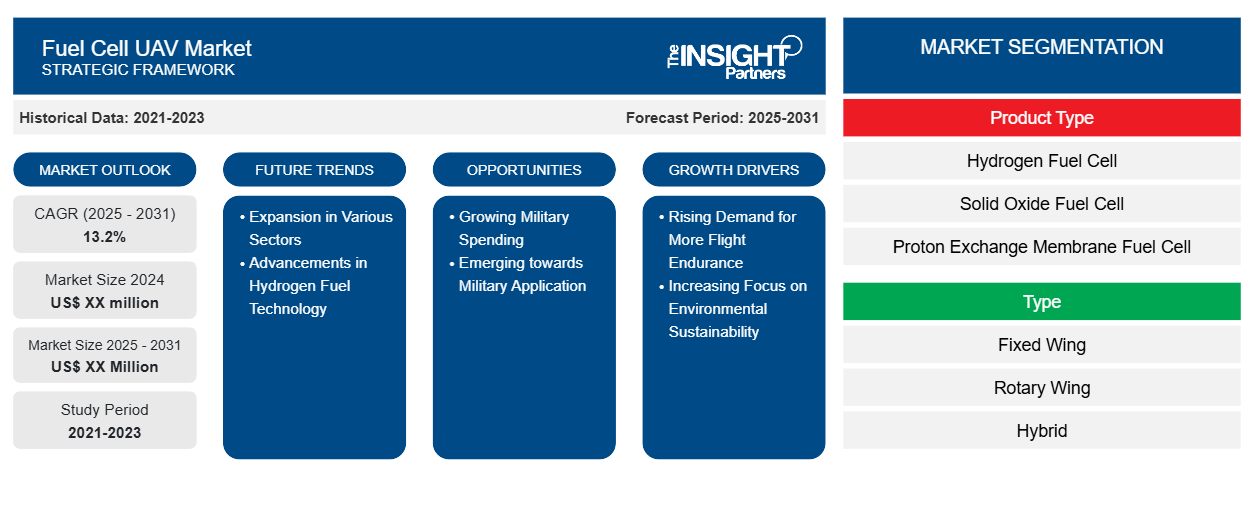
The global market expands across multiple segments based on product type, weight, and application. On the basis of technology, Proton Exchange Membrane (PEM) fuel cells lead the market due to their relatively low operating temperatures, high efficiency, and rapid startup times. Geographically, North America represents a substantial share of the market, fueled by major defense expenditures, advanced aerospace infrastructure, and proactive commercial integration. Concurrently, the Asia-Pacific region is experiencing rapid growth, driven by massive investments in agricultural drone applications and the infrastructure expansion of smart cities.
Get Full Copy of This Report– https://www.theinsightpartners.com/buy/TIPRE00024660
Future Outlook
The future outlook for the Fuel Cell UAV market remains highly optimistic, characterized by technical breakthroughs and expanding deployment scenarios. Over the next decade, the industry is poised to move past foundational technology hurdles, particularly concerning the weight of hydrogen storage cylinders and the localization of specialized fueling infrastructure. As composite materials continue to mature, lighter storage tanks will allow UAVs to carry even greater payloads without sacrificing operational range. Moreover, the long-term viability of the market will be heavily supported by a broader, macroeconomic shift toward a global hydrogen economy. As green hydrogen production scales and distribution networks mature, the operational cost of running hydrogen-powered drone fleets will drop significantly. The convergence of strict global emission regulations, a growing demand for automated delivery networks, and the continuous push for prolonged military surveillance capabilities ensures that fuel cell technology will occupy a central pillar in the future of unmanned flight.
Related Reports-
Alternate Fuel Aircraft Market
Renewable Aviation Fuel Market
Aircraft Engine Fuel Systems Market
Sustainable Aviation Fuel Market
About Us
The Insight Partners is a one-stop industry research provider of actionable intelligence. We help our clients in getting solutions to their research requirements through our syndicated and consulting research services. We specialize in industries such as Semiconductor and Electronics, Aerospace and Defense, Automotive and Transportation, Biotechnology, Healthcare IT, Manufacturing and Construction, Medical Devices, Technology, Media, and Telecommunications, as well as chemicals and Materials.
Contact Us
If you have any queries about this report or if you would like further information, don’t hesitate to get in touch with us:
Contact Person: Ankit Mathur
E-mail: ankit.mathur@theinsightpartners.com
Phone: +1-646-491-9876
