The IoT in Smart Cities refers to the deployment of interconnected devices, sensors, communication networks, and software platforms designed to improve urban operations and public services. Smart city initiatives leverage IoT technologies to collect real-time data from multiple sources and convert it into actionable insights.
Market Size, Share, Trends, Analysis, and Forecast Through 2031
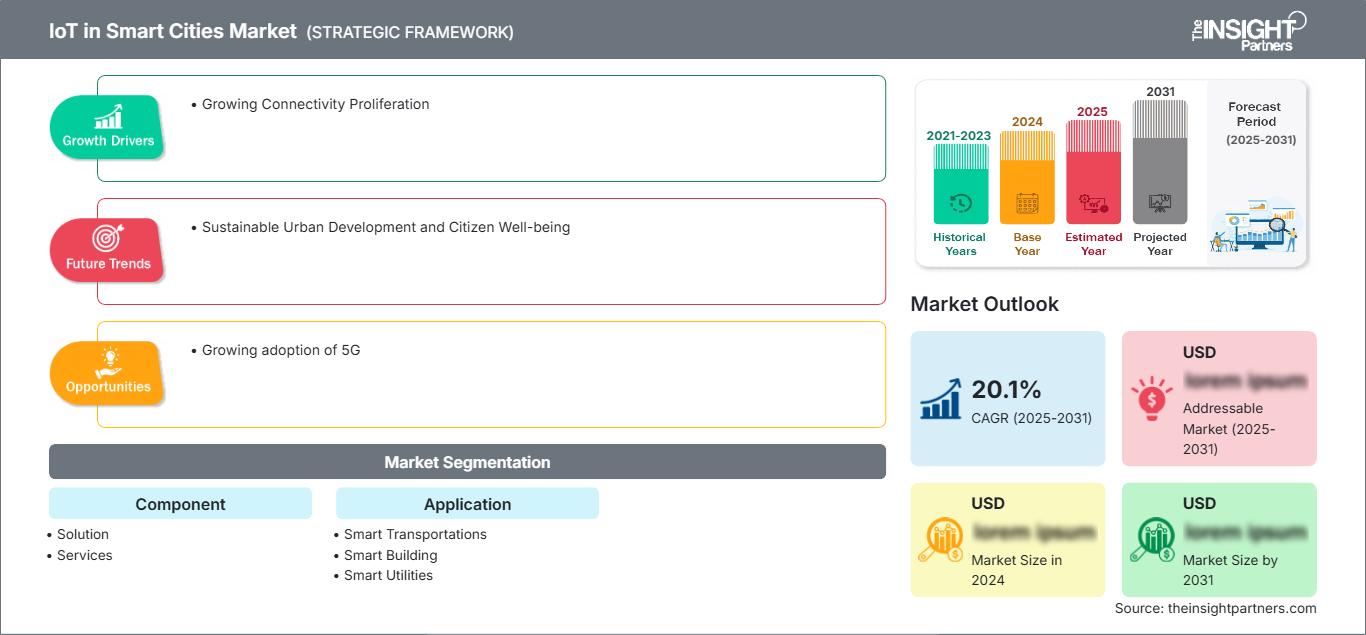
The IoT In Smart Cities Market size is expected to reach US$ 483.43 Billion by 2031. The market is anticipated to register a CAGR of 20.9% during 2025-2031. Growing adoption of 5G is likely to remain a key trend in the market.
Market Overview
The IoT in Smart Cities Market is evolving from isolated pilot projects into large-scale urban transformation programs. Governments are increasingly recognizing the importance of digital infrastructure in supporting economic growth, sustainability goals, and improved citizen experiences.
Technology vendors are collaborating with municipalities to deploy integrated smart city platforms capable of managing multiple urban services from a centralized ecosystem. These platforms help city administrators monitor infrastructure performance, reduce operational costs, and enhance service delivery.
The market is characterized by:
- Growing adoption of connected devices and sensors
- Expansion of smart transportation networks
- Increased implementation of intelligent utility management systems
- Rising investments in digital public infrastructure
- Integration of AI and machine learning into urban management systems
- Growing focus on cybersecurity and data privacy
The shift toward connected urban ecosystems is expected to remain a key growth catalyst throughout the forecast period.
Market Analysis
The IoT in Smart Cities Market is experiencing significant transformation as cities increasingly rely on real-time data to improve urban operations. The deployment of connected infrastructure allows municipalities to gain deeper visibility into city functions while improving efficiency and sustainability.
Transportation remains one of the largest application segments due to increasing investments in smart mobility solutions. Connected traffic systems, intelligent parking management, and vehicle-to-infrastructure communication technologies are helping reduce congestion and improve commuter experiences.
Smart utilities are also witnessing strong adoption. Utility providers are utilizing IoT-enabled monitoring systems to optimize electricity distribution, water management, and energy consumption.
Public safety applications are becoming increasingly important as city administrations deploy connected surveillance systems, emergency response technologies, and predictive security platforms.
Meanwhile, cloud computing and edge analytics are helping cities process large volumes of data more efficiently, enabling faster decision-making and improved operational performance.
Get a Sample PDF of the report @ https://www.theinsightpartners.com/sample/TIPTE100000228
Market Drivers and Opportunities
Several factors are driving growth in the IoT in Smart Cities Market.
Key Market Drivers
Rapid Urbanization:-The growing urban population is placing pressure on transportation, utilities, healthcare, and public infrastructure. Smart city technologies help address these challenges through efficient resource management.
Government Smart City Initiatives:-National and regional governments are launching programs that encourage digital infrastructure development and connected urban planning.
Sustainability Goals:-Cities are increasingly adopting IoT solutions to reduce emissions, improve energy efficiency, and support environmental sustainability initiatives.
Expansion of 5G Networks:-The rollout of advanced communication networks is enabling faster and more reliable connectivity for IoT devices and applications.
Rising Demand for Real-Time Data:-Municipal authorities are leveraging real-time analytics to improve operational efficiency and enhance citizen services.
Market Opportunities
- Smart mobility and transportation modernization
- AI-powered urban management systems
- Smart energy and utility management
- Connected healthcare infrastructure
- Environmental monitoring solutions
- Digital twin implementation
- Smart building integration
- Public safety and emergency response technologies
Global and Regional Analysis
North America:-North America remains a leading region in smart city technology adoption. Strong investments in digital infrastructure, advanced connectivity, and public sector innovation continue to drive market expansion.
Europe:-European countries are focusing heavily on sustainability and energy efficiency initiatives. Smart mobility projects, environmental monitoring systems, and connected utility networks are contributing to regional growth.
Asia-Pacific:-Asia-Pacific is expected to witness the fastest expansion due to rapid urbanization, large-scale smart city projects, and government-led digital transformation programs. Countries across the region are investing heavily in intelligent transportation, public safety, and utility modernization.
Middle East and Africa:-The region is experiencing growing adoption of smart city technologies through ambitious urban development initiatives, smart infrastructure investments, and digital government programs.
South and Central America:-Increasing investments in urban modernization and digital connectivity are creating new opportunities for IoT-enabled city management solutions throughout the region.
Get the Premium Research Report @ https://www.theinsightpartners.com/buy/TIPTE100000228
Major Companies / Top Market Players
- Cisco Systems
- Honeywell International Inc.
- Huawei Technologies Co., Ltd.
- IBM Corporation
- Intel Corporation
- Microsoft Corporation
- SAP SE
- SAS Insitute, Inc.
- Schneider Electric
- Siemens AG
These companies continue to invest in smart infrastructure platforms, connected devices, analytics solutions, and city management technologies to strengthen their market positions
Emerging Trends and Market Opportunities
Several emerging trends are shaping the future of the IoT in Smart Cities Market:
- Digital twin adoption for urban planning
- Autonomous transportation infrastructure
- Smart energy grid modernization
- AI-driven traffic optimization
- Connected public safety networks
- Predictive maintenance for city assets
- Smart water management systems
- Intelligent waste collection solutions
- Sustainable urban mobility initiatives
- Citizen-centric digital service platforms
These developments are expected to create substantial growth opportunities across both developed and emerging economies.
Recent Industry Developments
- Increased adoption of cloud-native smart city platforms
- Growth in AI-enabled predictive urban analytics
- Expansion of smart mobility projects
- Rising deployment of environmental sensing networks
- Stronger focus on cybersecurity for connected infrastructure
- Integration of edge computing for real-time decision making
- Expansion of intelligent utility management systems
These developments continue to accelerate innovation across the smart city ecosystem.
Market Future Outlook
The future of the IoT in Smart Cities Market remains highly promising. Cities worldwide are increasingly embracing digital transformation strategies to improve infrastructure efficiency, sustainability, and citizen engagement.
About The Insight Partners
The Insight Partners is a global leader in market research, delivering comprehensive analysis and actionable insights across diverse industries. The company empowers decision-makers with data-driven intelligence to navigate evolving markets and accelerate growth.
Contact Us:
- Contact Person: Ankit Mathur
- E-mail: ankit.mathur@theinsightpartners.com
- Phone: +1-646-491-9876
Also Available in :
Korean German Japanese French Chinese Italian Spanish
