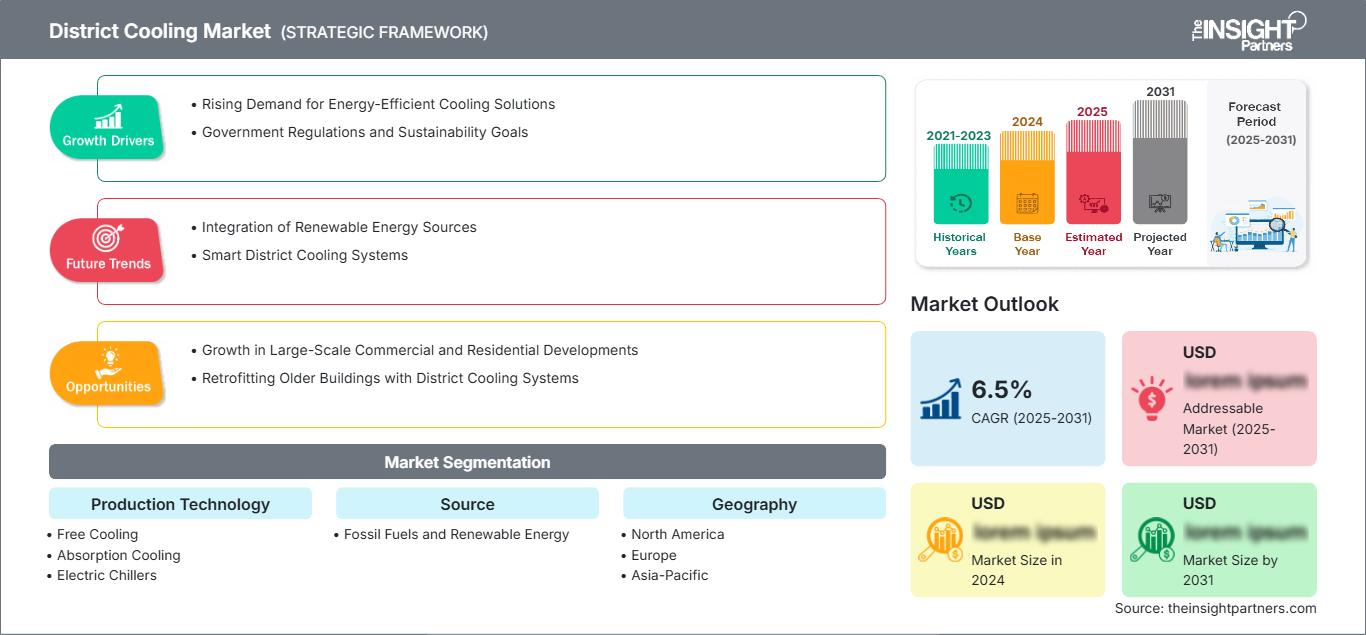
District cooling systems provide centralized cooling services to multiple buildings through a network of insulated pipes carrying chilled water from a central cooling plant. These systems offer higher energy efficiency, lower carbon emissions, and reduced operational costs compared to conventional building-level air conditioning systems.
As cities pursue sustainability goals and energy-efficient infrastructure development, district cooling is emerging as a critical solution for managing cooling demand in residential, commercial, industrial, and mixed-use developments.
Market Overview
The global District Cooling Market is expected to grow from US$ 33.34 Billion in 2025 to US$ 62.7 Billion by 2034, registering a CAGR of 7.27% during the forecast period 2026–2034.
Market growth is being driven by rapid urbanization, increasing demand for energy-efficient cooling solutions, growing investments in smart city projects, and rising efforts to reduce greenhouse gas emissions from buildings and urban infrastructure.
Key Market Insights
- Market Size (2025): US$ 33.34 Billion
- Forecast Market Size (2034): US$ 62.7 Billion
- CAGR (2026–2034): 7.27%
- Key Driver: Rising demand for sustainable cooling infrastructure
- Major Trend: Integration of district cooling with smart city developments
- Forecast Period: 2026–2034
Market Analysis
The District Cooling Market is witnessing significant growth as governments, municipalities, and developers increasingly seek efficient alternatives to traditional cooling systems. Centralized cooling networks help reduce electricity consumption, improve operational efficiency, and lower environmental impact.
Urbanization remains one of the primary growth drivers. Rapid development of commercial complexes, residential communities, airports, hospitals, educational institutions, and mixed-use districts is creating strong demand for large-scale cooling infrastructure.
The commercial real estate sector is a major adopter of district cooling solutions. Office buildings, shopping centers, hotels, and business districts benefit from reduced maintenance costs and improved energy performance through centralized cooling systems.
Sustainability initiatives are further accelerating market expansion. Governments worldwide are implementing energy efficiency regulations and climate action strategies that encourage adoption of low-carbon cooling technologies.
The integration of renewable energy sources and advanced energy management systems is enhancing the efficiency and attractiveness of district cooling networks.
Get a Sample PDF of the Report: https://www.theinsightpartners.com/sample/TIPRE00008733
Updated Market Trends
- Growing adoption of sustainable cooling technologies
- Rising investments in smart city infrastructure
- Increasing integration of renewable energy sources
- Expansion of large-scale urban development projects
- Growing focus on energy efficiency and carbon reduction
- Rising deployment of intelligent energy management systems
- Development of high-efficiency chilled water networks
- Increasing demand from commercial real estate projects
- Expansion of green building initiatives
- Growing adoption of digital monitoring and automation solutions
Regional Analysis
Middle East
The Middle East remains one of the leading markets due to extreme climatic conditions, large-scale urban developments, and extensive investments in sustainable infrastructure projects.
Asia-Pacific
Asia-Pacific is expected to experience strong growth driven by rapid urbanization, increasing construction activities, and expanding smart city initiatives across China, India, Southeast Asia, and other emerging economies.
Europe
Europe continues to witness growing adoption supported by stringent energy efficiency regulations, sustainability targets, and investments in low-carbon urban infrastructure.
North America
North America is gradually increasing district cooling deployment as cities focus on reducing energy consumption and improving the efficiency of large commercial and institutional facilities.
Get the Premium Research Report @ https://www.theinsightpartners.com/buy/TIPRE00008733
Key Players
- Emirates Central Cooling Systems Corporation (Empower)
- Tabreed PJSC
- ENGIE Group
- Veolia Environnement S.A.
- Siemens AG
- ADC Energy Systems LLC
- Shinryo Corporation
- Keppel DHCS Pte Ltd.
- Fortum Corporation
- Ramboll Group A/S
Emerging Trends
One of the most significant trends shaping the market is the integration of district cooling systems with smart energy management platforms that enable real-time monitoring, predictive maintenance, and optimized energy consumption.
Another notable trend is the use of renewable energy sources and thermal energy storage technologies to improve system efficiency and support long-term sustainability objectives.
Future Outlook
The District Cooling Market is expected to maintain steady growth as cities continue investing in sustainable infrastructure and energy-efficient cooling solutions. Increasing concerns regarding climate change, rising cooling demand, and urban population growth will remain key market drivers.
Advancements in digital controls, thermal storage systems, renewable energy integration, and smart utility technologies are anticipated to create substantial opportunities for industry participants during the forecast period.
Related Market Research Reports
Industrial Safety Integrated Components Market Share, Growth & Forecast by 2034
PLC Expansion Modules Market Size, Demand & Growth by 2034
Slide Potentiometers Market Share, Growth & Forecast by 2034
Contamination Monitors Market Demand, Size & Forecast by 2034
About The Partners
The Insight Partners is a Insight global leader in market research, delivering comprehensive analysis and actionable insights across diverse industries. The company empowers decision-makers with data-driven intelligence to navigate evolving markets and accelerate growth.
Contact Us:
- Contact Person: Ankit Mathur
- E-mail: ankit.mathur@theinsightpartners.com
- Phone: +1-646-491-9876
