The GCC Mass Spectrometry Market is experiencing steady growth due to increasing investments in healthcare infrastructure, expanding pharmaceutical and biotechnology research activities, and rising demand for advanced analytical technologies. Mass spectrometry has become an essential tool across clinical diagnostics, life sciences research, pharmaceutical development, food safety testing, environmental monitoring, and forensic investigations. The growing emphasis on precision medicine and advanced laboratory capabilities across Gulf Cooperation Council (GCC) countries is expected to accelerate market expansion in the coming years.
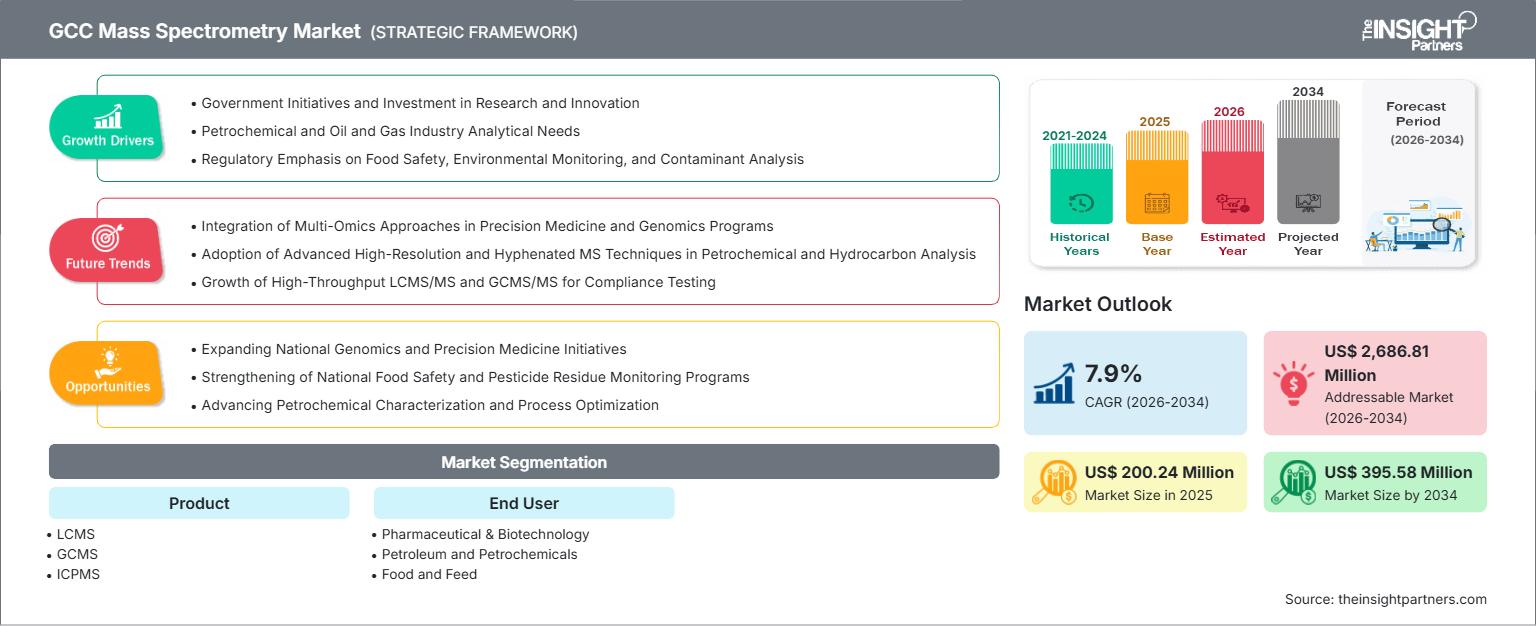
According to The Insight Partners, the GCC mass spectrometry market size is projected to reach US$ 395.58 million by 2034 from US$ 200.24 million in 2025. The market is expected to register a CAGR of 7.9% from 2026 to 2034. Increasing government support for scientific research, rising healthcare expenditure, and growing adoption of advanced laboratory technologies are key factors driving market growth throughout the forecast period.
Download Sample PDF @ https://www.theinsightpartners.com/sample/TIPRE00043151
Market Overview
Mass spectrometry is an analytical technique used to identify, quantify, and characterize chemical compounds based on their mass-to-charge ratio. The technology plays a critical role in drug discovery, proteomics, metabolomics, clinical diagnostics, environmental testing, and food quality analysis.
Healthcare institutions, research laboratories, academic organizations, and pharmaceutical companies across the GCC region are increasingly adopting mass spectrometry systems to improve analytical accuracy and research outcomes. The demand for advanced analytical instrumentation is growing as governments prioritize healthcare modernization and scientific innovation as part of long-term economic diversification strategies.
Countries such as Saudi Arabia, the United Arab Emirates, Qatar, Kuwait, Bahrain, and Oman are actively investing in healthcare and life sciences infrastructure, creating favorable conditions for market growth.
Key Market Drivers
Expanding Pharmaceutical and Biotechnology Research
One of the primary drivers of the GCC Mass Spectrometry Market is the growing investment in pharmaceutical and biotechnology research activities. Governments and private organizations across the region are focusing on strengthening local research capabilities and supporting innovation in drug development.
Mass spectrometry plays a vital role in pharmaceutical research by enabling detailed analysis of drug compounds, metabolites, and biological samples. The increasing number of research projects and clinical studies is driving demand for advanced analytical instruments throughout the GCC.
As pharmaceutical manufacturing and biotechnology initiatives continue to expand, the adoption of mass spectrometry systems is expected to increase significantly.
Rising Demand for Clinical Diagnostics
Clinical laboratories are increasingly utilizing mass spectrometry technologies for disease diagnosis, biomarker identification, toxicology testing, and therapeutic drug monitoring.
The growing prevalence of chronic diseases such as cancer, diabetes, cardiovascular disorders, and metabolic conditions is driving demand for highly accurate diagnostic tools. Mass spectrometry offers exceptional sensitivity and specificity, making it a preferred technology for advanced clinical applications.
Healthcare providers across the GCC region are investing in modern diagnostic laboratories to improve patient outcomes and support precision medicine initiatives.
Government Investments in Healthcare Infrastructure
Governments across GCC countries are implementing healthcare transformation programs aimed at improving medical services, research capabilities, and laboratory infrastructure.
Large-scale investments in hospitals, diagnostic centers, academic institutions, and research facilities are creating substantial opportunities for mass spectrometry equipment manufacturers. National healthcare strategies focused on innovation and advanced diagnostics continue to support market growth.
The increasing emphasis on healthcare self-sufficiency and scientific excellence is expected to strengthen demand for sophisticated analytical technologies.
Growth in Food Safety and Environmental Testing
Food quality assurance and environmental monitoring have become important priorities throughout the GCC region. Regulatory authorities are increasingly implementing strict testing requirements to ensure food safety and environmental protection.
Mass spectrometry systems are widely used for detecting contaminants, pesticides, toxins, and pollutants in food products, water supplies, and environmental samples. Growing regulatory compliance requirements are contributing to increased adoption of advanced analytical instrumentation.
Get Full Copy @ https://www.theinsightpartners.com/buy/TIPRE00043151
Market Trends
Increasing Adoption of High-Resolution Mass Spectrometry
One of the key trends shaping the market is the growing adoption of high-resolution mass spectrometry systems. These instruments provide enhanced analytical capabilities, allowing researchers to identify complex compounds with greater accuracy and sensitivity.
The demand for high-performance analytical solutions is increasing across pharmaceutical, biotechnology, and academic research applications.
Integration with Omics Research
Proteomics, metabolomics, and genomics research are becoming increasingly important across life sciences and personalized medicine applications.
Mass spectrometry technologies are playing a central role in these research fields by enabling detailed molecular analysis and biomarker discovery. The growing focus on precision medicine is expected to further accelerate market demand.
Automation and Digitalization of Laboratories
Laboratories are increasingly adopting automation and digital technologies to improve workflow efficiency and analytical accuracy.
Modern mass spectrometry systems are being integrated with advanced software platforms, data analytics tools, and laboratory information management systems. These innovations help laboratories improve productivity while reducing operational complexity.
Market Segmentation
According to The Insight Partners, the GCC Mass Spectrometry Market is segmented based on technology, application, end user, and geography.
By Technology
- Hybrid Mass Spectrometry
- Single Mass Spectrometry
- Inductively Coupled Plasma Mass Spectrometry
- Gas Chromatography Mass Spectrometry
- Liquid Chromatography Mass Spectrometry
By Application
- Pharmaceutical Analysis
- Clinical Diagnostics
- Proteomics
- Metabolomics
- Environmental Testing
- Food and Beverage Testing
- Forensic Analysis
By End User
- Pharmaceutical and Biotechnology Companies
- Hospitals and Diagnostic Laboratories
- Academic and Research Institutions
- Government Laboratories
- Environmental Testing Laboratories
Pharmaceutical and biotechnology organizations account for a significant share of market demand due to extensive use of mass spectrometry in drug development and research activities.
Competitive Landscape
The GCC Mass Spectrometry Market is characterized by the presence of leading global analytical instrument manufacturers. Companies are focusing on technological innovation, regional expansion, and strategic collaborations to strengthen their market positions.
Key companies operating in the market include:
- Thermo Fisher Scientific
- Agilent Technologies
- Shimadzu Corporation
- Waters Corporation
- Bruker Corporation
- Danaher Corp
- Revvity Inc
- Rigaku Corp
- JEOL Ltd.
- LECO Corporation
These companies continue to invest in advanced product development, research partnerships, and customer support services to address evolving market requirements.
Regional Analysis
Saudi Arabia represents one of the largest markets for mass spectrometry technologies in the GCC region due to extensive healthcare investments, expanding pharmaceutical research, and government-led innovation initiatives.
The United Arab Emirates is another major contributor to market growth, supported by advanced healthcare infrastructure, increasing research activities, and growing demand for precision diagnostics.
Qatar, Kuwait, Bahrain, and Oman are also witnessing increasing adoption of analytical technologies as they continue to invest in healthcare modernization and scientific research capabilities.
The region’s commitment to economic diversification and knowledge-based development is expected to create substantial opportunities for mass spectrometry manufacturers throughout the forecast period.
Future Outlook
The future of the GCC Mass Spectrometry Market appears highly promising. Growing investments in healthcare infrastructure, increasing pharmaceutical and biotechnology research, expanding clinical diagnostics applications, and rising regulatory requirements for food and environmental testing are expected to drive market growth through 2034.
The continued adoption of high-resolution analytical technologies, precision medicine initiatives, and laboratory automation solutions will create significant opportunities for market participants. Companies that focus on innovation, technical support, and regional expansion are expected to maintain strong competitive positions in this evolving analytical instrumentation market.
Related Reports @
Mass Spectrometry Market Size, Share & Forecast by 2034
Clinical Mass Spectrometry Market Analysis, Size, Share, Growth, Trends, and Forecast by 2031
About Us –
The Insight Partners provides comprehensive syndicated and tailored market research services in the healthcare, technology, and industrial domains. Renowned for delivering strategic intelligence and practical insights, the firm empowers businesses to remain competitive in ever-evolving global markets.
Contact Us:
Contact Person: Ankit Mathur
E-mail: ankit.mathur@theinsightpartners.com
Phone: +1-646-491-9876
