Braking resistors are electrical components designed to dissipate excess energy generated during the deceleration of electric motors and drive systems. These resistors play a critical role in industrial automation, elevators, cranes, railways, electric vehicles, material handling equipment, and manufacturing systems by improving braking performance, protecting equipment, and enhancing operational safety.
The increasing deployment of motor-driven systems and industrial automation technologies is fueling demand for braking resistors across various industries.
Market Overview
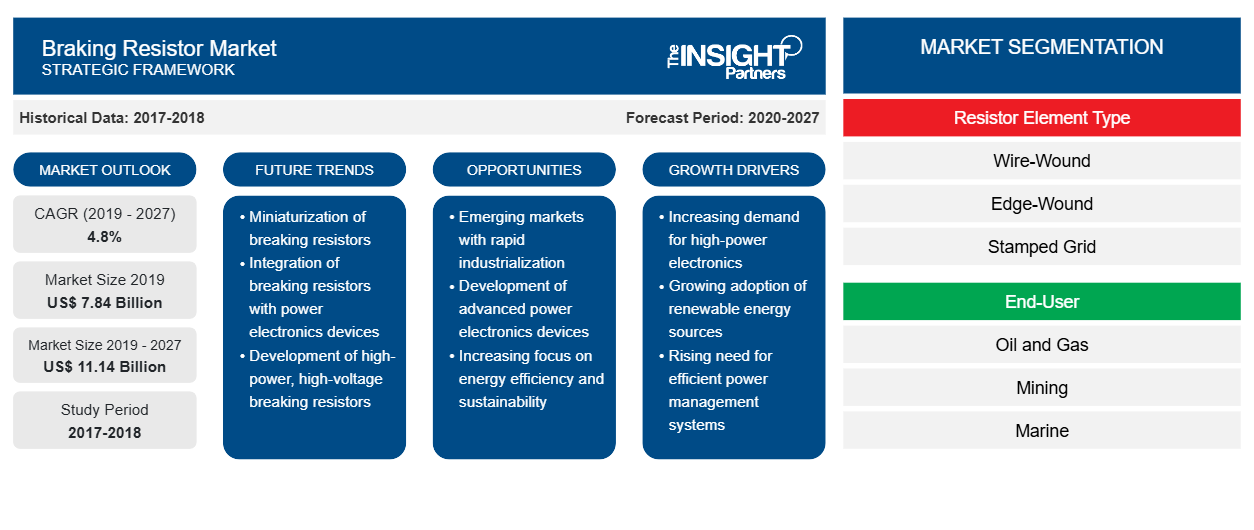
The global Braking Resistor Market was valued at US$ 7,838.1 Million in 2019 and is projected to reach US$ 11,141.9 Million by 2027, registering a CAGR of 4.8% during the forecast period 2020–2027.
Market growth is driven by rising industrial automation investments, increasing use of variable frequency drives (VFDs), expanding transportation infrastructure, and growing demand for energy-efficient motor control systems.
Key Market Insights
- Market Size (2019): US$ 7,838.1 Million
- Forecast Market Size (2027): US$ 11,141.9 Million
- CAGR (2020–2027): 4.8%
- Key Driver: Growing adoption of motor control and drive systems
- Major Trend: Increasing deployment in industrial automation applications
- Forecast Period: 2020–2027
Get a Sample PDF of the Report: https://www.theinsightpartners.com/sample/TIPRE00013134
Market Analysis
The Braking Resistor Market is experiencing steady growth as industries increasingly adopt automated machinery and motor-driven systems that require reliable braking solutions. Braking resistors help dissipate regenerative energy produced during motor deceleration, preventing damage to drive components and improving system performance.
Industrial automation remains one of the primary growth drivers. Manufacturing facilities are deploying advanced motor control systems, robotics, conveyors, and automated production lines that depend on braking resistors for safe and efficient operation.
The transportation sector also contributes significantly to market expansion. Railways, metro systems, elevators, escalators, and electric mobility solutions require braking resistors to manage excess energy generated during braking processes.
Material handling equipment such as cranes, hoists, and automated storage systems increasingly utilize braking resistors to ensure precise motion control and operational safety.
In addition, growing investments in renewable energy infrastructure and power conversion systems are creating new opportunities for braking resistor manufacturers.
Updated Market Trends
- Rising adoption of industrial automation technologies
- Increasing deployment of variable frequency drives
- Growth in electric mobility applications
- Expanding railway and metro infrastructure projects
- Rising demand for energy-efficient motor systems
- Increasing adoption of regenerative braking technologies
- Growth in material handling and logistics automation
- Development of high-performance resistor designs
- Expansion of smart manufacturing facilities
- Increasing use in renewable energy applications
Regional Analysis
Asia-Pacific
Asia-Pacific dominates the Braking Resistor Market due to rapid industrialization, expanding manufacturing activities, increasing infrastructure investments, and strong growth in automation technologies.
North America
North America remains a significant market supported by advanced industrial automation, transportation modernization initiatives, and increasing deployment of energy-efficient drive systems.
Europe
Europe continues to witness steady growth driven by industrial digitization, railway infrastructure upgrades, and expanding electric mobility adoption.
Rest of the World
Latin America, the Middle East, and Africa are gradually increasing investments in industrial automation, transportation infrastructure, and energy projects that require braking resistor solutions.
Get the Premium Research Report @ https://www.theinsightpartners.com/buy/TIPRE00013134
Key Players
- Vishay Intertechnology, Inc.
- TE Connectivity Ltd.
- ABB Ltd.
- Siemens AG
- Schneider Electric SE
- Rockwell Automation, Inc.
- Hubbell Incorporated
- Post Glover Resistors, Inc.
- Cressall Resistors Ltd.
- Bonitron, Inc.
Emerging Trends
One of the most significant trends shaping the market is the increasing adoption of regenerative braking systems that improve energy efficiency and require advanced resistor technologies for effective energy dissipation.
Another notable trend is the growing integration of braking resistors with intelligent motor control systems used in smart factories and automated industrial environments.
Future Outlook
The Braking Resistor Market is expected to maintain steady growth as industrial automation, transportation electrification, and advanced motor control applications continue expanding globally. Demand for reliable braking and energy management solutions will remain a key market driver.
Advancements in automation systems, electric mobility platforms, renewable energy integration, smart manufacturing technologies, and high-efficiency motor drives are anticipated to create significant opportunities throughout the forecast period.
Related Market Research Reports
Biometric Driver Identification System Market Size, Growth & Demand by 2034
Test and Measurement Equipment Market Trends, Demand & Growth by 2034
Intelligent Lighting Control Market Size, Growth & Demand by 2034
Digital Camcorders Market Growth, Size & Forecast by 2034
About The Partners
The Insight Partners is a Insight global leader in market research, delivering comprehensive analysis and actionable insights across diverse industries. The company empowers decision-makers with data-driven intelligence to navigate evolving markets and accelerate growth.
Contact Us:
- Contact Person: Ankit Mathur
- E-mail: ankit.mathur@theinsightpartners.com
- Phone: +1-646-491-9876
Also Available in :
