HVAC sensors are critical components used in heating, ventilation, and air conditioning systems to monitor and control parameters such as temperature, humidity, pressure, airflow, occupancy, and air quality. These sensors help optimize HVAC performance, improve indoor comfort, reduce energy consumption, and support building automation systems.
The increasing adoption of smart buildings and energy-efficient infrastructure is significantly driving demand for advanced HVAC sensor technologies worldwide.
Market Overview
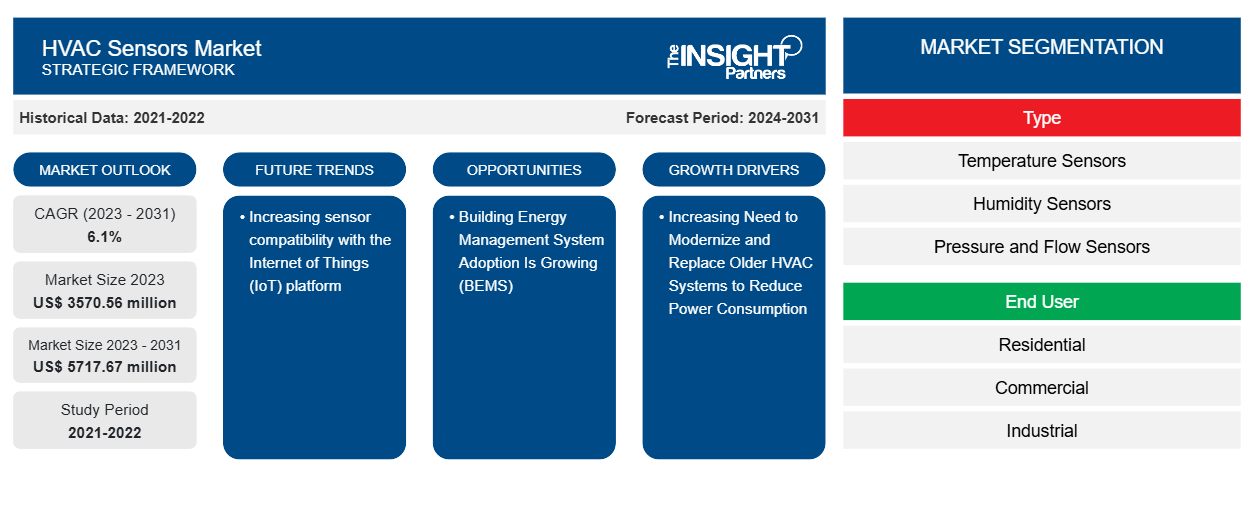
The global HVAC Sensors Market is projected to grow from US$ 3,570.56 Million in 2023 to US$ 5,717.67 Million by 2031, registering a CAGR of 6.1% during the forecast period 2023–2031.
Market growth is fueled by rising investments in building automation, growing focus on energy conservation, increasing demand for indoor air quality monitoring, and expanding smart city developments.
Key Market Insights
- Market Size (2023): US$ 3,570.56 Million
- Forecast Market Size (2031): US$ 5,717.67 Million
- CAGR (2023–2031): 6.1%
- Key Driver: Increasing demand for energy-efficient HVAC systems
- Major Trend: Integration of HVAC sensors with smart building platforms
- Forecast Period: 2023–2031
Get a Sample PDF of the Report: https://www.theinsightpartners.com/sample/TIPRE00011983
Market Analysis
The HVAC Sensors Market is experiencing steady growth as building owners and facility managers increasingly adopt intelligent climate control solutions. HVAC sensors play a crucial role in maintaining operational efficiency while reducing energy costs and environmental impact.
Commercial buildings represent a significant application area. Offices, shopping centers, hospitals, hotels, educational institutions, and industrial facilities are implementing advanced HVAC sensor systems to improve comfort levels and optimize energy usage.
Growing awareness of indoor air quality is further driving market expansion. Organizations are increasingly deploying air quality monitoring sensors to maintain healthier indoor environments and comply with evolving environmental standards.
The rise of smart buildings and connected infrastructure is creating additional opportunities. HVAC sensors are becoming integral components of building management systems that enable automated control and real-time monitoring.
In addition, government regulations promoting energy efficiency and sustainability are encouraging wider adoption of intelligent HVAC technologies.
Updated Market Trends
- Growing adoption of smart building technologies
- Rising demand for indoor air quality monitoring
- Increasing deployment of wireless HVAC sensors
- Expansion of building automation systems
- Integration with IoT-enabled platforms
- Growing focus on energy-efficient infrastructure
- Rising use of occupancy and motion sensors
- Adoption of predictive maintenance technologies
- Development of cloud-connected HVAC systems
- Increasing investments in smart city projects
Regional Analysis
North America
North America remains a leading market due to widespread adoption of smart building technologies, stringent energy efficiency regulations, and increasing investments in commercial infrastructure modernization.
Europe
Europe continues to experience strong growth driven by sustainability initiatives, green building standards, and growing demand for energy-efficient HVAC systems.
Asia-Pacific
Asia-Pacific is expected to witness significant growth due to rapid urbanization, expanding commercial construction activities, rising smart city developments, and increasing awareness of energy management solutions.
Rest of the World
Latin America, the Middle East, and Africa are gradually increasing adoption of HVAC sensor technologies as infrastructure development and energy efficiency initiatives continue to expand.
Get the Premium Research Report @ https://www.theinsightpartners.com/buy/TIPRE00011983
Key Players
- Honeywell International Inc.
- Johnson Controls International plc
- Schneider Electric SE
- Siemens AG
- Emerson Electric Co.
- Sensata Technologies Holding plc
- Bosch Sensortec GmbH
- TE Connectivity Ltd.
- Amphenol Corporation
- Belimo Holding AG
Emerging Trends
One of the most significant trends shaping the market is the integration of HVAC sensors with IoT and cloud-based building management platforms that enable real-time monitoring, predictive maintenance, and intelligent energy optimization.
Another notable trend is the increasing deployment of air quality sensors capable of monitoring carbon dioxide, particulate matter, humidity, and other environmental parameters to improve indoor health and comfort.
Future Outlook
The HVAC Sensors Market is expected to maintain steady growth as demand for smart buildings, sustainable infrastructure, and intelligent climate control systems continues to increase globally. Energy efficiency and occupant comfort will remain key market priorities.
Advancements in IoT connectivity, artificial intelligence, predictive analytics, wireless sensing technologies, and smart building automation are anticipated to create significant opportunities throughout the forecast period.
Related Market Research Reports
Acousto-Optic (AO) Modulator Market Trends, Share & Demand by 2034
Field Programmable Gate Array (FPGA) Market Share, Growth & Forecast by 2034
Satellite Modem Market Demand, Trends & Forecast by 2034
Optoelectronic Components Market Size, Share & Growth by 2034
About The Partners
The Insight Partners is a Insight global leader in market research, delivering comprehensive analysis and actionable insights across diverse industries. The company empowers decision-makers with data-driven intelligence to navigate evolving markets and accelerate growth.
Contact Us:
- Contact Person: Ankit Mathur
- E-mail: ankit.mathur@theinsightpartners.com
- Phone: +1-646-491-9876
Also Available in :
