Machine vision and vision guided robotics combine advanced imaging technologies, artificial intelligence, robotics, and real-time data processing to enable automated systems to perceive, analyze, and interact with their environments with remarkable precision. By integrating high-resolution cameras, smart sensors, image processing software, deep learning algorithms, and robotic manipulators, these solutions perform complex tasks such as quality inspection, object recognition, dimensional measurement, defect detection, robotic guidance, assembly verification, sorting, packaging, palletizing, and autonomous material handling. Industries including automotive, electronics, semiconductor manufacturing, pharmaceuticals, food and beverages, logistics, aerospace, healthcare, and consumer goods are increasingly deploying machine vision and vision guided robotic systems to improve production accuracy, enhance product quality, reduce labor dependency, and increase operational efficiency. As manufacturing facilities transition toward Industry 4.0 and digital transformation initiatives accelerate worldwide, intelligent robotic vision systems are becoming indispensable for creating highly automated, flexible, and data-driven production environments capable of supporting next-generation industrial operations.
Market Overview
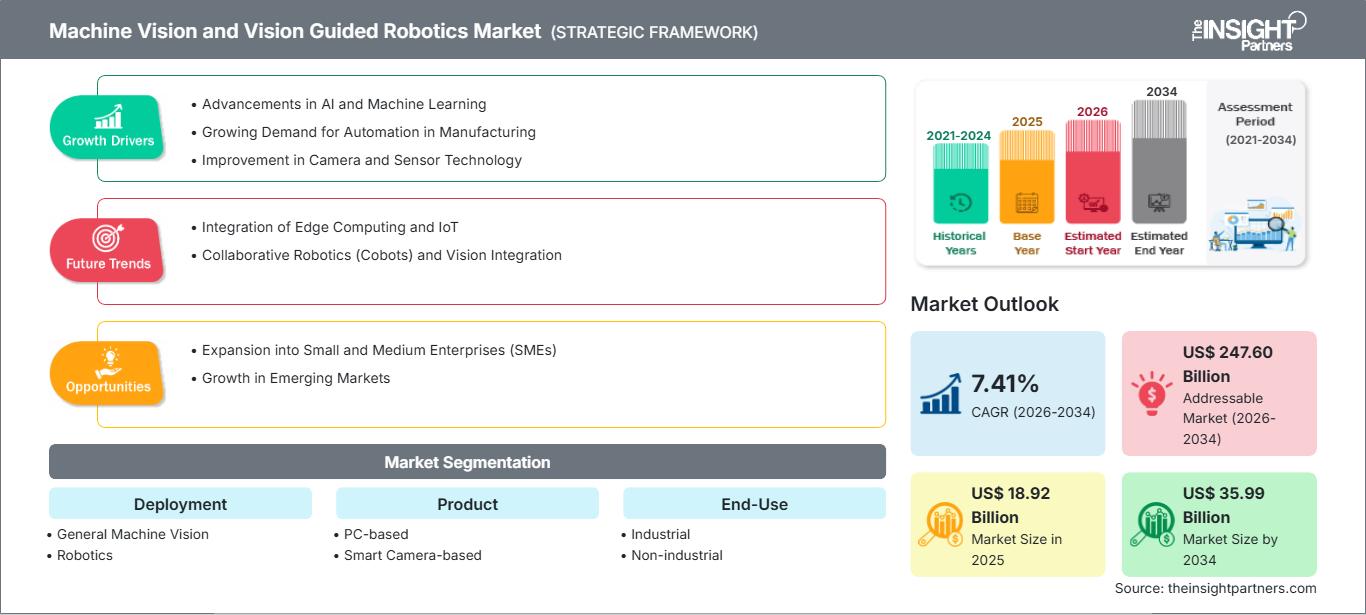
The Machine Vision and Vision Guided Robotics Market size is expected to reach US$ 35.99 billion by 2034 from US$ 18.92 billion in 2025. The market is estimated to record a CAGR of 7.41% during the forecast period 2026–2034. The market is expanding steadily due to growing industrial automation, increasing deployment of collaborative robots, rising demand for precision manufacturing, and continuous advancements in artificial intelligence and computer vision technologies. Manufacturers across various industries are investing in intelligent robotic systems capable of performing highly complex production tasks while maintaining exceptional accuracy and consistency. The integration of cloud computing, edge AI, 3D imaging, and digital twins is further enhancing the capabilities of machine vision systems, enabling manufacturers to optimize production processes, improve predictive maintenance, and achieve greater manufacturing flexibility in increasingly competitive industrial environments.
Key Market Insights
- Market Size (2025): US$ 18.92 billion
- Forecast Market Size (2034): US$ 35.99 billion
- CAGR (2026–2034): 7.41%
- Key Growth Driver: Rapid adoption of Industry 4.0 and intelligent factory automation
- Major Trend: AI-powered machine vision integrated with collaborative robotics
- Forecast Period:2026–2034
Get a Sample PDF of the Report: https://www.theinsightpartners.com/sample/TIPRE00039513
Market Drivers
Accelerating Industrial Automation Across Manufacturing
Manufacturers worldwide are investing heavily in intelligent automation technologies to improve production efficiency, reduce operational costs, and maintain consistent product quality. Machine vision systems equipped with advanced cameras and AI-powered image processing enable robotic systems to identify objects, inspect products, and perform precision assembly tasks with minimal human intervention. As production facilities continue adopting smart manufacturing practices, demand for vision guided robotic solutions is expected to increase significantly across automotive, electronics, pharmaceutical, and industrial manufacturing sectors. These technologies also support continuous production monitoring, allowing manufacturers to quickly identify defects and optimize production workflows.
Rising Adoption of Collaborative Robots
Collaborative robots, commonly known as cobots, are increasingly being integrated with machine vision technologies to perform tasks alongside human workers safely and efficiently. Vision guided robotic systems enable cobots to recognize objects, adapt to changing environments, and execute complex assembly and inspection operations with greater flexibility. Small and medium-sized enterprises are increasingly deploying collaborative robotic solutions because they require lower implementation costs while delivering substantial productivity improvements. The growing acceptance of collaborative automation is creating new opportunities for machine vision solution providers.
Growing Demand for Quality Inspection
Manufacturers across multiple industries are prioritizing automated inspection systems capable of detecting microscopic defects, dimensional inaccuracies, surface imperfections, and assembly errors with exceptional precision. Machine vision significantly improves product consistency while reducing inspection time and minimizing human error. High-speed vision systems enable real-time quality control throughout production lines, ensuring compliance with stringent manufacturing standards and customer expectations.
Expansion of E-commerce and Smart Logistics
The rapid growth of e-commerce has accelerated investments in intelligent warehouses and automated distribution centers where vision guided robots perform sorting, picking, packaging, inventory management, and autonomous material handling. Machine vision technologies improve warehouse efficiency by enabling robots to recognize products, navigate dynamic environments, and optimize logistics operations with minimal manual intervention.
Market Trends
Artificial Intelligence and Deep Learning Integration
Artificial intelligence is transforming machine vision by enabling systems to recognize complex patterns, identify defects, classify products, and continuously improve inspection accuracy through deep learning algorithms. AI-powered vision systems can adapt to new manufacturing scenarios without requiring extensive manual programming, significantly improving operational flexibility and reducing deployment time. These intelligent capabilities are becoming increasingly important in advanced manufacturing environments.
Adoption of 3D Vision Systems
Three-dimensional imaging technologies are enabling robots to perform more sophisticated tasks involving object localization, depth perception, robotic guidance, and precision assembly. Advanced 3D cameras provide highly detailed spatial information that allows robotic systems to operate accurately in complex production environments with varying object sizes and orientations. Industries requiring intricate assembly and inspection processes are increasingly adopting 3D machine vision solutions.
Edge Computing for Real-Time Processing
Manufacturers are integrating edge computing with machine vision systems to process image data directly at production sites rather than relying solely on cloud infrastructure. Edge-based image processing reduces latency, improves response times, enhances cybersecurity, and enables real-time decision-making for high-speed manufacturing operations. This trend is supporting greater autonomy in industrial automation systems.
Digital Twin and Smart Factory Integration
Machine vision systems are increasingly being integrated into digital twin platforms that create virtual representations of manufacturing processes. These digital models enable manufacturers to simulate production scenarios, optimize robotic workflows, predict equipment failures, and improve overall factory performance. The combination of digital twins and machine vision is strengthening the evolution of intelligent manufacturing ecosystems.
Get the Premium Research Report @ https://www.theinsightpartners.com/buy/TIPRE00039513
Regional Analysis
Asia-Pacific
Asia-Pacific dominates the market due to its extensive manufacturing base, rapid industrialization, expanding electronics production, and strong investments in industrial automation. Countries such as China, Japan, South Korea, and India continue increasing adoption of robotic automation across automotive, semiconductor, consumer electronics, and industrial manufacturing sectors. Government initiatives supporting smart manufacturing and advanced production technologies further strengthen regional market growth.
North America
North America continues to experience robust market expansion supported by early adoption of Industry 4.0 technologies, strong investments in robotics research, and increasing deployment of AI-powered manufacturing solutions. Automotive manufacturers, aerospace companies, logistics providers, and semiconductor producers are actively integrating machine vision systems to improve productivity and maintain competitive advantages in global markets.
Europe
Europe remains a major market due to its advanced manufacturing sector, strong automotive industry, and increasing emphasis on digital transformation. Manufacturers across Germany, France, Italy, and other European countries are investing heavily in intelligent robotics and automated inspection technologies to improve production quality while supporting sustainable manufacturing initiatives. Government support for industrial innovation continues driving regional market growth.
Middle East and Africa
The Middle East and Africa are gradually adopting machine vision and robotic automation technologies as industrial diversification, infrastructure development, and smart manufacturing initiatives continue expanding. Growing investments in logistics, food processing, pharmaceuticals, and industrial production facilities are creating new opportunities for intelligent automation solution providers throughout the region.
Competitive Landscape
The competitive landscape is characterized by continuous innovation in artificial intelligence, industrial imaging, robotic control systems, 3D vision technologies, and intelligent automation software. Leading companies are investing extensively in research and development to improve imaging accuracy, processing speed, software intelligence, and robotic flexibility. Strategic collaborations with industrial automation providers, robotics manufacturers, semiconductor companies, and cloud technology providers are accelerating product innovation and expanding global market presence. Mergers, acquisitions, and technology partnerships continue strengthening competitive positioning while enabling manufacturers to deliver integrated machine vision and robotic automation solutions for increasingly complex industrial applications.
Key Players
- Cognex Corporation
- Keyence Corporation
- Omron Corporation
- Basler AG
- Teledyne Technologies
- ABB
- FANUC
- KUKA
- Yaskawa Electric
- Rockwell Automation
Emerging Trends
Machine vision and vision guided robotics are evolving rapidly through the integration of generative AI, deep learning, autonomous robotics, and intelligent edge computing. Manufacturers are developing adaptive vision systems capable of learning from production data, automatically adjusting inspection parameters, and supporting autonomous robotic decision-making without extensive human programming. The growing convergence of machine vision, digital twins, cloud analytics, and predictive maintenance is enabling factories to achieve unprecedented levels of productivity, flexibility, and operational intelligence while reducing downtime and improving product quality.
Future Outlook
The future outlook for the Machine Vision and Vision Guided Robotics Market remains highly promising as industries continue accelerating investments in intelligent automation and digital manufacturing. Growing adoption of collaborative robots, expansion of smart factories, increasing demand for automated quality inspection, and rapid advancements in artificial intelligence will continue driving long-term market growth. Future innovations are expected to focus on autonomous robotic vision, AI-powered adaptive inspection, high-speed 3D imaging, edge intelligence, and seamless integration with industrial IoT platforms. These developments will further transform manufacturing operations while creating substantial opportunities for solution providers across global industrial sectors.
Related Market Research Reports
Portable Air Compressor Market Size, Demand & Growth by 2034
Water Softening Systems Market Trends, Demand & Growth by 2034
Hydraulic Equipment Market Size, Share & Trends by 2034
Wafer Cleaning Equipment Market Size, Share & Growth by 2034
About The Partners
The Insight Partners is a Insight global leader in market research, delivering comprehensive analysis and actionable insights across diverse industries. The company empowers decision-makers with data-driven intelligence to navigate evolving markets and accelerate growth.
Contact Us:
- Contact Person: Ankit Mathur
- E-mail: ankit.mathur@theinsightpartners.com
- Phone: +1-646-491-9876
Also Available in :
