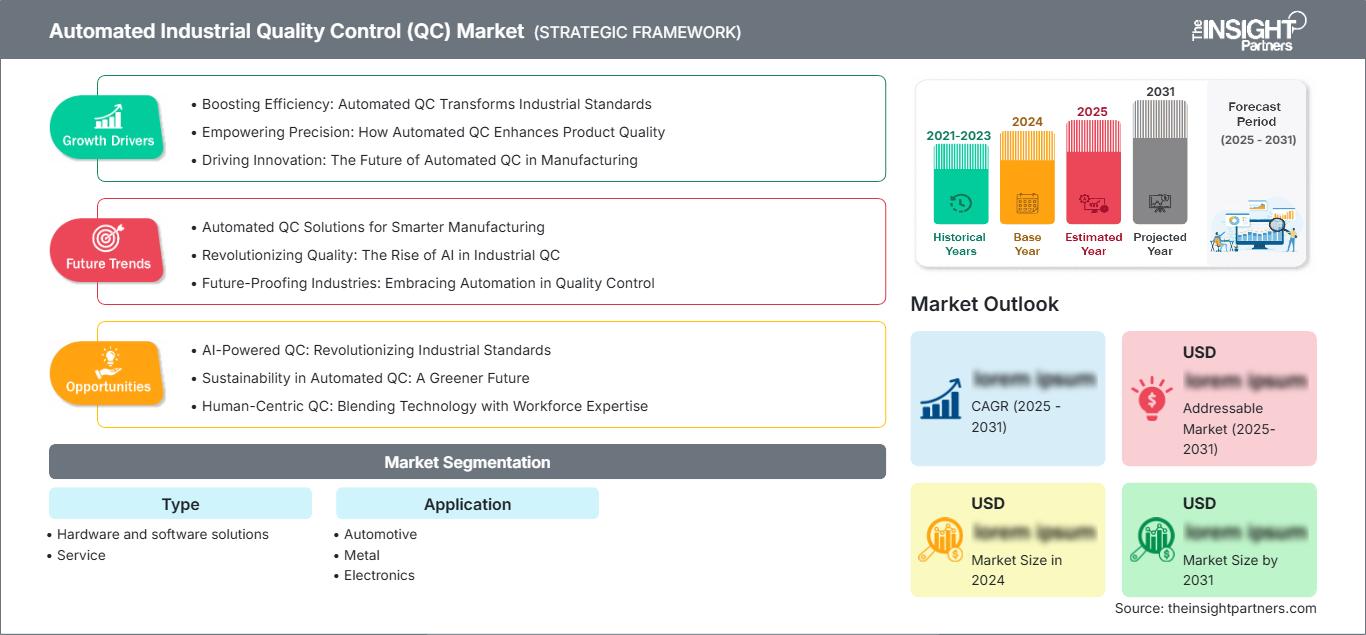
Automated industrial quality control (QC) has become a fundamental component of modern manufacturing by enabling manufacturers to maintain consistent product quality, improve production efficiency, reduce operational costs, and minimize defects throughout the manufacturing process. Automated QC systems utilize advanced machine vision, industrial cameras, artificial intelligence, robotics, laser inspection, three-dimensional imaging, sensors, and data analytics to inspect products in real time without interrupting production operations. These technologies are extensively deployed across automotive, electronics, semiconductor, pharmaceutical, food and beverage, aerospace, packaging, metal processing, medical devices, and consumer goods industries where precision, repeatability, and compliance with quality standards are essential. As manufacturers continue embracing Industry 4.0, digital factories, and intelligent production systems, automated quality control solutions are replacing manual inspection processes with highly accurate, high-speed inspection capabilities. Continuous advancements in artificial intelligence, edge computing, industrial Internet of Things platforms, and predictive analytics are further improving inspection accuracy, enabling manufacturers to identify defects earlier, optimize production processes, reduce material waste, and enhance customer satisfaction while supporting fully automated smart manufacturing environments.
Market Overview
The Automated Industrial Quality Control (QC) Market size is expected to reach US$ 2.2 billion by 2031. The market is anticipated to register a CAGR of 7.1% during the forecast period 2025–2031. Market growth is primarily driven by increasing industrial automation, growing demand for zero-defect manufacturing, rising adoption of artificial intelligence and machine vision technologies, and expanding implementation of smart manufacturing systems across multiple industries. Manufacturers are increasingly investing in automated quality inspection platforms to improve production efficiency, reduce labor dependency, ensure regulatory compliance, and maintain consistently high product quality. The rapid digital transformation of manufacturing operations continues creating significant opportunities for advanced automated quality control technologies worldwide.
Key Market Insights
- Forecast Market Size (2031): US$ 2.2 billion
- CAGR (2025–2031): 7.1%
- Key Growth Driver: Rising adoption of intelligent manufacturing and automated inspection technologies
- Major Trend: Artificial intelligence-powered machine vision quality control systems
- Forecast Period:2025–2031
Get a Sample PDF of the Report: https://www.theinsightpartners.com/sample/TIPRE00003699
Market Drivers
Growing Adoption of Smart Manufacturing
Manufacturers worldwide are rapidly adopting Industry 4.0 technologies to improve productivity, operational efficiency, and product quality. Automated quality control systems enable continuous inspection throughout production processes, reducing manual intervention while improving consistency and inspection accuracy. Integration with robotics, industrial automation platforms, manufacturing execution systems, and cloud analytics allows manufacturers to optimize production workflows and achieve higher operational efficiency. As smart factory adoption continues accelerating, demand for automated QC solutions is expected to grow steadily.
Increasing Demand for Zero-Defect Manufacturing
Global competition and increasing customer expectations are encouraging manufacturers to minimize production defects while improving overall product reliability. Automated inspection systems identify surface defects, dimensional variations, assembly errors, contamination, coating inconsistencies, and structural imperfections with significantly higher precision than manual inspection methods. Real-time defect detection enables immediate corrective actions, helping manufacturers reduce product recalls, warranty claims, production waste, and overall manufacturing costs while strengthening customer confidence.
Labor Shortages and Rising Manufacturing Costs
Manufacturing industries are experiencing increasing labor shortages and higher operational expenses, making automation an attractive long-term investment. Automated quality control systems perform repetitive inspection tasks continuously without fatigue, significantly improving productivity while reducing dependence on skilled inspection personnel. These systems enable manufacturers to maintain consistent production quality while lowering labor costs and increasing manufacturing efficiency.
Expansion of High-Precision Manufacturing
Industries including semiconductors, aerospace, electronics, automotive, pharmaceuticals, and medical devices require extremely high manufacturing precision where even microscopic defects can impact product performance. Automated inspection technologies equipped with artificial intelligence, high-resolution imaging, laser measurement, and advanced sensors provide the accuracy required for these highly regulated industries, driving continued adoption across precision manufacturing applications.
Market Trends
Artificial Intelligence and Deep Learning Integration
Artificial intelligence is revolutionizing automated quality control by enabling intelligent defect recognition, adaptive inspection, predictive quality analysis, and continuous learning capabilities. Deep learning algorithms can accurately classify complex defects, reduce false inspection results, and continuously improve inspection performance by analyzing large manufacturing datasets. AI-powered inspection systems are becoming central components of next-generation intelligent manufacturing environments.
Machine Vision Technology
Machine vision continues evolving through higher-resolution industrial cameras, advanced optics, three-dimensional imaging, hyperspectral imaging, and intelligent image processing software. These technologies enable rapid inspection of complex products while detecting defects that are difficult or impossible to identify through manual inspection. Machine vision systems significantly improve manufacturing consistency while increasing production throughput.
Industrial Internet of Things Connectivity
Automated quality control platforms increasingly integrate with Industrial Internet of Things networks, enabling real-time communication between inspection systems, manufacturing equipment, cloud platforms, and enterprise software. Connected inspection solutions provide continuous production visibility, remote diagnostics, predictive maintenance, and comprehensive quality reporting that support data-driven manufacturing decisions and continuous process improvement.
Edge Computing for Real-Time Inspection
Edge computing technologies enable inspection data to be processed directly at production facilities without relying solely on centralized cloud infrastructure. Real-time edge processing significantly reduces response times, supports immediate defect detection, and enables rapid corrective actions while maintaining continuous production operations. This trend is becoming increasingly important for high-speed manufacturing environments requiring instant inspection decisions.
Get the Premium Research Report @ https://www.theinsightpartners.com/buy/TIPRE00003699
Regional Analysis
Asia-Pacific
Asia-Pacific dominates the Automated Industrial Quality Control (QC) Market due to its extensive manufacturing ecosystem, strong electronics production, expanding automotive industry, and rapid adoption of industrial automation technologies. China, Japan, South Korea, India, and Southeast Asian countries continue investing heavily in smart manufacturing infrastructure, semiconductor fabrication, robotics, and artificial intelligence, creating significant opportunities for automated quality control solution providers.
North America
North America represents a major market supported by advanced manufacturing capabilities, early adoption of industrial automation, increasing investments in artificial intelligence, and growing implementation of Industry 4.0 initiatives. Automotive manufacturers, aerospace companies, semiconductor producers, pharmaceutical organizations, and electronics manufacturers continue investing in intelligent inspection technologies to improve quality, productivity, and regulatory compliance.
Europe
Europe continues experiencing steady market growth due to strong industrial automation capabilities, stringent product quality standards, expanding digital manufacturing initiatives, and increasing investments in sustainable manufacturing technologies. Countries including Germany, France, Italy, and the United Kingdom continue deploying intelligent quality control systems across automotive, industrial machinery, pharmaceutical, and precision manufacturing industries.
Middle East and Africa
The Middle East and Africa are gradually adopting automated industrial quality control technologies as governments promote industrial diversification, manufacturing expansion, and digital transformation initiatives. Investments in smart factories, food processing, pharmaceuticals, and industrial infrastructure are expected to create new growth opportunities for automated inspection system providers throughout the region.
Competitive Landscape
The Automated Industrial Quality Control (QC) Market is highly competitive as manufacturers continue investing in artificial intelligence, industrial automation, machine vision, robotics, and intelligent inspection software. Industry participants are focusing on improving inspection speed, image quality, software intelligence, system flexibility, and integration with broader manufacturing ecosystems. Strategic collaborations among automation providers, robotics manufacturers, software developers, semiconductor companies, and industrial camera suppliers are accelerating innovation while enabling companies to deliver increasingly advanced quality inspection solutions capable of supporting complex manufacturing environments.
Key Players
- Cognex Corporation
- Keyence Corporation
- Omron Corporation
- Basler AG
- Teledyne Technologies
- ISRA VISION
- Hexagon AB
- ZEISS Group
- SICK AG
- Mitsubishi Electric Corporation
Emerging Trends
The automated quality control industry continues evolving through advancements in generative artificial intelligence, deep learning, digital twins, collaborative robotics, hyperspectral imaging, and autonomous manufacturing systems. Manufacturers are developing intelligent inspection platforms capable of adapting automatically to new product designs, learning from historical production data, and predicting manufacturing defects before they occur. Increasing integration with cloud analytics, predictive maintenance platforms, enterprise manufacturing software, and industrial Internet of Things infrastructure is creating highly connected quality management ecosystems that support continuous production optimization and long-term operational excellence.
Future Outlook
The future outlook for the Automated Industrial Quality Control (QC) Market remains highly promising as global manufacturers continue investing in smart factories, artificial intelligence, robotics, and digital manufacturing technologies. Growing demand for zero-defect production, increasing labor automation, expanding semiconductor manufacturing, and rising adoption of intelligent inspection platforms will continue driving market growth throughout the forecast period. Future innovation is expected to focus on autonomous inspection systems, AI-powered predictive quality management, edge computing, cloud-native analytics, and fully integrated manufacturing ecosystems capable of delivering real-time quality intelligence across global production operations.
Related Market Research Reports
Conditional Access System Market by Size, Share & Trend 2031
Chiplets Market Size, Demand & Growth by 2034
Substation Automation Market Growth, Demand & Size by 2034
Silicon Photonics Market Growth, Size & Forecast by 2034
About The Partners
The Insight Partners is a Insight global leader in market research, delivering comprehensive analysis and actionable insights across diverse industries. The company empowers decision-makers with data-driven intelligence to navigate evolving markets and accelerate growth.
Contact Us:
- Contact Person: Ankit Mathur
- E-mail: ankit.mathur@theinsightpartners.com
- Phone: +1-646-491-9876
Also Available in :
