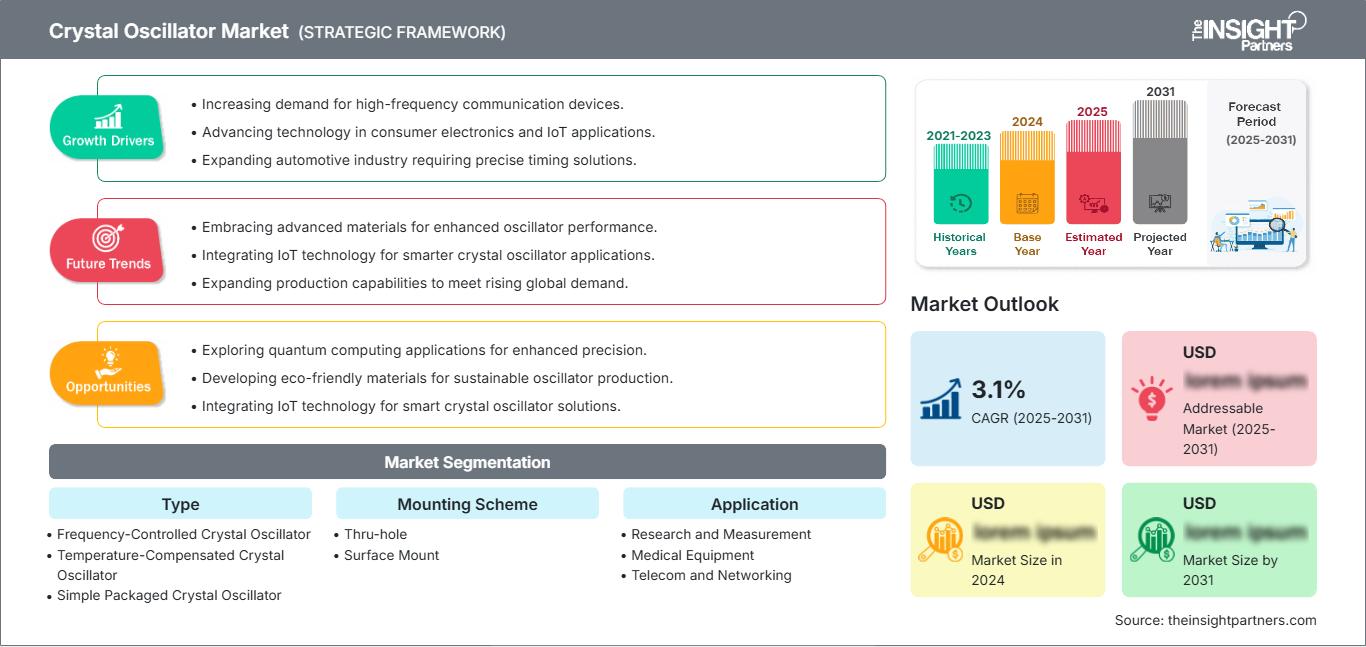
Crystal oscillators are among the most essential electronic timing components used to generate highly stable frequency signals for a wide range of electronic systems. By utilizing the piezoelectric properties of quartz crystals, these devices provide precise clock signals that synchronize the operation of integrated circuits, processors, communication modules, sensors, and embedded systems. Crystal oscillators are widely employed across consumer electronics, telecommunications, automotive electronics, industrial automation, aerospace, defense, healthcare devices, networking equipment, satellite communications, and data centers where accurate timing is critical for reliable system performance. As electronic devices continue becoming more compact, intelligent, and interconnected, the need for highly stable, low-power, and miniaturized timing solutions continues to increase. Continuous advancements in semiconductor technology, wireless communication, electric vehicles, Internet of Things devices, artificial intelligence infrastructure, and high-speed networking are further expanding the application scope of crystal oscillators, enabling manufacturers to develop compact products that deliver exceptional frequency stability, low phase noise, improved reliability, and long operational life under demanding environmental conditions.
Market Overview
The Crystal Oscillator Market is expected to register a CAGR of 4.43% from 2026 to 2034, with the market size expanding from US$ 3.03 billion in 2025 to US$ 4.48 billion by 2034. Market growth is supported by increasing demand for high-performance electronic devices, expanding deployment of 5G communication infrastructure, rising adoption of connected devices, growing automotive electronics production, and continuous expansion of industrial automation. Crystal oscillators remain indispensable components in modern digital systems due to their excellent frequency accuracy, energy efficiency, and long-term reliability. Increasing investments in next-generation communication technologies, smart consumer electronics, and advanced semiconductor manufacturing are expected to create sustained opportunities for crystal oscillator manufacturers throughout the forecast period.
Key Market Insights
- Market Size (2025): US$ 3.03 billion
- Forecast Market Size (2034): US$ 4.48 billion
- CAGR (2026–2034): 4.43%
- Key Growth Driver: Rising demand for precise timing components in advanced electronic systems
- Major Trend: Miniaturized crystal oscillators supporting 5G, IoT, and automotive electronics
- Forecast Period:2026–2034
Get a Sample PDF of the Report: https://www.theinsightpartners.com/sample/TIPRE00004641
Market Drivers
Expansion of Consumer Electronics
The global consumer electronics industry continues generating substantial demand for crystal oscillators as smartphones, tablets, laptops, wearable devices, gaming consoles, smart televisions, and smart home products require highly accurate timing signals for efficient operation. Modern electronic devices integrate multiple oscillators to support processors, wireless communication modules, display controllers, memory systems, and power management circuits. Continuous product innovation and growing consumer demand for advanced connected devices continue driving consistent market expansion.
Rapid Growth of 5G and Telecommunications Infrastructure
The deployment of 5G networks is significantly increasing demand for high-precision frequency control components capable of supporting ultra-fast wireless communication, low latency, and high network reliability. Crystal oscillators are extensively used in base stations, networking equipment, wireless routers, communication modules, optical transmission systems, and satellite communication infrastructure. As global telecommunications networks continue expanding, demand for advanced timing devices is expected to grow steadily.
Increasing Automotive Electronics Integration
Modern vehicles incorporate numerous electronic control units responsible for engine management, advanced driver assistance systems, infotainment, navigation, battery management, vehicle connectivity, and autonomous driving technologies. Crystal oscillators provide accurate timing synchronization for these electronic systems while ensuring reliable communication between multiple vehicle subsystems. The rapid growth of electric vehicles and software-defined automotive architectures continues creating strong demand for automotive-grade crystal oscillators.
Growth of Industrial Automation
Manufacturing industries increasingly rely on programmable logic controllers, robotics, industrial communication systems, machine vision, sensors, and automation platforms that require highly stable clock signals for synchronized operations. Crystal oscillators play a vital role in maintaining precise timing across automated manufacturing environments, supporting improved productivity, equipment reliability, and process accuracy as Industry 4.0 adoption continues accelerating worldwide.
Market Trends
Miniaturization of Electronic Components
Manufacturers are continuously developing smaller crystal oscillator packages without compromising frequency stability or performance. Miniaturized oscillators support compact electronic devices including wearable electronics, medical implants, smartphones, wireless sensors, and portable communication equipment. Advances in packaging technologies continue enabling greater integration while reducing overall system size and power consumption.
Temperature-Compensated and Oven-Controlled Oscillators
Demand for highly stable oscillators capable of maintaining frequency accuracy under varying environmental conditions continues increasing across aerospace, defense, industrial automation, and telecommunications applications. Temperature-compensated crystal oscillators and oven-controlled crystal oscillators provide exceptional performance under challenging operating environments, supporting mission-critical electronic systems that require precise timing reliability.
Internet of Things Expansion
The rapid proliferation of Internet of Things devices is creating new opportunities for low-power crystal oscillators optimized for battery-operated applications. Smart sensors, connected meters, industrial monitoring systems, healthcare wearables, asset tracking devices, and smart city infrastructure rely on compact timing components that deliver reliable performance while maximizing battery life. This trend continues expanding the addressable market for advanced oscillator technologies.
Advanced Semiconductor Manufacturing
Continuous innovation in semiconductor fabrication is improving oscillator performance through enhanced crystal processing, advanced packaging techniques, lower phase noise, reduced power consumption, and greater manufacturing precision. Semiconductor manufacturers continue investing in research and development to deliver timing components that support increasingly sophisticated electronic applications while maintaining high production efficiency.
Get the Premium Research Report @ https://www.theinsightpartners.com/buy/TIPRE00004641
Regional Analysis
Asia-Pacific
Asia-Pacific dominates the Crystal Oscillator Market due to its extensive semiconductor manufacturing capabilities, large-scale consumer electronics production, expanding automotive industry, and rapidly growing telecommunications infrastructure. China, Japan, South Korea, Taiwan, and India continue investing heavily in electronics manufacturing, 5G deployment, semiconductor fabrication, and industrial automation, creating substantial demand for crystal oscillator technologies across multiple industries.
North America
North America represents a significant market supported by strong demand for aerospace electronics, defense systems, telecommunications infrastructure, advanced computing, and data center technologies. Growing investments in artificial intelligence infrastructure, high-speed networking, autonomous vehicles, and semiconductor manufacturing continue driving adoption of high-performance crystal oscillators throughout the region.
Europe
Europe continues experiencing stable market growth due to expanding automotive electronics production, industrial automation, aerospace manufacturing, and telecommunications modernization. Countries including Germany, France, Italy, and the United Kingdom continue investing in advanced electronic technologies that require reliable and highly accurate timing components for mission-critical applications.
Middle East and Africa
The Middle East and Africa are gradually increasing adoption of crystal oscillator technologies as telecommunications infrastructure, industrial automation, renewable energy projects, and smart city initiatives continue expanding. Growing investments in digital transformation and connected infrastructure are expected to support long-term market growth across the region.
Competitive Landscape
The Crystal Oscillator Market remains highly competitive as manufacturers continue investing in miniaturization, advanced frequency stability, low-power operation, and high-reliability packaging technologies. Companies are focusing on expanding manufacturing capacity, improving product quality, and developing oscillators capable of meeting increasingly demanding requirements across telecommunications, automotive electronics, industrial automation, healthcare, and consumer electronics applications. Strategic collaborations with semiconductor manufacturers, automotive suppliers, networking equipment providers, and communication technology companies continue accelerating product innovation while strengthening competitive positioning within the global market.
Key Players
- Seiko Epson Corporation
- Nihon Dempa Kogyo Co., Ltd.
- TXC Corporation
- Kyocera Corporation
- Microchip Technology Inc.
- Murata Manufacturing Co., Ltd.
- Daishinku Corporation (KDS)
- Rakon Limited
- Abracon LLC
- SiTime Corporation
Emerging Trends
The crystal oscillator industry is evolving through the integration of MEMS timing technologies, artificial intelligence hardware, high-speed communication infrastructure, edge computing, and next-generation semiconductor platforms. Manufacturers are developing highly reliable oscillators with lower power consumption, improved frequency stability, and enhanced resistance to vibration and temperature variations. Increasing demand for autonomous vehicles, industrial Internet of Things, smart healthcare devices, satellite communications, and quantum computing infrastructure is expected to drive continuous innovation in precision timing technologies over the coming years.
Future Outlook
The future outlook for the Crystal Oscillator Market remains positive as digital transformation, connected devices, 5G deployment, industrial automation, and automotive electronics continue expanding globally. Growing investments in advanced semiconductor technologies, artificial intelligence infrastructure, aerospace systems, and high-speed communication networks will continue creating sustained demand for highly accurate timing components. Future developments are expected to focus on ultra-miniaturized oscillators, improved energy efficiency, enhanced environmental stability, and intelligent timing solutions capable of supporting increasingly complex electronic systems.
Related Market Research Reports
Network Access Control Market Demand, Trends & Forecast by 2034
Connected Ship Market Growth, Share & Trends by 2034
LED Driver Market Size, Share & Demand by 2034
Quantum Computing Market Size, Share & Demand by 2034
About The Partners
The Insight Partners is a Insight global leader in market research, delivering comprehensive analysis and actionable insights across diverse industries. The company empowers decision-makers with data-driven intelligence to navigate evolving markets and accelerate growth.
Contact Us:
- Contact Person: Ankit Mathur
- E-mail: ankit.mathur@theinsightpartners.com
- Phone: +1-646-491-9876
Also Available in :
