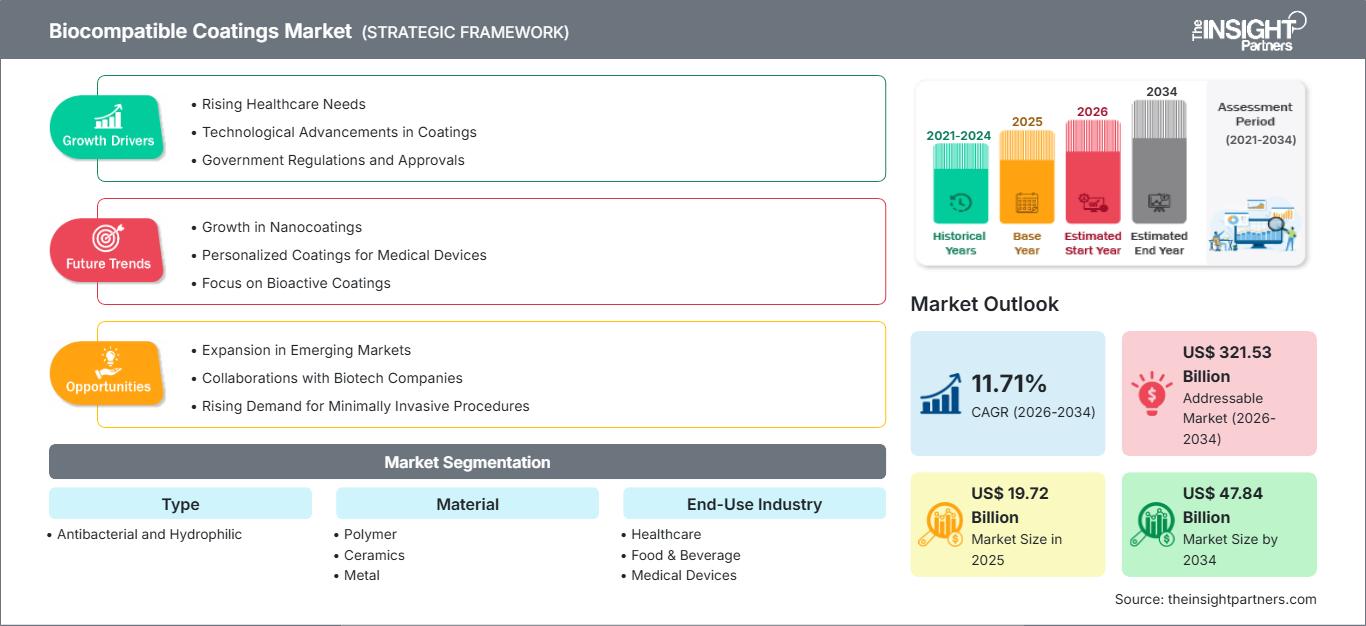
Medical devices are only as good as the surfaces they carry. A coating that the human body rejects can turn a life-saving device into a serious risk. The Biocompatible Coatings Market is valued at US$ 19.72 Billion in 2025 and is projected to reach US$ 47.84 Billion by 2034, growing at a strong CAGR of 11.71% from 2026 to 2034, as published by The Insight Partners.
Few material science markets are growing this fast. The combination of aging populations, rising surgical volumes, and tighter device safety standards is creating sustained, structural demand.
What Are Biocompatible Coatings?
Biocompatible coatings are surface treatments applied to materials that come into contact with the human body or food systems. They prevent harmful reactions, reduce infection risk, and improve device performance. Common types include antibacterial coatings that kill pathogens and hydrophilic coatings that reduce friction in medical devices.
What Is Driving This Market?
The medical device industry is the primary engine. Catheters, stents, implants, and surgical tools all need surfaces that the body will not attack. Without a proper biocompatible coating, these devices can trigger inflammation, clotting, or infection. Hospitals and device makers cannot afford those outcomes. So, demand for high-performance coatings is built into every device development cycle.
Request a Sample Copy of the Report: https://www.theinsightpartners.com/sample/TIPRE00040250
Rising rates of chronic disease are amplifying this further. More people are living with diabetes, heart disease, and joint disorders. Many of them need implanted devices or regular catheter use. As the global patient population grows, so does the volume of devices that require biocompatible surface treatment.
Regulatory agencies are also raising the bar. The US FDA and European Medicines Agency have tightened requirements for device surface safety. Manufacturers must demonstrate biocompatibility through rigorous testing before any product reaches a patient. This compliance pressure pushes device companies to invest more in proven coating technologies rather than cut corners.
Infection control is another critical driver. Hospital-acquired infections cost health systems billions every year. Antibacterial biocompatible coatings on catheters and implants can significantly reduce infection rates. Hospitals are actively seeking devices with these coatings. This creates a clear commercial incentive for manufacturers to adopt advanced coating solutions.
The food and beverage industry are a growing secondary market. Processing equipment that contacts food must meet strict hygiene standards. Biocompatible polymer and ceramic coatings help manufacturers meet these standards while extending equipment lifespan. As food safety regulations tighten globally, this segment is quietly becoming more significant.
Segmentation Overview
By Type:
Antibacterial coatings are in high demand for implants and catheters where infection risk is greatest. Hydrophilic coatings reduce surface friction and improve patient comfort, making them essential for guidewires, catheters, and endoscopes.
By Material:
Polymer coatings offer flexibility and are widely used across medical devices and food contact surfaces. Ceramic coatings provide hardness and chemical resistance, often used in implants and industrial applications. Metal-based coatings deliver durability and are applied where mechanical wear resistance matters most.
By End-Use Industry:
Healthcare leads consumption by a wide margin, driven by the sheer volume and diversity of medical devices. Medical devices form a distinct sub-segment where coating specifications are tightly controlled. Food and beverage applications are growing steadily as hygiene and safety requirements evolve.
Key Market Players
- SurModics, Inc.
- DSM Biomedical
- Hydromer Inc.
- Covalon Technologies Ltd.
- Hemoteq AG
- Applied Medical Coatings
- Aculon, Inc.
- Freudenberg Medical
- Biointeractions Limited
Buy Premium Report: https://www.theinsightpartners.com/buy/TIPRE00040250
Sustainability and Innovation Trends
Research into next-generation coatings is accelerating. Scientists are developing drug-eluting coatings that release therapeutic agents directly from the device surface. These coatings can prevent clot formation or deliver anti-inflammatory drugs exactly where needed. This blurs the line between a device and a drug delivery system, opening an entirely new category of high-value products.
Nanotechnology is also making inroads. Nano-scale coatings offer superior uniformity and can be engineered to respond to body conditions. Some coatings in development can switch between antibacterial and tissue-promoting modes depending on the healing stage. These are still emerging but represent the next frontier for the industry.
Sustainability is entering the conversation too. Manufacturers are exploring water-based and solvent-free coating processes that reduce environmental impact without compromising biocompatibility. Regulators in Europe are beginning to scrutinize the environmental footprint of medical manufacturing, adding another reason to innovate.
Regional Outlook
North America holds the largest market share. The United States is home to the world’s most advanced medical device industry. High surgical volumes, strong R&D investment, and rigorous FDA oversight all support sustained demand for biocompatible coatings across every device category.
Europe is a mature and innovation-driven market. Countries like Germany, France, and Switzerland have strong medical technology sectors. EU regulations on device safety and sustainability are pushing manufacturers toward advanced, compliant coating solutions faster than in many other regions.
Asia Pacific is the fastest-growing region. China, Japan, South Korea, and India are expanding their domestic medical device manufacturing rapidly. Rising healthcare spending, growing surgical volumes, and government support for local production are all accelerating coating demand across the region.
South and Central America represent a smaller but developing opportunity. Improving healthcare infrastructure and growing medical tourism in countries like Brazil and Mexico are gradually lifting demand for quality-coated medical devices.
Related Reports:
Anti-reflective Coatings Market
MRO Protective Coatings Market
About The Insight Partners
The Insight Partners is a leading global market research and consulting firm. It delivers actionable intelligence and strategic insights across a wide range of industries. The firm helps businesses understand market dynamics, competitive forces, and growth opportunities through rigorous data-driven research.
Contact Us
The Insight Partners
Phone: +1-646-491-9876
E-mail: sales@theinsightpartners.com
Also Available in: Korean | German | Japanese | French | Chinese | Italian | Spanish
