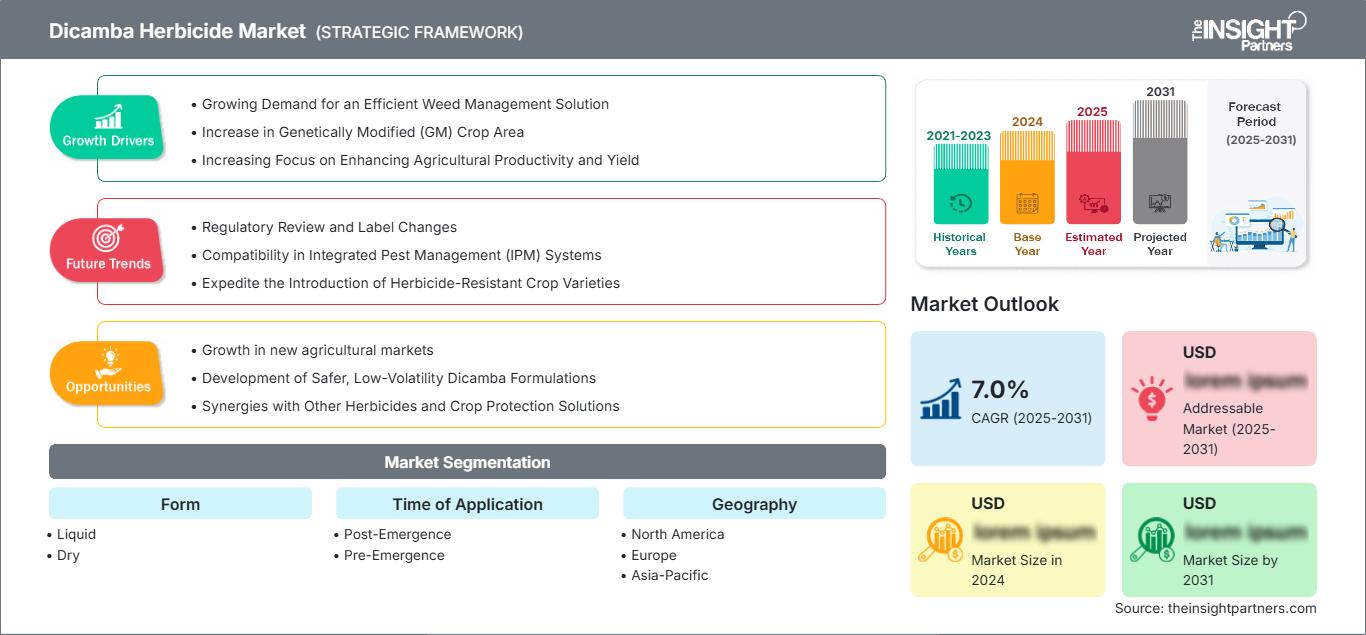
Weed resistance is one of the biggest headaches in modern farming. Farmers across the world are watching their fields get overrun by weeds that no longer respond to common herbicides. Dicamba has emerged as one of the most effective answers to this problem. Dicamba Herbicide Market size is expected to expand from US$ 676.30 million in 2025 to US$ 1,283.75 million by 2034. The market is set to grow at a CAGR of 7.38% during the forecast period 2026–2034. Rising adoption of herbicide-tolerant crops and growing pressure from resistant weed populations are the core forces shaping this market.
What Is Dicamba Herbicide?
Dicamba is a selective broadleaf herbicide belonging to the benzoic acid chemical family. It controls a wide range of difficult weeds in cereals, oilseeds, pastures, and forage crops. It is available in both liquid and dry forms and can be applied before or after crop emergence, depending on the weed pressure and crop type. Modern low-volatility formulations have improved its safety profile and expanded its use in genetically modified crop systems.
What Is Driving Demand for Dicamba Herbicides?
The spread of herbicide-resistant weeds is the single most powerful driver of dicamba demand. Weeds such as water hemp, Palmer amaranth, and kochia have developed resistance to glyphosate, which was the dominant herbicide for decades. Farmers now need alternative or complementary herbicide programmes. Dicamba fits this role well. It targets broadleaf weeds that glyphosate-resistant crop systems cannot control, making it an essential tool in integrated weed management.
Request a Sample Copy of the Report: https://www.theinsightpartners.com/sample/TIPRE00010371
The commercialisation of dicamba-tolerant soybean and cotton varieties has dramatically expanded the addressable market. Seed technology companies have developed crop varieties engineered to withstand dicamba applications during the growing season. This has allowed farmers to spray dicamba post-emergence without damaging their crops, opening up millions of acres to its use. Adoption of these dicamba-tolerant seed systems has grown rapidly across North America and is now spreading into South America.
Cereal and grain farming also drives significant demand. Wheat and barley crops are particularly susceptible to broadleaf weed infestations. Pre-emergence and post-emergence dicamba applications help farmers protect yield potential in these high-value crops. As global food security concerns push for higher cereal productivity, herbicide use in this segment is rising.
Formulation advances are also lifting the market. Early dicamba formulations were prone to volatilisation, causing unintended drift onto neighbouring crops. Newer salt-based and low-volatility acid formulations have significantly reduced this risk. Regulatory agencies in key markets have approved these next-generation formulations, restoring farmer confidence and enabling broader adoption.
Segmentation Overview
The dicamba herbicide market is segmented by physical form, time of application, crop type, and formulation.
By Physical Form:
- Liquid
- Dry
By Time of Application:
- Post-Emergence
- Pre-Emergence
By Crop Type:
- Cereals and Grains
- Oilseeds and Pulses
- Pastures and Forage Crops
By Formulation:
- Salt
- Acid
Key Market Players
- Albaugh, Inc.
- BASF SE
- Bayer Cropscience AG
- I. Dupont De Nemours and Company
- Helena Chemical Company
- Monsanto Company
- Nufarm Limited
- Syngenta AG
- The Andersons, Inc.
- The DOW Chemical Company
Buy Premium Report: https://www.theinsightpartners.com/buy/TIPRE00010371
Sustainability and Innovation Trends
The agricultural chemicals sector faces growing pressure to develop safer, more targeted herbicide solutions. In response, manufacturers are investing in precision application technologies that reduce the total volume of dicamba used per acre. Drone-based spraying systems and variable-rate application equipment are helping farmers apply herbicides more accurately, cutting input costs and minimising off-target effects.
Research is also focusing on combining dicamba with other modes of action in premix formulations. These stacked herbicide products offer broader weed control and help delay the development of dicamba resistance, which is a growing concern in some regions. Stewardship programmes promoted by leading agrochemical companies are educating farmers on correct application timing, buffer zones, and equipment calibration to protect neighbouring crops and maintain regulatory compliance.
Regional Outlook
North America dominates the global dicamba herbicide market. The United States is the largest market, driven by the widespread adoption of dicamba-tolerant soybean and cotton varieties across the Midwest and Southern states. Canada contributes steady demand, particularly in canola and cereal production regions.
South and Central America are the fastest-growing markets. Brazil and Argentina are rapidly expanding their soybean acreage, and dicamba-tolerant varieties are gaining regulatory approval and farmer acceptance in both countries. This regional expansion represents one of the largest near-term growth opportunities in the global market.
Europe shows moderate demand, concentrated in cereal-growing nations such as France, Germany, and the United Kingdom. Regulatory oversight in the EU is stringent, and approvals for new dicamba formulations can be slow. Asia Pacific is an emerging market, with growth driven by expanding agricultural output in India, Australia, and Southeast Asia.
Related Reports:
Agricultural Biologicals Market
About The Insight Partners
The Insight Partners is among the leading market research and consulting firms in the world. We take pride in delivering exclusive reports along with sophisticated strategic and tactical insights into the industry. Reports are generated through a combination of primary and secondary research, solely aimed at giving our clientele a knowledge-based insight into the market and domain. This is done to assist clients in making wiser business decisions. A holistic perspective in every study undertaken forms an integral part of our research methodology and makes the report unique and reliable.
Contact Us:
If you have any queries about this report or if you would like further information, please contact us:
Phone: +1-646-491-9876
E-mail: sales@theinsightpartners.com
Also Available in: Korean | German | Japanese | French | Chinese | Italian | Spanish
