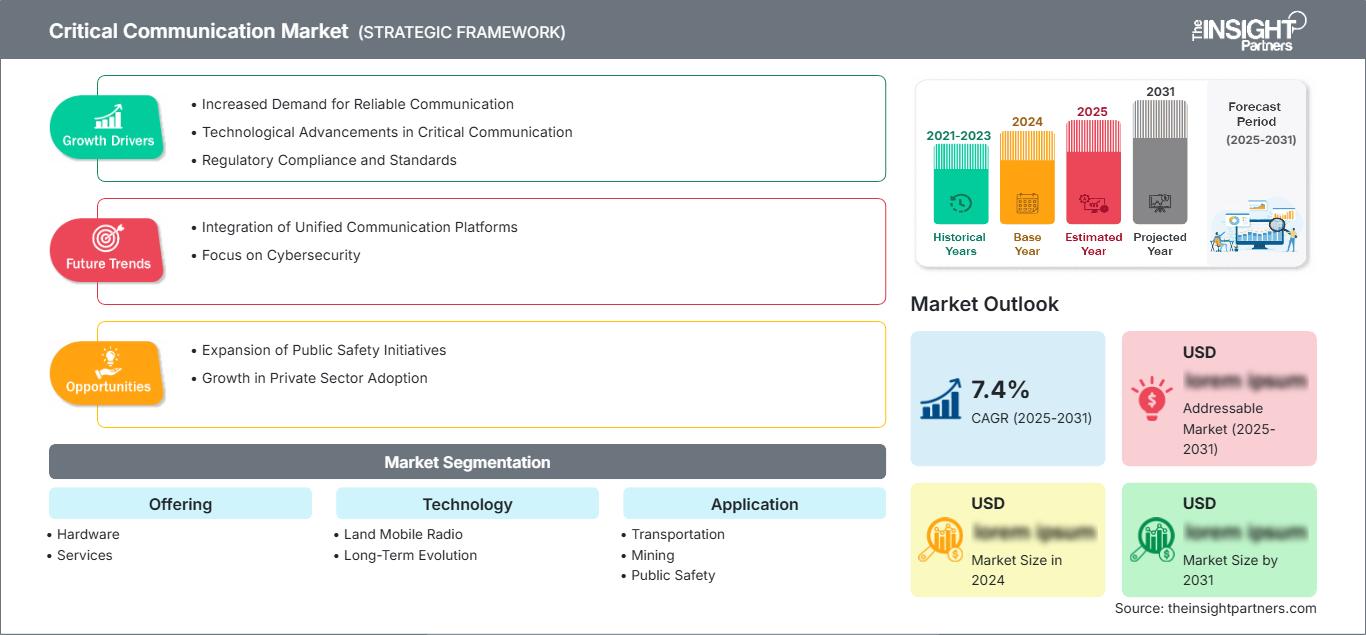
Critical communication systems serve as the backbone of mission-critical operations by enabling secure, reliable, and uninterrupted communication across emergency response organizations, defense agencies, transportation networks, public safety departments, utilities, industrial facilities, healthcare providers, and government institutions. These communication solutions are specifically designed to operate under demanding conditions where continuous connectivity is essential for protecting lives, securing infrastructure, coordinating emergency operations, and maintaining operational continuity. Modern critical communication networks integrate technologies such as land mobile radio systems, LTE and broadband communication, private 5G networks, satellite communication, dispatch consoles, command and control software, body-worn communication devices, and Internet of Things-enabled monitoring platforms. The increasing frequency of natural disasters, public safety emergencies, industrial incidents, cyber threats, and infrastructure modernization projects is accelerating the deployment of highly resilient communication systems worldwide. Continuous advancements in artificial intelligence, cloud computing, edge computing, mission-critical push-to-talk services, and next-generation wireless technologies are transforming critical communication by improving interoperability, network resilience, real-time situational awareness, and operational efficiency across multiple sectors.
Market Overview
The Critical Communication Market size is projected to reach US$ 48.29 billion by 2034 from US$ 27.63 billion in 2025. The market is anticipated to register a CAGR of 7.23% during the forecast period 2026–2034. Market expansion is driven by increasing investments in public safety infrastructure, modernization of emergency communication systems, deployment of private broadband networks, expansion of smart city projects, and growing adoption of mission-critical communication technologies across defense, transportation, healthcare, and industrial sectors. Governments worldwide continue strengthening national emergency preparedness while upgrading aging communication infrastructure to improve disaster response capabilities and operational resilience. Increasing demand for secure, high-speed, and interoperable communication platforms is expected to sustain long-term market growth throughout the forecast period.
Key Market Insights
- Market Size (2025): US$ 27.63 billion
- Forecast Market Size (2034): US$ 48.29 billion
- CAGR (2026–2034): 7.23%
- Key Growth Driver: Rising investments in mission-critical public safety communication infrastructure
- Major Trend: Private 5G and AI-enabled mission-critical communication networks
- Forecast Period:2026–2034
Get a Sample PDF of the Report: https://www.theinsightpartners.com/sample/TIPRE00006780
Market Drivers
Increasing Investments in Public Safety Infrastructure
Governments across developed and emerging economies continue investing heavily in public safety communication systems to strengthen emergency response capabilities, disaster management, homeland security, and law enforcement operations. Fire departments, police agencies, emergency medical services, disaster response organizations, and civil defense authorities require highly reliable communication networks capable of operating under extreme conditions. Modern mission-critical communication platforms improve coordination among multiple agencies while enabling faster emergency response, improved resource allocation, and enhanced public safety outcomes. Continuous modernization initiatives remain one of the strongest growth drivers for the market.
Expansion of Smart Cities
Smart city development initiatives are creating substantial demand for integrated communication platforms capable of supporting public safety, intelligent transportation, utility management, and emergency response operations. Critical communication systems enable seamless coordination between government agencies, first responders, transportation authorities, healthcare providers, and utility operators. Integration with surveillance systems, intelligent traffic management, environmental monitoring, and emergency notification platforms significantly enhances urban resilience and operational efficiency.
Growing Industrial Safety Requirements
Industrial sectors including oil and gas, mining, power generation, manufacturing, chemicals, and transportation increasingly deploy mission-critical communication solutions to protect workers, coordinate field operations, and improve emergency response. Reliable communication enables organizations to monitor hazardous environments, respond rapidly to operational incidents, and maintain business continuity during emergencies. Growing workplace safety regulations continue encouraging industries to invest in advanced communication infrastructure.
Modernization of Defense Communication Networks
Defense organizations worldwide continue upgrading military communication systems to improve battlefield connectivity, secure information sharing, command coordination, and situational awareness. Advanced communication technologies provide encrypted voice, video, and data transmission capabilities while supporting highly mobile military operations across diverse operational environments. Increasing defense modernization programs continue contributing significantly to market growth.
Market Trends
Private 5G Network Deployment
Private 5G networks are transforming mission-critical communication by delivering ultra-low latency, higher bandwidth, enhanced security, and reliable wireless connectivity. Public safety organizations, industrial enterprises, ports, airports, manufacturing facilities, and energy companies increasingly deploy private 5G infrastructure to support mission-critical applications requiring continuous, high-performance communication.
Artificial Intelligence Integration
Artificial intelligence is enhancing critical communication systems through intelligent dispatching, predictive incident analysis, automated resource allocation, voice recognition, language translation, and real-time decision support. AI-powered analytics improve emergency response efficiency while providing command centers with actionable operational intelligence that supports faster and more effective decision-making.
Mission-Critical Push-to-Talk Services
Mission-critical push-to-talk technology is rapidly evolving beyond traditional land mobile radio systems by utilizing broadband LTE and 5G networks. These solutions provide secure voice communication, multimedia messaging, location tracking, and group coordination capabilities while enabling interoperability across multiple agencies and communication platforms.
Cloud-Based Communication Platforms
Cloud computing enables centralized communication management, scalable infrastructure, remote administration, disaster recovery, and real-time collaboration across geographically distributed organizations. Cloud-native communication platforms improve operational flexibility while reducing infrastructure complexity and supporting rapid deployment of advanced communication services.
Get the Premium Research Report @ https://www.theinsightpartners.com/buy/TIPRE00006780
Regional Analysis
North America
North America remains a leading market due to substantial investments in homeland security, emergency response modernization, defense communication systems, and public safety infrastructure. Government agencies, transportation operators, utility companies, and industrial enterprises continue adopting advanced mission-critical communication technologies that improve operational resilience and emergency preparedness. Ongoing deployment of private broadband networks and first responder communication systems further supports regional growth.
Europe
Europe represents a significant market driven by smart city development, transportation modernization, public safety initiatives, and industrial digital transformation. Countries including Germany, France, the United Kingdom, Italy, and the Nordic nations continue investing in interoperable communication systems that strengthen emergency coordination, infrastructure protection, and disaster management capabilities.
Asia-Pacific
Asia-Pacific is expected to experience the fastest market growth due to expanding urbanization, increasing government investments in public safety, rapid industrialization, growing defense modernization programs, and large-scale smart city initiatives. China, India, Japan, South Korea, Australia, and Southeast Asian countries continue deploying advanced communication networks that support emergency services, transportation systems, industrial operations, and critical infrastructure protection.
Middle East and Africa
The Middle East and Africa continue strengthening communication infrastructure through investments in smart cities, oil and gas operations, transportation modernization, defense capabilities, and national security initiatives. Growing infrastructure development, public safety improvements, and industrial expansion are expected to generate increasing demand for reliable mission-critical communication systems throughout the region.
Competitive Landscape
The Critical Communication Market is characterized by continuous technological innovation, strategic partnerships, and increasing investments in secure communication platforms. Leading companies are focusing on expanding private broadband capabilities, integrating artificial intelligence, enhancing cybersecurity, improving interoperability, and developing next-generation mission-critical communication solutions. Strategic collaborations between communication equipment manufacturers, software developers, telecommunications providers, defense contractors, and government agencies are accelerating innovation while enabling organizations to deploy highly resilient communication ecosystems capable of supporting complex operational requirements.
Key Players
- Motorola Solutions Inc.
- Ericsson
- Nokia Corporation
- Hytera Communications Corporation Limited
- JVCKENWOOD Corporation
- L3Harris Technologies Inc.
- Airbus SE
- Leonardo S.p.A.
- Zetron Inc.
- Tait Communications
Emerging Trends
The critical communication industry continues evolving through artificial intelligence, edge computing, private 5G deployment, cloud-native communication platforms, satellite connectivity, and integrated command-and-control ecosystems. Organizations are increasingly deploying intelligent communication networks capable of supporting multimedia collaboration, predictive emergency management, autonomous incident response, and real-time operational intelligence. Integration with drones, wearable technologies, smart sensors, digital twins, and Internet of Things platforms is expected to further strengthen communication capabilities across public safety, industrial, and defense environments.
Future Outlook
The future outlook for the Critical Communication Market remains highly positive as governments and enterprises continue prioritizing resilient communication infrastructure, public safety modernization, and digital transformation. Increasing investments in smart cities, emergency preparedness, industrial automation, transportation infrastructure, and national security will continue creating substantial opportunities for market participants. Future innovations are expected to focus on artificial intelligence-driven communication management, autonomous emergency response coordination, advanced cybersecurity, satellite-enabled broadband connectivity, and highly interoperable mission-critical communication ecosystems.
Related Market Research Reports
Smart Retail Devices Market Strategic Insights by 2031
Synchronous Condenser Market Size and Growth Report by 2031
UV Lamp Market Demand, Trends & Forecast by 2034
Gesture Sensing Control Market Size, Share & Demand by 2034
About The Partners
The Insight Partners is a Insight global leader in market research, delivering comprehensive analysis and actionable insights across diverse industries. The company empowers decision-makers with data-driven intelligence to navigate evolving markets and accelerate growth.
Contact Us:
- Contact Person: Ankit Mathur
- E-mail: ankit.mathur@theinsightpartners.com
- Phone: +1-646-491-9876
Also Available in :
