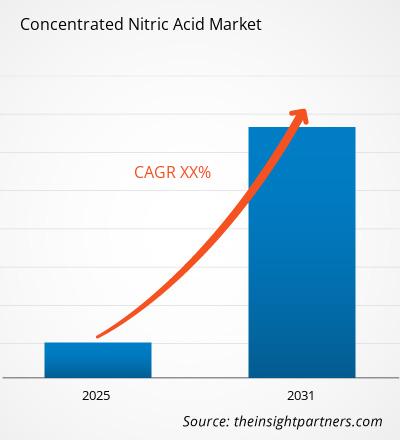
Fertilisers feed the world. Explosives build its roads and tunnels. Nylon makes its clothing. All three depend on a single industrial chemical that most people have never heard of. Concentrated nitric acid sits at the heart of global manufacturing, quietly enabling industries that keep modern economies running. Concentrated Nitric Acid Market is poised for steady growth over the forecast period 2026–2034, driven by rising demand from agrochemicals, explosives, automotive, and electronics end-use industries. The market is set to register a healthy CAGR during this period, supported by expanding industrial output across both developed and developing economies.
What Is Concentrated Nitric Acid?
Concentrated nitric acid is a highly corrosive strong mineral acid produced through the oxidation of ammonia via the Ostwald process. It is available in two primary forms: strong nitric acid, typically containing 65 to 68 percent nitric acid, and fuming nitric acid, which contains over 86 percent and is used in more demanding industrial and defence applications. Both forms serve as essential feedstocks for producing nitrogen-containing compounds used across agriculture, chemicals, and manufacturing.
What Is Driving Demand for Concentrated Nitric Acid?
Agrochemicals represent the largest application segment. Ammonium nitrate, produced by reacting nitric acid with ammonia, is one of the most widely used nitrogen fertilisers in the world. As global food production must scale up to meet rising population demand, fertiliser consumption is growing in tandem. Emerging agricultural markets in Asia, Africa, and Latin America are expanding their use of nitrogen-based fertilisers, directly lifting demand for concentrated nitric acid as a key upstream input.
Request a Sample Copy of the Report: https://www.theinsightpartners.com/sample/TIPRE00005483
The explosives industry is another major consumer. Mining operations worldwide use ammonium nitrate-based explosives to extract coal, iron ore, copper, and precious metals. As commodity demand from infrastructure development and electrification programmes grows, mining activity is intensifying. This creates consistent, large-volume demand for concentrated nitric acid used in explosive formulations. Construction of tunnels, highways, and hydroelectric projects in developing regions adds further impetus to this segment.
The automotive and chemicals industries drive demand through adipic acid and toluene diisocyanate production. Adipic acid, made using nitric acid, is a primary building block for nylon-6,6, widely used in automotive components, textiles, and engineering plastics. Toluene diisocyanate is essential for producing flexible polyurethane foams used in car seats and furniture. As vehicle production ramps up globally and lightweight material use in automotive design increases, demand for these nitric acid derivatives is rising steadily.
Electronics is a fast-growing end-use segment. Concentrated nitric acid is used in semiconductor fabrication for etching, cleaning, and surface treatment of silicon wafers and printed circuit boards. The global push to expand domestic semiconductor manufacturing capacity, particularly in the United States, Europe, South Korea, and Japan, is generating strong incremental demand for high-purity nitric acid grades suited to electronics applications.
Segmentation Overview
The concentrated nitric acid market is segmented by type, application, and end-use industry.
By Type:
- Strong Nitric Acid
- Fuming Nitric Acid
By Application:
- Ammonium Nitrate
- Adipic Acid
- Nitrobenzene
- Toluene Diisocyanate
- Others
By End-Use Industry:
- Agrochemicals
- Explosives
- Automotive
- Electronics
- Others
Key Market Players
- Agrium Inc.
- BASF Corporation
- Dupont De Nemours Inc.
- Hanwha Group
- Lsb Industries Inc.
- Oci Fertilizers and Chemicals
- Potash Corporation
- The Linde Group
- Ube Industries Ltd.
- Yara International Asa
Buy Premium Report: https://www.theinsightpartners.com/buy/TIPRE00005483
Sustainability and Innovation Trends
The production of nitric acid is a significant source of nitrous oxide emissions, a greenhouse gas with roughly 300 times the warming potential of carbon dioxide. Regulators in Europe and North America are pressuring producers to install abatement technologies that destroy nitrous oxide before it reaches the atmosphere. Secondary catalytic abatement systems are now standard in new European plants, and retrofit programmes are underway at older facilities. These investments are raising production costs but also creating a more sustainable supply base that meets tightening environmental standards.
Green ammonia, produced using renewable hydrogen, is gaining attention as a feedstock for nitric acid production. If the upstream ammonia supply chain decarbonises, the carbon footprint of nitric acid and its derivatives could fall substantially. Several major producers are partnering with green hydrogen developers to pilot low-carbon nitric acid production pathways, particularly in Europe where carbon pricing makes green chemistry investments more financially attractive.
Regional Outlook
Asia Pacific is the largest and fastest-growing market for concentrated nitric acid. China dominates production and consumption, supported by its vast fertiliser manufacturing base, growing explosives demand from mining, and expanding chemicals sector. India is a high-growth market, driven by agricultural intensification and rapid industrialisation. Southeast Asian nations are also emerging as significant consumers as their manufacturing sectors expand.
Europe holds a mature but technically advanced market position. Germany, France, and the Netherlands are major producers, with strong demand from automotive chemicals, electronics, and speciality chemicals sectors. Environmental regulations in the EU are shaping investment in abatement and process efficiency improvements. North America shows steady demand, anchored by agricultural fertiliser use and defence-related applications for fuming nitric acid. South and Central America are growing markets, supported by expanding mining activity in Chile, Peru, and Brazil.
Related Reports:
Ammonium Phosphate Facilitating Crop Nutrition Market
About The Insight Partners
The Insight Partners is among the leading market research and consulting firms in the world. We take pride in delivering exclusive reports along with sophisticated strategic and tactical insights into the industry. Reports are generated through a combination of primary and secondary research, solely aimed at giving our clientele a knowledge-based insight into the market and domain. This is done to assist clients in making wiser business decisions. A holistic perspective in every study undertaken forms an integral part of our research methodology and makes the report unique and reliable.
Contact Us:
If you have any queries about this report or if you would like further information, please contact us:
Phone: +1-646-491-9876
E-mail: sales@theinsightpartners.com
Also Available in: Korean | German | Japanese | French | Chinese | Italian | Spanish
