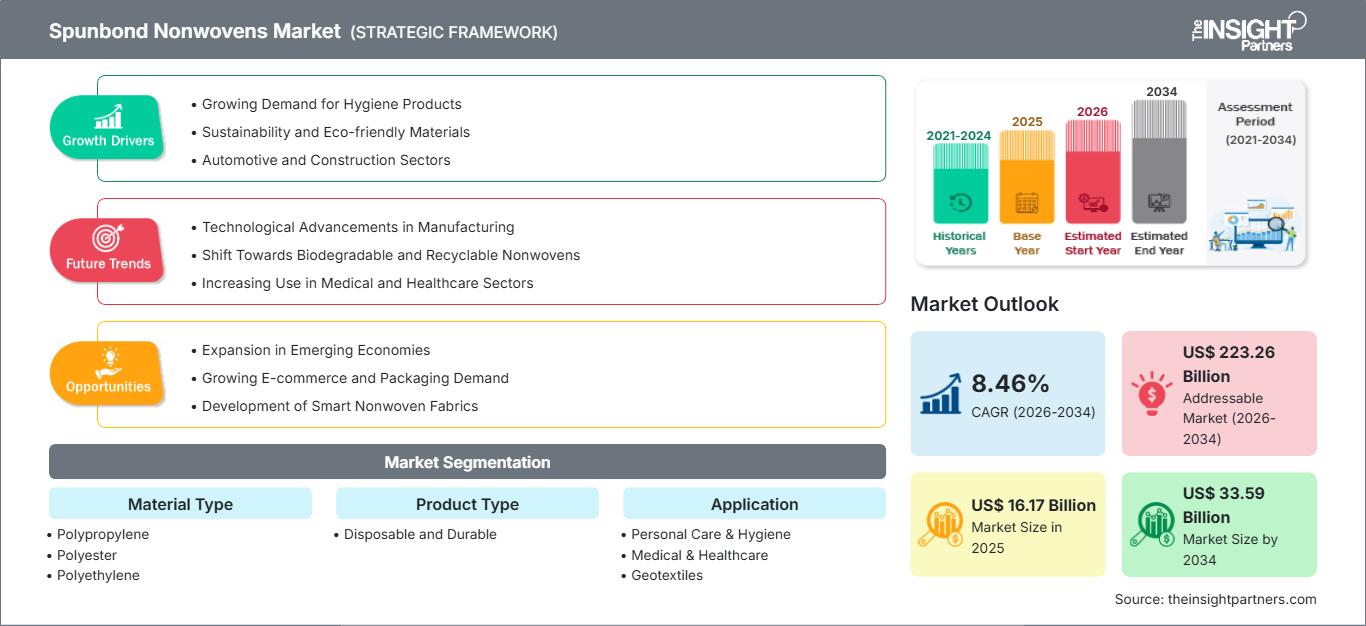
Every diaper, surgical gown, crop cover, and geotextile liner has something in common. They are all made from nonwoven fabrics, and spunbond technology produces the lion’s share of them. This manufacturing process bonds continuous filaments directly into a fabric without weaving or knitting, delivering strength, softness, and breathability at high production speeds and low cost. Spunbond Nonwovens Market size is projected to reach US$ 33.59 billion by 2034 from US$ 16.17 billion in 2025. The market is set to grow at a CAGR of 8.46% during the forecast period 2026–2034. Booming demand from personal care, healthcare, and civil engineering applications is powering this exceptional growth rate.
What Are Spunbond Nonwovens?
Spunbond nonwovens are engineered fabrics produced by extruding continuous polymer filaments, laying them onto a conveyor belt in a random or patterned web, and bonding them thermally or chemically to create a coherent fabric structure. Polypropylene is the dominant raw material, valued for its low cost, chemical resistance, and ease of processing. Polyester and polyethylene variants offer different performance profiles suited to durable outdoor and medical applications. The resulting fabrics are lightweight, uniform, and can be engineered to specific barrier, filtration, or strength requirements.
What Is Driving the Spunbond Nonwovens Market?
Personal care and hygiene is the largest and most dynamic application segment. Baby diapers, adult incontinence products, and feminine hygiene items all rely on spunbond nonwovens for their topsheet and backsheet layers. Population ageing in developed economies is a structural driver of adult incontinence product demand. Rising birth rates and improving living standards in emerging markets are expanding the baby diaper segment across Asia, Africa, and Latin America. As disposable income grows in these regions, consumers shift from cloth to disposable hygiene products, creating massive new demand for spunbond nonwoven fabrics.
Request a Sample Copy of the Report: https://www.theinsightpartners.com/sample/TIPRE00040334
Healthcare is a fast-accelerating segment. Surgical gowns, drapes, face masks, sterilisation wraps, and wound care products all require nonwoven materials that are breathable, fluid-resistant, and cost-effective enough for single-use disposal. The global health sector learned hard lessons about personal protective equipment supply chain fragility during recent public health emergencies. Investment in domestic nonwoven and PPE manufacturing capacity has surged in North America, Europe, and Asia in response, creating sustained long-term demand for spunbond production capacity.
Geotextiles represent a major growth opportunity driven by infrastructure investment. Spunbond nonwoven geotextiles are used in road construction, railway bed separation, erosion control, landfill lining, and drainage systems. They prevent soil mixing between layers, improve load distribution, and extend infrastructure service life at a fraction of the cost of conventional alternatives. As governments worldwide accelerate infrastructure spending to support economic development and climate resilience, geotextile consumption is rising sharply. Large-scale projects in India, Southeast Asia, and Africa are generating particularly strong demand for polypropylene spunbond geotextiles.
Agriculture is an emerging application. Crop protection covers made from lightweight spunbond nonwovens shield plants from frost, insects, and UV radiation while allowing light and air to pass through. As precision agriculture expands and farmers seek cost-effective ways to extend growing seasons and reduce pesticide use, agricultural nonwoven consumption is growing rapidly across Europe, China, and the Americas.
Segmentation Overview
The spunbond nonwovens market is segmented by material type, product type, and application.
By Material Type:
- Polypropylene
- Polyester
- Polyethylene
By Product Type:
- Disposable
- Durable
By Application:
- Personal Care and Hygiene
- Medical and Healthcare
- Geotextiles
Key Market Players
- PFNonwovens Group
- DuPont de Nemours and Company
- DuPont
- Freudenberg Group
- Berry Global Group, Inc
- Mitsui Chemicals
- Kimberly-Clark Corporation
- Pegas Nonwovens S.A.
- Avgol Ltd.
- Asahi Kasei Corporation
Buy Premium Report: https://www.theinsightpartners.com/buy/TIPRE00040334
Sustainability and Innovation Trends
Sustainability is the most pressing challenge facing the spunbond nonwovens industry. Single-use polypropylene products face growing regulatory pressure, particularly in Europe where disposable plastic regulations are tightening rapidly. Manufacturers are responding by developing bio-based polypropylene and polylactic acid spunbond fabrics that offer comparable performance with a lower environmental footprint. Recyclable mono-material nonwoven constructions are also gaining traction among hygiene product brands seeking to meet extended producer responsibility obligations.
On the innovation front, bicomponent spunbond technologies are enabling new fabric architectures that combine different polymer properties in a single fibre cross-section. Sheath-core and side-by-side bicomponent fibre configurations allow manufacturers to engineer precisely tailored softness, bonding, and barrier characteristics in a single production step. Nanofibre integration into spunbond structures is opening new filtration and medical application opportunities, delivering superior particulate capture efficiency in face masks and air filtration media.
Regional Outlook
Asia Pacific dominates the global spunbond nonwovens market. China is the world’s largest producer and consumer, backed by its enormous hygiene products manufacturing industry, expanding healthcare sector, and massive infrastructure investment programme. India is the fastest-growing market in the region, driven by rising hygiene product penetration, healthcare infrastructure development under national health programmes, and extensive road and railway construction activity. Southeast Asian nations including Vietnam, Indonesia, and Thailand are expanding nonwoven production capacity to serve both domestic and export markets.
Europe holds a significant and technically advanced market position. Germany, France, and Italy lead in durable geotextile and medical nonwoven applications, supported by stringent quality standards and strong public infrastructure spending. North America shows robust growth, led by healthcare, hygiene, and construction geotextile demand in the United States. The Inflation Reduction Act and Bipartisan Infrastructure Law are both generating construction activity that directly lifts geotextile consumption. South and Central America present growing opportunities, with Brazil and Mexico leading through expanding hygiene product consumption and infrastructure development.
Related Reports:
About The Insight Partners
The Insight Partners is among the leading market research and consulting firms in the world. We take pride in delivering exclusive reports along with sophisticated strategic and tactical insights into the industry. Reports are generated through a combination of primary and secondary research, solely aimed at giving our clientele a knowledge-based insight into the market and domain. This is done to assist clients in making wiser business decisions. A holistic perspective in every study undertaken forms an integral part of our research methodology and makes the report unique and reliable.
Contact Us:
If you have any queries about this report or if you would like further information, please contact us:
Phone: +1-646-491-9876
E-mail: sales@theinsightpartners.com
Also Available in: Korean | German | Japanese | French | Chinese | Italian | Spanish
