Solar silicon wafers form the foundation of photovoltaic solar cells and are among the most critical components in solar panel manufacturing. Produced from high-purity crystalline silicon ingots, these wafers serve as the substrate for converting sunlight into electrical energy with high efficiency and long-term durability. Solar silicon wafers are widely utilized across residential rooftop systems, commercial buildings, utility-scale solar farms, industrial facilities, floating solar projects, and distributed renewable energy installations. As countries continue accelerating their transition toward clean energy, the demand for advanced silicon wafers has grown significantly due to their direct impact on solar module performance, energy conversion efficiency, and production costs. Continuous innovations in wafer thinning technologies, larger wafer formats, monocrystalline manufacturing processes, diamond wire cutting, and high-efficiency photovoltaic cell architectures are enabling manufacturers to improve power output while reducing material consumption and production expenses. Increasing investments in renewable energy infrastructure, government decarbonization initiatives, and global commitments to achieving carbon neutrality continue driving widespread adoption of solar silicon wafers across the renewable energy industry.
Market Overview
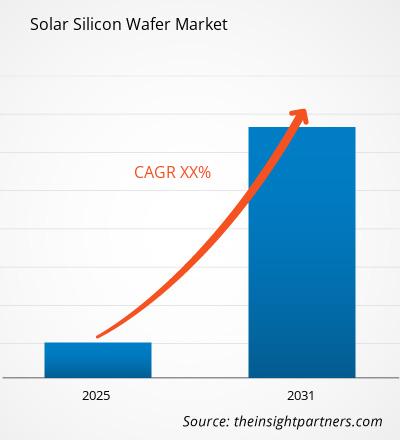
The Solar Silicon Wafer Market size is expected to reach US$ 26.6 billion by 2034 from US$ 14.74 billion in 2025. The market is estimated to record a CAGR of 6.78% during the forecast period 2026–2034. Market growth is driven by rising deployment of solar photovoltaic systems, increasing investments in clean energy infrastructure, supportive government policies promoting renewable electricity generation, and continuous technological advancements in photovoltaic manufacturing. Growing electricity demand, declining solar installation costs, expanding utility-scale renewable projects, and increasing corporate sustainability commitments continue strengthening demand for high-quality solar silicon wafers capable of supporting efficient and reliable energy production.
Key Market Insights
- Market Size (2025): US$ 14.74 billion
- Forecast Market Size (2034): US$ 26.6 billion
- CAGR (2026–2034): 6.78%
- Key Growth Driver: Rapid expansion of global solar photovoltaic installations
- Major Trend: High-efficiency monocrystalline silicon wafers with larger wafer formats
- Forecast Period:2026–2034
Get a Sample PDF of the Report: https://www.theinsightpartners.com/sample/TIPRE00020284
Market Drivers
Growing Global Renewable Energy Deployment
Governments worldwide are accelerating investments in renewable energy to reduce greenhouse gas emissions, strengthen energy security, and achieve climate objectives. Solar photovoltaic systems continue representing one of the fastest-growing renewable energy technologies, significantly increasing demand for high-performance silicon wafers. Utility-scale solar farms, residential rooftop installations, commercial solar projects, and distributed generation systems continue driving large-scale wafer production worldwide.
Supportive Government Policies
Numerous countries have introduced financial incentives, tax benefits, renewable portfolio standards, feed-in tariffs, and clean energy subsidies to encourage solar energy adoption. These supportive policy frameworks continue stimulating investments across the photovoltaic value chain, creating sustained demand for solar silicon wafers as manufacturers expand production capacity to meet growing installation requirements.
Technological Advancements in Photovoltaic Manufacturing
Manufacturers continue developing thinner wafers, larger wafer dimensions, advanced crystal growth techniques, and precision cutting technologies that improve energy conversion efficiency while reducing manufacturing costs. Innovations supporting TOPCon, heterojunction, passivated emitter rear contact, and other next-generation photovoltaic technologies are increasing demand for premium-quality silicon wafers with superior electrical performance.
Corporate Sustainability Initiatives
Businesses across multiple industries are increasingly investing in renewable energy to reduce operational emissions and achieve environmental sustainability targets. Large-scale commercial solar installations supporting manufacturing facilities, logistics centers, office buildings, and industrial operations continue expanding demand for high-efficiency photovoltaic modules manufactured using advanced silicon wafers.
Market Trends
Shift Toward Monocrystalline Silicon Wafers
Monocrystalline silicon wafers continue gaining market share due to their superior energy conversion efficiency, longer operational lifespan, improved performance under varying environmental conditions, and compatibility with advanced photovoltaic technologies. Manufacturers are increasingly prioritizing monocrystalline production to meet growing demand for high-performance solar modules.
Larger Wafer Formats
The industry is rapidly transitioning toward larger wafer sizes that improve module power output while reducing manufacturing complexity and installation costs. Larger wafers enable greater electricity generation per panel, improving project economics for residential, commercial, and utility-scale solar installations.
Advanced Manufacturing Automation
Solar wafer manufacturers are adopting artificial intelligence, robotics, digital quality inspection, predictive maintenance, and automated production technologies to improve manufacturing precision, reduce material waste, and increase production efficiency. Smart manufacturing supports consistent product quality while enhancing competitiveness across global markets.
Sustainable Production Practices
Manufacturers are increasingly implementing environmentally responsible production methods that reduce energy consumption, recycle silicon materials, optimize water utilization, and lower greenhouse gas emissions throughout the wafer manufacturing process. Sustainable production practices are becoming important competitive advantages as environmental standards continue evolving.
Get the Premium Research Report @ https://www.theinsightpartners.com/buy/TIPRE00020284
Regional Analysis
Asia-Pacific
Asia-Pacific dominates the Solar Silicon Wafer Market owing to its extensive photovoltaic manufacturing capacity, strong government support for renewable energy, expanding solar installations, and integrated semiconductor supply chains. China remains the largest producer of solar silicon wafers globally, while Japan, South Korea, India, and Southeast Asian countries continue investing heavily in photovoltaic manufacturing and renewable energy infrastructure.
Europe
Europe continues experiencing robust market growth driven by ambitious climate goals, renewable energy expansion, supportive policy frameworks, and increasing investments in domestic photovoltaic manufacturing. Germany, Spain, France, Italy, and the Netherlands continue deploying large-scale solar projects while strengthening regional renewable energy supply chains.
North America
North America represents a significant market due to growing utility-scale solar development, increasing residential solar adoption, expanding domestic manufacturing initiatives, and government incentives promoting clean energy investments. Continued modernization of electrical infrastructure and growing corporate renewable energy procurement continue supporting market expansion.
Middle East and Africa
The Middle East and Africa are witnessing increasing adoption of solar energy owing to abundant solar resources, large-scale renewable energy projects, rising electricity demand, and government diversification strategies. Investments in utility-scale solar farms and sustainable infrastructure continue creating long-term opportunities for solar silicon wafer manufacturers.
Competitive Landscape
The Solar Silicon Wafer Market remains highly competitive as manufacturers continue focusing on production efficiency, crystal growth technologies, wafer quality, cost optimization, and advanced photovoltaic compatibility. Companies are investing heavily in manufacturing expansion, automation, research and development, and strategic partnerships across the solar value chain to improve competitiveness while supporting increasing global demand for renewable energy technologies.
Key Players
- LONGi Green Energy Technology Co., Ltd.
- TCL Zhonghuan Renewable Energy Technology Co., Ltd.
- GCL Technology Holdings Limited
- JA Solar Technology Co., Ltd.
- JinkoSolar Holding Co., Ltd.
- Trina Solar Co., Ltd.
- Canadian Solar Inc.
- Wacker Chemie AG
- OCI Holdings Company Ltd.
- Tongwei Co., Ltd.
Emerging Trends
The solar silicon wafer industry continues evolving through artificial intelligence-driven manufacturing, ultra-thin wafer technologies, advanced photovoltaic cell architectures, digital quality inspection, and sustainable production methods. Manufacturers are developing wafers optimized for TOPCon, heterojunction, back-contact, and tandem solar cell technologies capable of delivering significantly higher energy conversion efficiencies. Increasing investments in green hydrogen production, energy storage integration, smart grids, and utility-scale renewable infrastructure are expected to create additional opportunities for advanced silicon wafer technologies.
Future Outlook
The future outlook for the Solar Silicon Wafer Market remains highly promising as governments, utilities, corporations, and consumers continue investing in renewable energy solutions. Increasing global electricity demand, declining photovoltaic manufacturing costs, supportive clean energy policies, and continuous advancements in solar cell technologies will continue driving market expansion. Future innovations are expected to focus on higher-efficiency wafer materials, automated manufacturing processes, sustainable production techniques, and next-generation photovoltaic architectures that improve energy output while reducing production costs.
Related Market Research Reports
SONAR System Market Growth, Trends & Demand by 2034
Air Conditioning Systems Market Growth, Size & Forecast by 2034
Automated Industrial Quality Control (QC) Market Growth & Size 2031
Crystal Oscillator Market Size, Demand & Growth by 2034
About The Partners
The Insight Partners is a Insight global leader in market research, delivering comprehensive analysis and actionable insights across diverse industries. The company empowers decision-makers with data-driven intelligence to navigate evolving markets and accelerate growth.
Contact Us:
- Contact Person: Ankit Mathur
- E-mail: ankit.mathur@theinsightpartners.com
- Phone: +1-646-491-9876
Also Available in :
