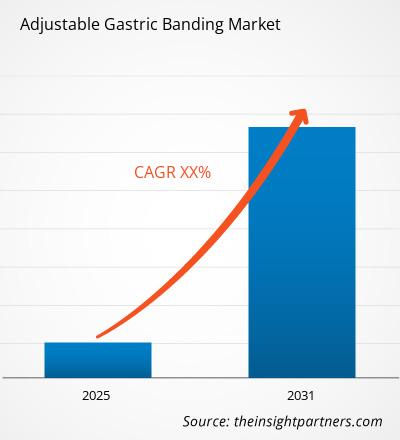
According to The Insight Partners, the global Adjustable Gastric Banding Market is projected to grow from US$ 1.32 billion in 2025 to US$ 2.32 billion by 2034, registering a CAGR of 6.52% during the forecast period (2026–2034). The market is witnessing consistent growth due to the increasing global burden of obesity, rising preference for minimally invasive bariatric surgeries, and continuous advancements in surgical devices. Growing awareness regarding obesity-related health risks, coupled with favorable healthcare policies in developed economies, is encouraging more patients to opt for surgical weight-loss interventions.
Adjustable gastric banding is a minimally invasive bariatric procedure that involves placing an adjustable silicone band around the upper portion of the stomach to restrict food intake and promote gradual weight loss. Compared to more invasive bariatric procedures, gastric banding offers advantages such as adjustability, reversibility, and shorter recovery periods. These benefits continue to attract patients seeking safer surgical options for obesity management.
Get a Sample PDF – https://www.theinsightpartners.com/sample/TIPRE00017632
The increasing incidence of obesity has become one of the primary growth drivers for the market. According to global healthcare organizations, obesity has emerged as a major public health challenge, significantly increasing the risk of diabetes, cardiovascular diseases, hypertension, sleep apnea, and several other chronic disorders. As healthcare systems increasingly focus on preventive care and long-term disease management, bariatric procedures are gaining greater acceptance among both physicians and patients.
Technological innovation is further transforming the adjustable gastric banding market. Manufacturers are introducing advanced gastric band systems featuring improved adjustability, enhanced patient comfort, and better long-term clinical outcomes. The integration of digital monitoring systems, minimally invasive surgical tools, and robotic-assisted procedures is improving surgical precision while reducing complications and recovery times.
Growing awareness campaigns conducted by healthcare organizations, obesity associations, and government agencies are also supporting market expansion. Educational initiatives emphasizing the benefits of surgical weight-loss procedures, combined with improved patient counseling, are encouraging eligible patients to consider adjustable gastric banding as a viable treatment option. Increasing acceptance of bariatric surgery among younger adults and aging populations is expected to create sustained market demand.
Healthcare infrastructure improvements across emerging economies are opening new opportunities for market participants. Countries across Asia-Pacific, Latin America, and the Middle East are investing heavily in modern hospitals, specialized bariatric centers, and advanced surgical technologies. Rising disposable incomes, expanding medical insurance coverage, and increasing healthcare expenditure are enabling more patients to access obesity treatment procedures.
Medical tourism has become another important contributor to market growth. Several countries have established themselves as preferred destinations for affordable bariatric surgeries performed by experienced surgeons using internationally recognized medical standards. Lower treatment costs combined with high-quality healthcare services continue to attract international patients seeking cost-effective weight-loss procedures.
Despite positive growth prospects, the market faces certain challenges. Alternative bariatric procedures such as sleeve gastrectomy and gastric bypass have gained popularity due to their higher long-term weight-loss outcomes in selected patient populations. Additionally, the need for long-term follow-up care, lifestyle modifications, dietary compliance, and periodic band adjustments may discourage some patients from choosing gastric banding procedures.
Potential complications including band slippage, erosion, infection, pouch dilation, and device-related revisions also require careful patient selection and postoperative management. However, continuous improvements in device design, surgeon training, and patient monitoring are helping reduce complication rates while improving long-term treatment success.
Hospitals remain the largest end users of adjustable gastric banding devices owing to the availability of experienced bariatric surgeons, advanced operating facilities, and comprehensive postoperative care. Specialized bariatric clinics are also witnessing growing patient volumes due to personalized treatment programs, multidisciplinary care teams, and increasing patient preference for specialized obesity management services.
The competitive landscape is characterized by continuous research and development activities, strategic collaborations, product innovation, mergers, acquisitions, and geographic expansion. Leading manufacturers are focusing on developing next-generation adjustable gastric banding systems that offer improved safety, enhanced patient comfort, and optimized clinical performance. Investments in robotic-assisted surgery, minimally invasive technologies, and digital patient management platforms are expected to further strengthen market competitiveness over the coming years.
Regulatory support and favorable reimbursement policies across several developed countries continue to encourage market growth. As governments recognize obesity as a significant public health concern, greater emphasis is being placed on expanding access to bariatric treatment options. Increased healthcare funding, improved insurance coverage, and stronger clinical guidelines are expected to create a supportive environment for adjustable gastric banding procedures throughout the forecast period.
The market is also benefiting from increasing collaboration between healthcare providers, medical device companies, and academic research institutions. These partnerships are accelerating clinical research, improving surgical techniques, and supporting the development of innovative obesity treatment solutions that deliver better long-term patient outcomes.
Key Players
- Aspire Bariatrics
- Olympus Corporation of the Americas
- Apollo Endosurgery
- Ethicon
- SpatzFgia
- Intuitive Surgical
- Mediflex Surgical Product
- ReShape Lifesciences
- GI Dynamics, Inc.
- TransEnterix, Inc.
Future Outlook
The adjustable gastric banding market is expected to maintain steady growth through 2034, supported by the increasing prevalence of obesity and rising demand for minimally invasive bariatric procedures. Continuous technological advancements, expanding healthcare infrastructure, and greater awareness of surgical weight-loss options will further accelerate market adoption. Emerging economies are expected to provide significant growth opportunities as healthcare accessibility improves. Strategic innovation, patient-centered care, and ongoing clinical advancements will remain key factors shaping the future of the global adjustable gastric banding market.
Get Premium Research Report Market Size and Report at:
https://www.theinsightpartners.com/buy/TIPRE00017632
About Us
The Insight Partners is a one stop industry research provider of actionable intelligence. We help our clients in getting solutions to their research requirements through our syndicated and consulting research services. We specialize in industries such as Semiconductor and Electronics, Aerospace and Defense, Automotive and Transportation, Biotechnology, Healthcare IT, Manufacturing and Construction, Medical Device, Technology, Media and Telecommunications, Chemicals and Materials.
Contact Us
Ankit Mathur | The Insight Partners
E-mail: ankit.mathur@theinsightpartners.com
Phone: +1-646-491-9876
Also Available in : Korean | German | Japanese | French | Chinese | Italian | Spanish
