Digital power conversion has become a fundamental technology for modern electronic systems by enabling efficient, intelligent, and highly precise control of electrical power across diverse industrial and commercial applications. Unlike conventional analog power management systems, digital power conversion utilizes programmable digital controllers, advanced microprocessors, digital signal processors, and software-driven algorithms to regulate voltage, current, frequency, and power delivery with exceptional accuracy and flexibility. Digital power conversion technologies are extensively deployed across data centers, telecommunications infrastructure, renewable energy systems, electric vehicles, industrial automation, medical equipment, aerospace, consumer electronics, smart grids, and energy storage systems. Continuous advancements in semiconductor technologies, wide-bandgap materials, artificial intelligence, and digital control architectures are significantly improving power efficiency, system reliability, thermal management, and operational intelligence. As industries continue pursuing energy optimization and digital transformation, digital power conversion solutions are becoming increasingly critical for supporting high-performance electrical systems.
Market Overview
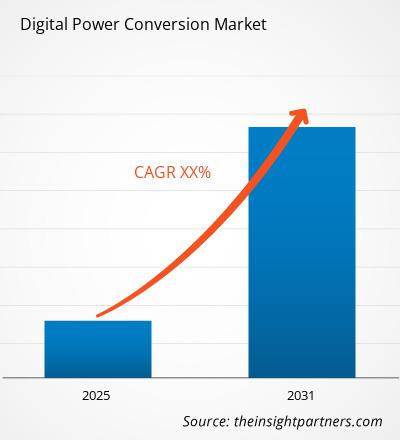
The Digital Power Conversion Market size is expected to reach US$ 27.45 billion by 2034 from US$ 9.59 billion in 2025. The market is estimated to record a CAGR of 12.39% during the forecast period 2026–2034. Market growth is driven by increasing demand for energy-efficient power management, expanding deployment of renewable energy systems, rapid adoption of electric vehicles, growing investments in smart grids, and continuous innovation in digital power electronics. Organizations are increasingly implementing intelligent power conversion technologies to improve operational efficiency, reduce energy losses, and support advanced energy management strategies.
Key Market Insights
- Market Size (2025): US$ 9.59 billion
- Forecast Market Size (2034): US$ 27.45 billion
- CAGR (2026–2034): 12.39%
- Key Growth Driver: Rising demand for intelligent and energy-efficient power management systems
- Major Trend: Artificial intelligence-enabled digital power conversion integrated with smart energy infrastructure
- Forecast Period:2026–2034
Get a Sample PDF of the Report: https://www.theinsightpartners.com/sample/TIPRE00010106
Market Drivers
Expansion of Renewable Energy Infrastructure
The increasing deployment of solar power plants, wind farms, battery energy storage systems, and distributed energy resources is significantly driving demand for advanced digital power conversion technologies. Intelligent power converters maximize energy efficiency, improve grid synchronization, optimize power quality, and enhance overall system reliability within renewable energy installations.
Growth of Electric Vehicles
Electric vehicle manufacturers rely heavily on digital power conversion technologies for battery charging, onboard power management, motor control, and energy optimization. As global electric vehicle adoption accelerates, demand for high-efficiency digital power conversion systems continues expanding across both vehicle platforms and charging infrastructure.
Increasing Data Center Investments
Modern data centers require highly efficient power conversion systems capable of minimizing energy losses while maintaining reliable power delivery to critical computing infrastructure. Digital power converters provide precise voltage regulation, intelligent monitoring, predictive diagnostics, and optimized energy utilization, helping operators reduce operating costs and improve system performance.
Industrial Automation and Smart Manufacturing
Manufacturing facilities increasingly utilize digital power conversion systems to support automated production equipment, robotics, industrial drives, and process control systems. Intelligent power management improves equipment efficiency, reduces downtime, and enables real-time monitoring of electrical performance across industrial operations.
Market Trends
Artificial Intelligence Integration
Artificial intelligence is increasingly enhancing digital power conversion systems by enabling predictive maintenance, adaptive power optimization, intelligent fault detection, and automated energy management. AI-driven algorithms continuously optimize converter performance while improving efficiency under varying operating conditions.
Wide-Bandgap Semiconductor Adoption
The growing use of silicon carbide and gallium nitride semiconductor technologies is significantly improving digital power conversion performance. These advanced materials enable higher switching frequencies, reduced power losses, improved thermal efficiency, and more compact power conversion systems.
Smart Grid Integration
Digital power conversion technologies are becoming integral components of modern smart grids by supporting bidirectional power flow, distributed energy resource management, grid stability, and intelligent load balancing. Advanced digital control enables utilities to improve network reliability while accommodating increasing renewable energy penetration.
Cloud-Based Energy Monitoring
Manufacturers are integrating digital power converters with cloud platforms and Industrial Internet of Things technologies to enable remote monitoring, predictive maintenance, real-time analytics, and centralized energy management. Connected power systems improve operational visibility while supporting data-driven decision-making.
Get the Premium Research Report @ https://www.theinsightpartners.com/buy/TIPRE00010106
Regional Analysis
North America
North America remains a leading market due to strong investments in renewable energy, electric vehicles, advanced manufacturing, cloud computing, and smart grid modernization. Continuous technological innovation and government support for clean energy initiatives continue driving adoption of intelligent power conversion technologies across the region.
Europe
Europe continues experiencing significant market growth supported by ambitious energy transition programs, increasing electric vehicle adoption, expanding renewable energy generation, and industrial digitalization. Germany, France, Italy, the United Kingdom, and Nordic countries continue investing heavily in advanced power electronics and intelligent energy infrastructure.
Asia-Pacific
Asia-Pacific is expected to register the fastest market growth owing to rapid industrialization, expanding electronics manufacturing, increasing renewable energy investments, growing electric vehicle production, and large-scale smart grid development. China, Japan, South Korea, India, and Southeast Asian countries continue strengthening digital power infrastructure through significant investments in advanced power electronics.
Middle East and Africa
The Middle East and Africa are witnessing increasing adoption of digital power conversion technologies across renewable energy projects, industrial facilities, utilities, telecommunications infrastructure, and smart city developments. Expanding investments in energy diversification and digital infrastructure continue creating substantial growth opportunities throughout the region.
Competitive Landscape
The Digital Power Conversion Market remains highly competitive as semiconductor manufacturers, power electronics companies, and industrial technology providers continue investing in digital controllers, artificial intelligence, wide-bandgap semiconductors, energy management software, and intelligent power architectures. Companies are focusing on improving conversion efficiency, system reliability, thermal performance, and digital connectivity while expanding strategic partnerships with renewable energy developers, automotive manufacturers, industrial automation providers, and utility companies.
Key Players
- Infineon Technologies AG
- Texas Instruments Incorporated
- Analog Devices, Inc.
- STMicroelectronics N.V.
- Renesas Electronics Corporation
- NXP Semiconductors N.V.
- ON Semiconductor Corporation
- Microchip Technology Inc.
- Vicor Corporation
- Delta Electronics, Inc.
Emerging Trends
The digital power conversion industry continues advancing through artificial intelligence, edge computing, cloud-based energy management, silicon carbide and gallium nitride semiconductors, Industrial Internet of Things integration, and autonomous energy optimization. Manufacturers are developing next-generation power conversion platforms capable of predictive diagnostics, adaptive control, intelligent fault management, and seamless integration with renewable energy systems, electric mobility, industrial automation, and digital infrastructure. Increasing investments in sustainable energy, electrification, and smart power management are expected to generate significant opportunities throughout the forecast period.
Future Outlook
The future outlook for the Digital Power Conversion Market remains highly promising as industries continue transitioning toward intelligent energy management and digital electrification. Growing investments in renewable energy, electric transportation, advanced manufacturing, smart grids, and cloud infrastructure will continue driving market expansion. Future innovations are expected to focus on higher conversion efficiency, enhanced artificial intelligence capabilities, compact system architectures, advanced semiconductor materials, and fully connected intelligent power ecosystems.
Related Market Research Reports
Portable Navigation Device Market Share, Growth & Demand by 2034
Smart Grid Sensors Market Dynamics and Analysis by 2031
Air Purifier Market Growth, Share & Trends by 2034
Electrical Protective Equipment Market Top Players by 2031
About The Partners
The Insight Partners is a Insight global leader in market research, delivering comprehensive analysis and actionable insights across diverse industries. The company empowers decision-makers with data-driven intelligence to navigate evolving markets and accelerate growth.
Contact Us:
- Contact Person: Ankit Mathur
- E-mail: ankit.mathur@theinsightpartners.com
- Phone: +1-646-491-9876
Also Available in :
