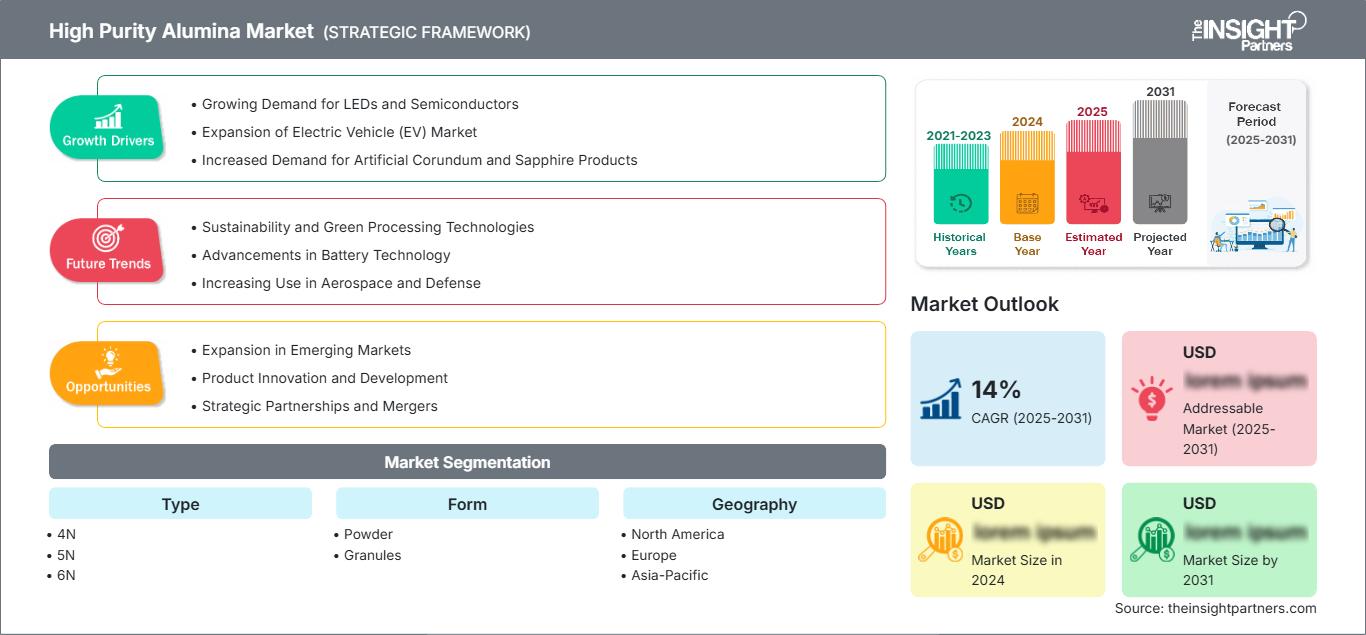
LED bulbs, EV batteries, and sapphire glass all share one hidden ingredient. The high purity alumina market size is expected to grow from US$ 4.75 Billion in 2024 to US$ 16.35 Billion by 2031. Demand for the High Purity Alumina Market is climbing fast as electronics and battery makers push for cleaner, more precise raw materials. The market is set to expand at a CAGR of 19.3% between 2025 and 2031.
What Is High Purity Alumina?
High purity alumina is an ultra-refined form of aluminum oxide, stripped of nearly all impurities. It comes in three grades, 4N, 5N, and 6N, based on purity level. Manufacturers rely on it wherever even trace contamination can ruin a product’s performance.
Request a Sample Copy of the Report: https://www.theinsightpartners.com/sample/TIPRE00003437
Segmentation
By Product:
- 4N
- 5N
- 6N
By Application:
- LED
- Semiconductor
- Lithium-Ion Battery
- Phosphor
- Sapphire
- Others
Key Market Players:
- Sumitomo Chemical Co., Ltd
- Altech Chemicals Ltd.
- Almatis, Inc.
- Nippon Light Metal Holdings Co., Ltd.
- Baikowski
- Polar Sapphire Ltd.
- Orbite Technologies Inc.
- Zibo Honghe Chemical Co., Ltd.
- CoorsTek Inc.
- FYI Resources Limited
These players are racing to scale up 5N and 6N grade production. Several are securing long-term supply deals with battery and semiconductor manufacturers. New refining facilities are being built closer to key demand hubs in Asia.
Lithium-ion batteries are the biggest growth engine right now. High purity alumina coats separator films, improving battery safety and lifespan. As EV adoption accelerates worldwide, that single application is reshaping demand across the entire supply chain.
Semiconductors tell a similar story. Chipmakers need materials with almost zero contamination risk, and high purity alumina fits that bar. What makes this particularly significant is how tightly this ties to broader chip supply chain investments happening across the US, Europe, and Asia right now.
Sapphire glass adds another layer of demand. Smartphone camera lenses and scratch-resistant watch faces both rely on sapphire crystals grown from high purity alumina feedstock. So why is supply struggling to keep pace? Producing 5N and 6N grades requires specialized, capital-intensive refining processes that few companies have mastered at scale.
Sustainability and Innovation Trends
Producers are shifting toward more energy-efficient refining methods to cut the carbon footprint of alumina purification. Some are exploring alternative feedstocks, including recycled aluminum sources, to reduce reliance on virgin bauxite. Investment in closed-loop water systems is also picking up across newer facilities.
Buy Premium Report: https://www.theinsightpartners.com/buy/TIPRE00003437
Regional Outlook
Asia Pacific leads the market, powered by China, Japan, and South Korea’s dominance in electronics and battery manufacturing. North America is expanding steadily as EV and semiconductor investment grows on domestic soil. Europe is catching up, driven by battery gigafactory announcements across Germany and France. South and Central America remains a smaller but emerging player, tied to raw material sourcing.
Trending Reports
Ultrafine Alumina Trihydrate (ATH) Market
About The Insight Partners
The Insight Partners is among the leading market research and consulting firms in the world. We take pride in delivering exclusive reports along with sophisticated strategic and tactical insights into the industry. Reports are generated through a combination of primary and secondary research, solely aimed at giving our clientele a knowledge-based insight into the market and domain. This is done to assist clients in making wiser business decisions.
Contact Us:
If you have any queries about this report or if you would like further information, please contact us:
Phone: +1-646-491-9876
E-mail: sales@theinsightpartners.com
Also Available in: Korean | German | Japanese | French | Chinese | Italian | Spanish
