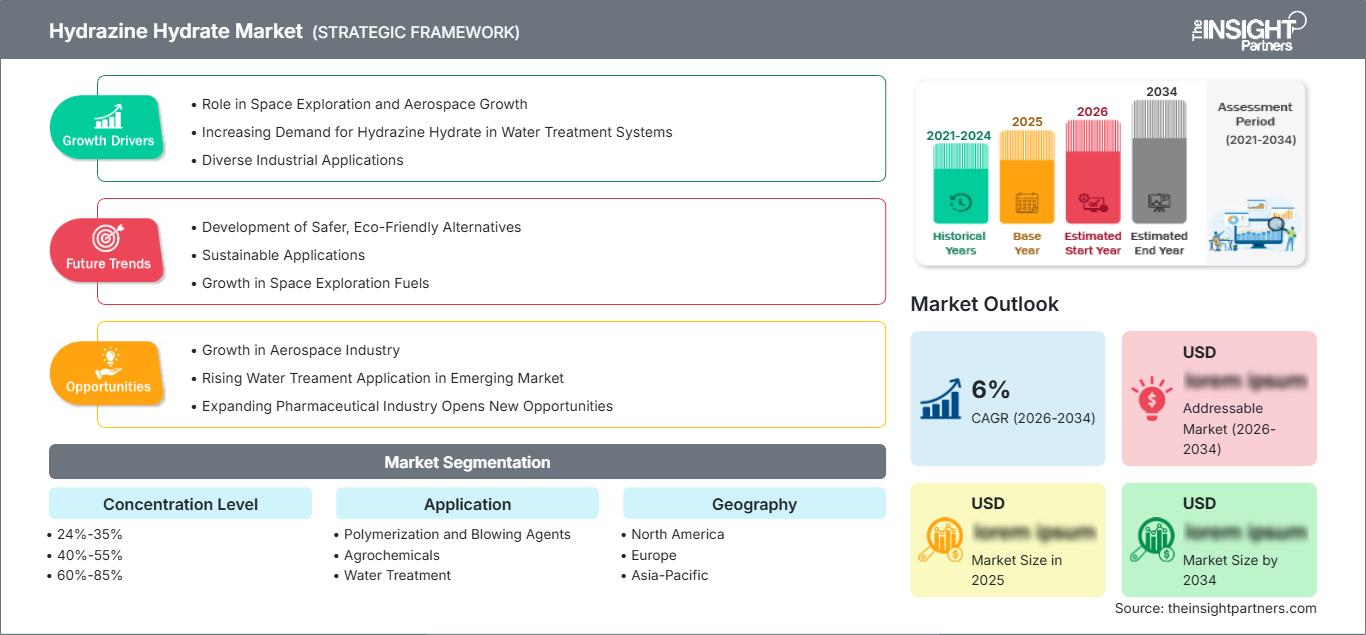
Water treatment plants need chemicals that clean without leaving harmful residue behind. That need is one reason the Hydrazine Hydrate Market is set to grow from US$ 324.21 Million in 2025 to US$ 558.80 Million by 2034, at a CAGR of 6.24% between 2026 and 2034. Boiler operators use it to strip oxygen from water. Farmers rely on it to make crop protection chemicals. Drugmakers use it too, in small but critical doses, to build life saving compounds.
What Is Hydrazine Hydrate?
Hydrazine hydrate is a colourless liquid made from ammonia and sodium hypochlorite. It works as a strong reducing agent, which makes it useful in water treatment, agrochemical synthesis, polymer foaming, and pharmaceutical manufacturing.
Market Drivers
Power plants are the biggest pull on this market. Boilers need oxygen scavengers to stop pipe corrosion, and hydrazine hydrate does that job better than most alternatives. As countries build new power capacity, especially in Asia Pacific, this demand keeps climbing.
Agrochemicals add real weight too. Farmers need higher crop yields, and that pushes chemical firms to produce more pesticides and herbicides. Hydrazine hydrate serves as a base chemical in many of these formulas, so agrochemical growth feeds resin demand directly.
Request a Sample Copy of the Report:
https://www.theinsightpartners.com/sample/TIPRE00017389
Water treatment plays a growing role as well. Cities are under pressure to clean wastewater before it reaches rivers and oceans. Hydrazine hydrate helps remove dissolved oxygen from treated water, which slows down pipe corrosion in distribution systems.
Pharmaceutical use, while smaller in volume, carries high value. Drug makers use hydrazine hydrate as a building block in several active ingredients. As global drug output rises, this steady but premium demand segment continues to support the broader market.
Segmentation Overview
By Concentration Level:
The 60%–85% range holds a strong position, since it fits most industrial reducing applications well. The 40%–55% range serves general purpose chemical processing. The 24%–35% range works for lighter dilution needs, often in water treatment. The 100% grade, the purest form, goes mainly into pharmaceutical and specialty chemical synthesis.
By Application:
Polymerization and blowing agents make up a major share, since hydrazine hydrate helps create foamed plastics and rubber products. Agrochemicals follow close behind, driven by rising pesticide and herbicide output worldwide. Water treatment is expanding fast, backed by stricter discharge rules in developed markets. Pharmaceuticals round out the segment, smaller in size but growing at a firm pace.
Key Market Players
- Arkema SA
- Hunan Zhuzhou Chemical Industry Group Co. Ltd.
- Japan FineChem Co. Inc.
- LANXESS
- Lonza Group Ltd
- Nippon Carbide Industries Co., Inc.
- Otsuka-MGC Chemical Company, Inc.
- Tanshang Chen Hong Industrial Co. Ltd.
- Weifang Yaxing Chemical Co. Ltd.
- Yibin Tianyuan Group Co. Ltd.
Large chemical groups such as Arkema and LANXESS bring scale and integrated production, which helps them control costs. Regional producers like Hunan Zhuzhou Chemical and Yibin Tianyuan Group hold strong positions in Asia Pacific, where much of the new demand is forming.
Sustainability and Innovation Trends
Safety handling is a growing focus. Hydrazine hydrate is reactive and needs careful storage, so producers are investing in better containment systems and safer transport methods. This protects workers and cuts the risk of costly plant incidents.
Green chemistry is shaping production too. Some manufacturers are exploring lower emission synthesis routes that cut waste during hydrazine hydrate production. This matters most in Europe, where environmental rules on chemical manufacturing keep getting stricter.
Recovery and reuse systems are another area of change. Plants that use hydrazine hydrate in boiler treatment are adopting closed loop systems that recover unused chemical, which lowers both cost and environmental impact.
Buy Premium Report:
https://www.theinsightpartners.com/buy/TIPRE00017389
Regional Outlook
Asia Pacific leads the market by a wide margin. China’s power sector expansion and its large agrochemical industry both drive strong local demand. North America follows, supported by steady water treatment investment and pharmaceutical manufacturing. Europe grows at a measured pace, shaped by tight environmental rules that push producers toward cleaner processes. South and Central America remains a smaller market, though rising industrial activity offers room for gradual growth.
Related Reports:
Industrial Wastewater Treatment Chemicals Market
Agricultural Biologicals Market
About The Insight Partners
The Insight Partners is among the leading market research and consulting firms in the world. We take pride in delivering exclusive reports along with sophisticated strategic and tactical insights into the industry. Reports are generated through a combination of primary and secondary research, solely aimed at giving our clientele a knowledge-based insight into the market and domain. This is done to assist clients in making wiser business decisions. A holistic perspective in every study undertaken forms an integral part of our research methodology and makes the report unique and reliable.
Contact Us:
If you have any queries about this report or if you would like further information, please contact us:
Phone: +1-646-491-9876
E-mail: sales@theinsightpartners.com
Also Available in: Korean | German | Japanese | French | Chinese | Italian | Spanish
