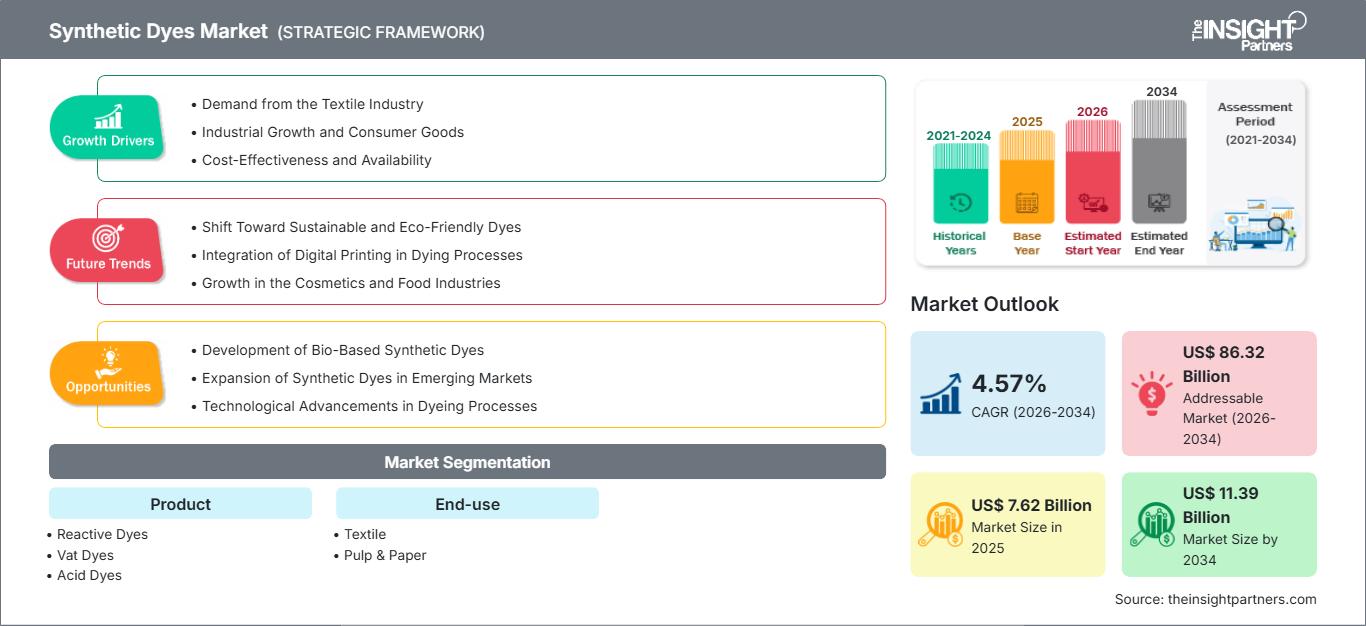
Fabric that keeps its colour after dozens of washes does not happen by chance. It relies on chemistry, and that chemistry sits at the core of the Synthetic Dyes Market, set to grow from US$ 7.62 Billion in 2025 to US$ 11.39 Billion by 2034, at a CAGR of 4.57% between 2026 and 2034. Textile mills need dyes that bond well with fibres. Paper producers need shades that stay consistent across large production runs. Synthetic dyes deliver both, which keeps demand steady across industries.
What Is a Synthetic Dye?
Synthetic dyes are man-made colouring agents produced through chemical synthesis, unlike natural dyes drawn from plants or insects. They offer stronger colour fastness, wider shade ranges, and lower costs, which is why they dominate textile and paper colouring today.
Request a Sample Copy of the Report:
https://www.theinsightpartners.com/sample/TIPRE00040493
Market Drivers
Textile production keeps expanding, and that is the single biggest driver behind this market. Fast fashion brands need constant colour variety, and synthetic dyes give them a wide, reliable palette at a cost that natural dyes cannot match. As clothing consumption rises across Asia and North America, dye demand rises with it.
Pulp and paper manufacturing adds a second strong pull. Packaging firms need consistent, bright colours for branding, and paper producers use synthetic dyes to hit exact shade targets across large batches. This need for uniformity is hard to achieve with natural alternatives.
Rising disposable income in developing economies plays a role too. As people spend more on clothing, home textiles, and packaged goods, manufacturers scale up production, which lifts dye consumption across the supply chain.
Technical performance also matters. Reactive and vat dyes bond strongly with fibres, giving fabrics better wash and light fastness. This durability keeps textile makers loyal to synthetic options over cheaper but less reliable alternatives.
Segmentation Overview
By Product:
Reactive dyes lead the market, prized for their strong bond with cotton and other natural fibres, which makes them a top choice in garment manufacturing. Vat dyes follow, known for excellent wash and light fastness, often used in denim and workwear production. Acid dyes hold a smaller share, mainly applied to wool, silk, and nylon where their bright, vivid shades work best.
By End-Use:
Textile applications dominate the market by a wide margin, driven by constant demand from clothing, home furnishing, and industrial fabric producers. Pulp and paper follow as the second major end-use, where dyes are used to colour packaging materials, printing paper, and specialty paper products.
Key Market Players
- Huntsman International LLC
- BASF SE
- LANXESS
- SHAH INDUSTRIES
- KIWA Chemical Industry Co., Ltd.
- Kiri Industries Ltd.
- Archroma
- Atul Ltd
- The Chemours Company
Large chemical groups such as BASF SE, LANXESS, and Huntsman International bring scale, broad product ranges, and strong distribution networks. Archroma and Atul Ltd hold a strong footing in Asia, where much of the world’s textile production takes place, while smaller specialists like Kiri Industries and KIWA Chemical Industry focus on niche dye chemistries.
Sustainability and Innovation Trends
Environmental rules are reshaping dye production. Wastewater from dyeing processes has long drawn scrutiny, and regulators in Europe and parts of Asia are pushing manufacturers toward cleaner production methods that cut water use and chemical runoff.
Low impact dyeing technology is gaining traction too. Some producers are developing dyes that need less water and lower processing temperatures, which cuts both cost and environmental footprint for textile mills.
Bio-based dye research is still developing, but a few companies are testing plant and microbial sources as partial substitutes for petroleum-based dye chemistry. This work remains early stage, though it points to where the market could shift over the next decade.
Buy Premium Report:
https://www.theinsightpartners.com/buy/TIPRE00040493
Regional Outlook
Asia Pacific dominates the market, powered by its massive textile manufacturing base in China, India, and Bangladesh. North America follows, supported by steady demand from packaging and specialty paper producers. Europe grows at a measured pace, shaped by strict environmental rules that push dye makers toward cleaner processes. South and Central America remains a smaller market, though growing textile exports offer room for gradual expansion.
Related Reports:
Pulp and Paper Chemicals Market
About The Insight Partners
The Insight Partners is among the leading market research and consulting firms in the world. We take pride in delivering exclusive reports along with sophisticated strategic and tactical insights into the industry. Reports are generated through a combination of primary and secondary research, solely aimed at giving our clientele a knowledge-based insight into the market and domain. This is done to assist clients in making wiser business decisions. A holistic perspective in every study undertaken forms an integral part of our research methodology and makes the report unique and reliable.
Contact Us:
If you have any queries about this report or if you would like further information, please contact us:
Phone: +1-646-491-9876
E-mail: sales@theinsightpartners.com
Also Available in: Korean | German | Japanese | French | Chinese | Italian | Spanish
