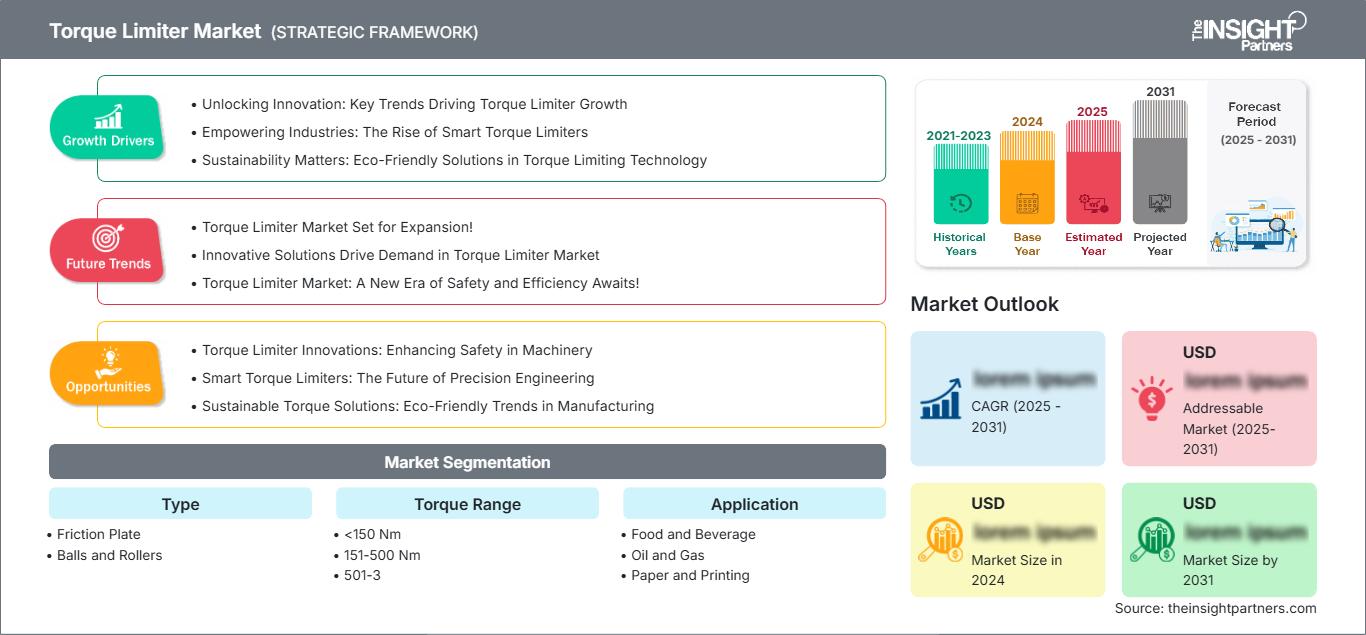
Torque limiters are mechanical safety devices designed to protect machinery and power transmission systems from overload conditions by limiting the amount of torque transmitted between rotating components. These devices automatically disengage or slip when torque exceeds a predetermined limit, preventing equipment damage, minimizing downtime, and improving operational safety. Torque limiters are widely used in manufacturing, packaging, food processing, mining, automotive, robotics, material handling, printing, conveyors, machine tools, renewable energy systems, and industrial automation equipment. Available in various designs such as friction torque limiters, ball detent torque limiters, magnetic torque limiters, and shear pin torque limiters, these components enhance machine reliability while reducing maintenance costs. Continuous advancements in precision engineering, smart manufacturing, sensor integration, and high-performance materials are improving torque limiter efficiency, durability, and response time. As industries increasingly automate production processes and prioritize equipment protection, torque limiters continue to play a vital role in ensuring reliable and uninterrupted industrial operations.
Market Overview
The Torque Limiter Market size is projected to reach US$ 1,275.27 Million by 2034 from US$ 807.1 Million in 2025. The market is anticipated to register a CAGR of 5.4% during the forecast period 2026-2034. Market growth is driven by increasing industrial automation, expanding manufacturing activities, rising demand for machine safety, growing investments in robotics and automated production systems, and continuous modernization of industrial equipment. Manufacturers continue developing advanced torque limiter solutions that provide higher precision, improved durability, and enhanced operational reliability.
Key Market Insights
- Market Size (2025): US$ 807.1 Million
- Forecast Market Size (2034): US$ 1,275.27 Million
- CAGR (2026-2034): 5.4%
- Key Growth Driver: Rising demand for machinery protection in industrial automation
- Major Trend: Smart torque limiters with sensor-based condition monitoring
- Forecast Period:2026-2034
Get a Sample PDF of the Report: https://www.theinsightpartners.com/sample/TIPRE00006774
Market Drivers
Expansion of Industrial Automation
Manufacturers are increasingly implementing automated production lines to improve productivity, reduce labor costs, and enhance operational efficiency. Automated machinery requires reliable overload protection to prevent mechanical failures and costly downtime. Torque limiters safeguard critical equipment by disconnecting power transmission during overload conditions, ensuring continuous and safe manufacturing operations.
Growing Demand for Machine Protection
Industrial machinery operates under varying load conditions that can lead to excessive torque and mechanical damage. Torque limiters protect motors, gearboxes, shafts, conveyors, and other rotating equipment from unexpected overloads, extending equipment lifespan while reducing maintenance expenses. Increasing focus on preventive maintenance continues supporting market growth.
Increasing Adoption of Robotics
Industrial robots and collaborative robots require precise motion control and reliable overload protection to maintain operational accuracy and equipment safety. Torque limiters help protect robotic joints, actuators, and transmission systems from unexpected mechanical stress, supporting efficient operation in automated manufacturing environments.
Expansion of Material Handling Systems
Warehouses, logistics centers, airports, and manufacturing facilities increasingly rely on conveyors, automated storage systems, and material handling equipment. Torque limiters ensure smooth operation by protecting mechanical drive systems against jams, overloads, and unexpected operational interruptions, improving overall system reliability.
Market Trends
Smart Condition Monitoring
Manufacturers are integrating torque limiters with sensors and Industrial Internet of Things technologies that enable real-time monitoring of torque levels, overload events, equipment health, and predictive maintenance. Intelligent monitoring systems help reduce downtime while improving asset management and operational efficiency.
Compact High-Performance Designs
Industries increasingly require lightweight, compact torque limiter solutions that deliver high torque capacity while minimizing installation space. Advances in materials engineering and precision manufacturing are enabling the development of smaller yet highly durable overload protection systems suitable for modern automated machinery.
Industry 4.0 Integration
The growing adoption of Industry 4.0 technologies is encouraging manufacturers to develop torque limiters compatible with digital manufacturing environments. Integrated monitoring, remote diagnostics, cloud connectivity, and predictive analytics are becoming standard features within advanced industrial power transmission systems.
Demand for Maintenance-Free Solutions
Industrial users increasingly prefer torque limiters requiring minimal maintenance while delivering long operational lifespans and consistent performance under demanding operating conditions. Manufacturers continue introducing maintenance-free designs that reduce servicing requirements and improve equipment availability.
Get the Premium Research Report @ https://www.theinsightpartners.com/buy/TIPRE00006774
Regional Analysis
North America
North America remains a major market due to advanced manufacturing industries, widespread industrial automation, expanding robotics deployment, and increasing investments in smart factories. Strong adoption of predictive maintenance technologies continues supporting regional market growth.
Europe
Europe continues experiencing stable growth driven by industrial modernization, precision engineering, automotive manufacturing, packaging industries, and increasing adoption of Industry 4.0 technologies. Germany, Italy, France, and the United Kingdom remain leading markets for advanced power transmission solutions.
Asia-Pacific
Asia-Pacific is expected to register the fastest market growth owing to rapid industrialization, manufacturing expansion, increasing automation investments, and rising production of industrial machinery. China, Japan, South Korea, India, and Southeast Asian countries continue strengthening demand for advanced machine protection technologies.
Middle East and Africa
The Middle East and Africa are witnessing increasing adoption of torque limiters across mining, oil and gas, manufacturing, logistics, and infrastructure development projects. Continued industrial diversification and modernization initiatives are supporting long-term regional market expansion.
Competitive Landscape
The Torque Limiter Market remains highly competitive as industrial component manufacturers, power transmission companies, automation solution providers, and precision engineering firms continue investing in advanced overload protection technologies, smart monitoring capabilities, and durable mechanical designs. Companies are focusing on improving product performance, operational reliability, customization, and integration with automated industrial systems while expanding partnerships across manufacturing, logistics, energy, mining, and automotive sectors.
Key Players
- Mayr GmbH + Co. KG
- R+W Antriebselemente GmbH
- KTR Systems GmbH
- Ringfeder Power Transmission GmbH
- Rexnord Corporation
- Altra Industrial Motion Corp.
- Tsubakimoto Chain Co.
- Cross & Morse Ltd.
- Zero-Max, Inc.
- Howdon Torque Limiters Ltd.
Emerging Trends
The torque limiter industry continues advancing through Industrial Internet of Things connectivity, predictive maintenance, artificial intelligence-based machine diagnostics, robotics, smart manufacturing, digital twins, advanced materials, and precision motion control technologies. Manufacturers are developing next-generation torque limiter systems capable of delivering intelligent overload detection, remote monitoring, improved durability, and seamless integration with connected industrial environments. Growing investments in automation, manufacturing efficiency, and digital transformation are expected to create substantial market opportunities throughout the forecast period.
Future Outlook
The future outlook for the Torque Limiter Market remains positive as industries continue modernizing manufacturing operations and investing in intelligent automation technologies. Increasing demand for machine reliability, predictive maintenance, industrial safety, and advanced robotics will continue supporting market growth. Future innovations are expected to focus on intelligent sensing, compact designs, maintenance-free operation, higher torque precision, and enhanced compatibility with smart factory ecosystems.
Related Market Research Reports
Portable Monitors Market Demand, Trends & Forecast by 2034
Wrist Wearable Market Growth, Trends & Demand by 2034
POS Printers Market Growth, Demand & Size by 2034
Metering ICs Market Size, Share & Demand by 2034
About The Partners
The Insight Partners is a Insight global leader in market research, delivering comprehensive analysis and actionable insights across diverse industries. The company empowers decision-makers with data-driven intelligence to navigate evolving markets and accelerate growth.
Contact Us:
- Contact Person: Ankit Mathur
- E-mail: ankit.mathur@theinsightpartners.com
- Phone: +1-646-491-9876
Also Available in :
