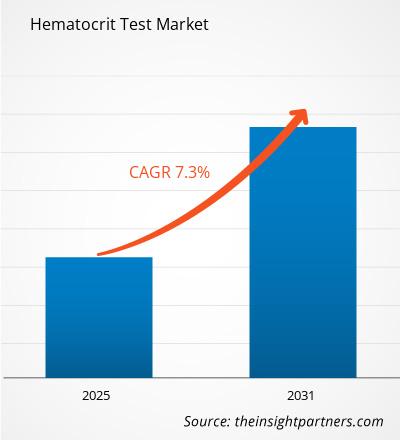
According to The Insight Partners, the Hematocrit Test Market is projected to grow from US$ 3.6 billion in 2025 to US$ 4.25 billion by 2034, registering a CAGR of 2.10% during 2026–2034. Market Overview
The hematocrit test market plays a critical role in modern clinical diagnostics by measuring the proportion of red blood cells in blood samples. Hematocrit testing is routinely performed as part of complete blood count (CBC) examinations to diagnose and monitor conditions such as anemia, dehydration, polycythemia, kidney disorders, and various blood-related diseases. The increasing burden of chronic diseases and the growing emphasis on early disease diagnosis continue to drive the demand for hematocrit testing worldwide.
Get a Sample PDF – https://www.theinsightpartners.com/sample/TIPRE00021859
Healthcare providers increasingly rely on automated hematology analyzers capable of delivering rapid, accurate, and standardized results. These technological advancements have significantly improved laboratory efficiency while minimizing human error. Additionally, portable hematocrit analyzers designed for point-of-care settings are gaining popularity due to their ability to provide immediate diagnostic information in emergency departments, outpatient clinics, and remote healthcare facilities.
Growing healthcare expenditures, expanding laboratory infrastructure, and increasing government initiatives promoting preventive healthcare are expected to support long-term market growth. The rising aging population, which is more susceptible to chronic illnesses requiring routine blood monitoring, also contributes to sustained demand for hematocrit testing solutions.
Market Drivers
One of the primary drivers of the hematocrit test market is the increasing prevalence of anemia worldwide. Iron deficiency anemia, vitamin deficiency anemia, chronic disease-related anemia, and inherited blood disorders continue to affect millions of individuals globally. Early diagnosis through hematocrit testing enables timely intervention, reducing complications and improving patient outcomes.
Another significant growth driver is the rising incidence of chronic kidney disease. Patients undergoing dialysis or receiving erythropoietin therapy require regular hematocrit monitoring to evaluate treatment effectiveness. Similarly, cancer patients receiving chemotherapy often undergo routine blood testing to monitor changes in red blood cell counts.
The expansion of preventive healthcare programs has also increased the frequency of routine blood testing. Annual health check-ups, occupational health assessments, and wellness programs commonly include complete blood count testing, thereby increasing the utilization of hematocrit tests.
Technological Advancements
Continuous innovation in diagnostic technology has transformed hematocrit testing. Modern automated hematology analyzers integrate advanced optical, electrical impedance, and flow cytometry technologies to provide highly accurate results with minimal manual intervention. These systems improve workflow efficiency while enabling laboratories to process large testing volumes.
Point-of-care hematocrit testing devices have emerged as another important technological advancement. Compact analyzers deliver rapid results directly at the patient’s bedside, improving decision-making in emergency care, intensive care units, ambulatory clinics, and rural healthcare settings.
Artificial intelligence and digital laboratory management systems are increasingly being incorporated into hematology diagnostics. AI-assisted quality control, automated result validation, and cloud-connected laboratory information systems help healthcare providers improve operational efficiency while ensuring consistent diagnostic accuracy.
Market Segmentation
The hematocrit test market can be segmented based on product type, technology, end user, and geography.
By product type, the market includes hematology analyzers, consumables, reagents, and accessories. Consumables and reagents account for a significant revenue share due to recurring demand from hospitals and diagnostic laboratories.
Based on technology, the market comprises automated analyzers, semi-automated systems, and manual testing methods. Automated analyzers continue to dominate because they offer faster turnaround times, greater precision, and reduced labor requirements.
In terms of end users, hospitals represent the largest market segment owing to high patient volumes and extensive diagnostic capabilities. Diagnostic laboratories also contribute substantially due to increasing outsourcing of laboratory testing services. Academic institutions, research organizations, blood banks, and ambulatory care centers further expand market opportunities.
Regional Analysis
North America remains the leading regional market due to advanced healthcare infrastructure, extensive laboratory automation, and strong adoption of innovative diagnostic technologies. High awareness regarding preventive health screenings and the presence of major diagnostic manufacturers continue supporting regional growth.
Europe represents another significant market, supported by universal healthcare systems, favorable reimbursement policies, and increasing demand for early disease detection. Countries such as Germany, France, the United Kingdom, and Italy continue investing in advanced clinical laboratory infrastructure.
The Asia Pacific region is expected to witness notable growth throughout the forecast period. Rapid healthcare modernization, expanding hospital networks, rising healthcare expenditure, and increasing awareness regarding routine blood diagnostics contribute significantly to market expansion. Large patient populations in China and India further create substantial growth opportunities.
Latin America and the Middle East & Africa are also gradually expanding due to improvements in healthcare accessibility, government investments, and increasing diagnostic awareness.
Competitive Landscape
The hematocrit test market remains highly competitive, with leading manufacturers focusing on technological innovation, product launches, strategic collaborations, mergers, and geographic expansion. Companies are investing heavily in research and development to improve analyzer efficiency, diagnostic accuracy, and workflow automation.
Manufacturers are also expanding their point-of-care testing portfolios to meet the growing demand for decentralized diagnostics. Integration of digital health technologies, cloud connectivity, and AI-assisted laboratory management continues to differentiate leading market participants.
Key Players
- Abbott Laboratories
- Boule Diagnostics AB
- Danaher Corporation
- EKF Diagnostics
- F. Hoffmann-La Roche Ltd.
- HORIBA, Ltd.
- Nova Biomedical
- Sysmex Corporation
- Beckman Coulter
- Nihon Kohden Corporation
- Siemens AG
- Bio-Rad Laboratories, Inc.
- Horiba
- Mindray Medical International Limited
Get Premium Research Report Market Size and Report at:
https://www.theinsightpartners.com/buy/TIPRE00021859
Future Outlook
The hematocrit test market is expected to experience stable and sustainable growth through 2034, supported by increasing demand for routine blood diagnostics, expanding healthcare infrastructure, and continuous advancements in laboratory automation. The adoption of point-of-care testing technologies and AI-enabled diagnostic platforms will further enhance testing efficiency and accessibility. As healthcare systems increasingly prioritize early diagnosis and preventive care, hematocrit testing will remain an essential component of modern clinical diagnostics.
About Us
The Insight Partners is a one stop industry research provider of actionable intelligence. We help our clients in getting solutions to their research requirements through our syndicated and consulting research services. We specialize in industries such as Semiconductor and Electronics, Aerospace and Defense, Automotive and Transportation, Biotechnology, Healthcare IT, Manufacturing and Construction, Medical Device, Technology, Media and Telecommunications, Chemicals and Materials.
Contact Us
Ankit Mathur | The Insight Partners
E-mail: ankit.mathur@theinsightpartners.com
Phone: +1-646-491-9876
Also Available in : Korean | German | Japanese | French | Chinese | Italian | Spanish
