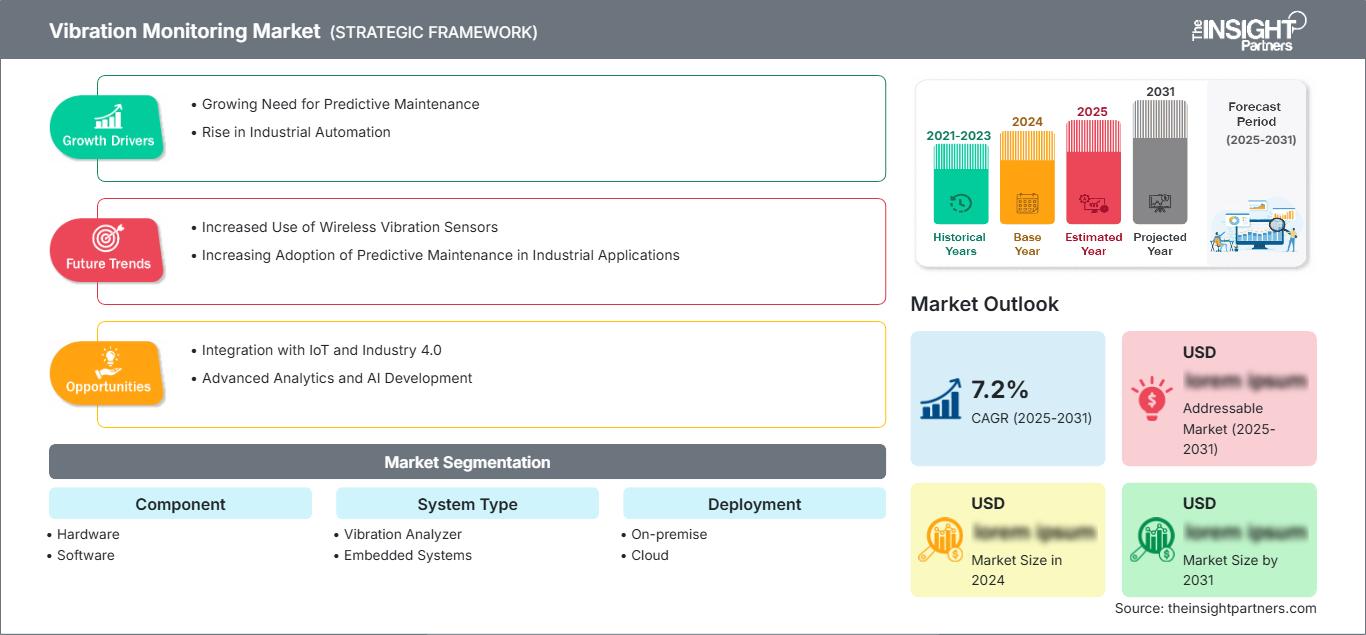
Vibration monitoring is a condition monitoring technique used to measure, analyze, and evaluate the vibration characteristics of rotating and stationary industrial equipment. By continuously monitoring vibration levels, organizations can detect equipment faults, mechanical wear, imbalance, misalignment, bearing failures, looseness, and other performance issues before they result in costly breakdowns. Vibration monitoring systems are extensively deployed across manufacturing, oil and gas, power generation, mining, chemical processing, aerospace, automotive, transportation, marine, and renewable energy industries. These systems typically consist of sensors, accelerometers, transmitters, data acquisition units, software platforms, and cloud-based analytics that provide real-time equipment health insights. Continuous advancements in Industrial Internet of Things technologies, artificial intelligence, machine learning, wireless sensing, and predictive analytics are transforming vibration monitoring into an intelligent asset management solution capable of improving equipment reliability, operational efficiency, and maintenance planning. As industries increasingly adopt predictive maintenance strategies, vibration monitoring continues to become a critical component of modern industrial operations.
Market Overview
The Vibration Monitoring Market size is projected to reach US$ 3,334.4 Million by 2034 from US$ 1,868.92 Million in 2025. The market is anticipated to register a CAGR of 6.64% during the forecast period 2026-2034. Market growth is driven by increasing adoption of predictive maintenance, expanding industrial automation, growing investments in smart manufacturing, rising deployment of Industrial Internet of Things solutions, and continuous digital transformation across industrial sectors. Companies continue investing in advanced condition monitoring technologies to improve equipment availability and reduce maintenance costs.
Key Market Insights
- Market Size (2025): US$ 1,868.92 Million
- Forecast Market Size (2034): US$ 3,334.4 Million
- CAGR (2026-2034): 6.64%
- Key Growth Driver: Rising adoption of predictive maintenance across industrial operations
- Major Trend: Artificial intelligence-enabled vibration monitoring and real-time analytics
- Forecast Period: 2026-2034
Get a Sample PDF of the Report: https://www.theinsightpartners.com/sample/TIPRE00010133
Market Drivers
Growing Adoption of Predictive Maintenance
Industries are increasingly shifting from reactive and preventive maintenance to predictive maintenance strategies that minimize unplanned downtime and extend equipment lifespan. Vibration monitoring systems continuously analyze machine performance, enabling maintenance teams to detect faults before failures occur. This proactive approach reduces maintenance costs while improving operational reliability and production efficiency.
Expansion of Industrial Automation
Modern manufacturing facilities increasingly rely on automated machinery, robotics, conveyors, compressors, pumps, turbines, and electric motors that require continuous condition monitoring. Vibration monitoring systems help maintain optimal equipment performance while protecting valuable industrial assets from unexpected mechanical failures and production interruptions.
Increasing Investments in Smart Manufacturing
Industry 4.0 initiatives continue accelerating the adoption of intelligent monitoring technologies capable of collecting real-time operational data from connected industrial equipment. Vibration monitoring platforms integrated with cloud computing, Industrial Internet of Things networks, and advanced analytics enable manufacturers to optimize maintenance schedules and improve production efficiency.
Growing Demand Across Energy Industries
Power generation plants, renewable energy facilities, oil and gas operations, and mining companies depend on vibration monitoring to maintain reliable operation of critical rotating equipment. Continuous monitoring helps identify early-stage mechanical issues in turbines, generators, compressors, pumps, and motors, improving equipment reliability while reducing operational risks.
Market Trends
Artificial Intelligence Integration
Artificial intelligence and machine learning algorithms are transforming vibration monitoring by enabling automated fault diagnosis, predictive failure analysis, anomaly detection, and intelligent maintenance recommendations. AI-powered analytics improve diagnostic accuracy while reducing the need for manual equipment inspections.
Wireless Monitoring Systems
Wireless vibration sensors are gaining widespread adoption due to simplified installation, reduced wiring costs, and greater flexibility in monitoring difficult-to-access equipment. Wireless monitoring solutions support scalable condition monitoring across large industrial facilities and remote operating environments.
Cloud-Based Asset Management
Manufacturers increasingly deploy cloud-based vibration monitoring platforms that enable centralized equipment monitoring, historical trend analysis, predictive maintenance scheduling, and remote diagnostics across multiple production sites. Cloud connectivity improves operational visibility while supporting enterprise-wide asset management.
Industrial Internet of Things Connectivity
Industrial Internet of Things integration enables vibration monitoring systems to communicate with enterprise resource planning software, maintenance management systems, digital twins, and factory automation platforms. Connected monitoring ecosystems provide comprehensive insights into equipment health and operational performance.
Get the Premium Research Report @ https://www.theinsightpartners.com/buy/TIPRE00010133
Regional Analysis
North America
North America remains a major market due to widespread industrial automation, advanced manufacturing, increasing adoption of predictive maintenance, and strong investments in digital transformation across manufacturing, energy, aerospace, and transportation sectors. Growing Industrial Internet of Things deployment continues supporting regional market expansion.
Europe
Europe continues experiencing significant growth driven by Industry 4.0 initiatives, smart factory implementation, renewable energy development, advanced manufacturing technologies, and industrial modernization. Germany, France, the United Kingdom, Italy, and the Nordic countries continue investing in intelligent condition monitoring solutions.
Asia-Pacific
Asia-Pacific is expected to register the fastest market growth owing to rapid industrialization, manufacturing expansion, increasing automation investments, and rising deployment of Industrial Internet of Things technologies. China, Japan, South Korea, India, and Southeast Asian countries continue strengthening industrial monitoring capabilities across diverse manufacturing sectors.
Middle East and Africa
The Middle East and Africa are witnessing increasing adoption of vibration monitoring systems across oil and gas facilities, mining operations, utilities, manufacturing plants, and infrastructure projects. Continued investments in industrial modernization and asset reliability are creating long-term market opportunities.
Competitive Landscape
The Vibration Monitoring Market remains highly competitive as industrial automation companies, sensor manufacturers, instrumentation providers, software developers, and condition monitoring specialists continue investing in artificial intelligence, Industrial Internet of Things platforms, cloud analytics, wireless sensing, and predictive maintenance technologies. Companies are focusing on improving monitoring accuracy, connectivity, data analytics, cybersecurity, and integration with digital industrial ecosystems while expanding partnerships across manufacturing, energy, transportation, mining, and process industries.
Key Players
- Emerson Electric Co.
- SKF AB
- Schaeffler AG
- Honeywell International Inc.
- Siemens AG
- ABB Ltd.
- Baker Hughes Company
- Fluke Corporation
- Rockwell Automation, Inc.
- National Instruments Corporation
Emerging Trends
The vibration monitoring industry continues advancing through artificial intelligence, machine learning, edge computing, digital twins, Industrial Internet of Things connectivity, cloud computing, predictive analytics, autonomous maintenance, and smart manufacturing technologies. Manufacturers are developing next-generation monitoring platforms capable of delivering continuous equipment diagnostics, intelligent fault prediction, real-time asset optimization, and seamless integration with connected industrial environments. Growing investments in digital transformation, sustainability, and operational efficiency are expected to create significant market opportunities throughout the forecast period.
Future Outlook
The future outlook for the Vibration Monitoring Market remains highly promising as industries continue prioritizing predictive maintenance, asset reliability, and operational efficiency. Increasing adoption of Industrial Internet of Things technologies, expanding automation, rising investments in digital manufacturing, and continuous advancements in artificial intelligence will continue supporting market growth. Future innovations are expected to focus on autonomous monitoring, advanced analytics, edge intelligence, wireless sensing, and intelligent maintenance automation.
Related Market Research Reports
Surveillance Camera Market Overview and Forecast by 2031
Tactile Switches Market Size, Demand & Growth by 2034
Quantum Dots Market Growth, Trends & Forecast by 2034
Display Technology Market Share, Growth & Forecast by 2034
About The Partners
The Insight Partners is a Insight global leader in market research, delivering comprehensive analysis and actionable insights across diverse industries. The company empowers decision-makers with data-driven intelligence to navigate evolving markets and accelerate growth.
Contact Us:
- Contact Person: Ankit Mathur
- E-mail: ankit.mathur@theinsightpartners.com
- Phone: +1-646-491-9876
Also Available in :
