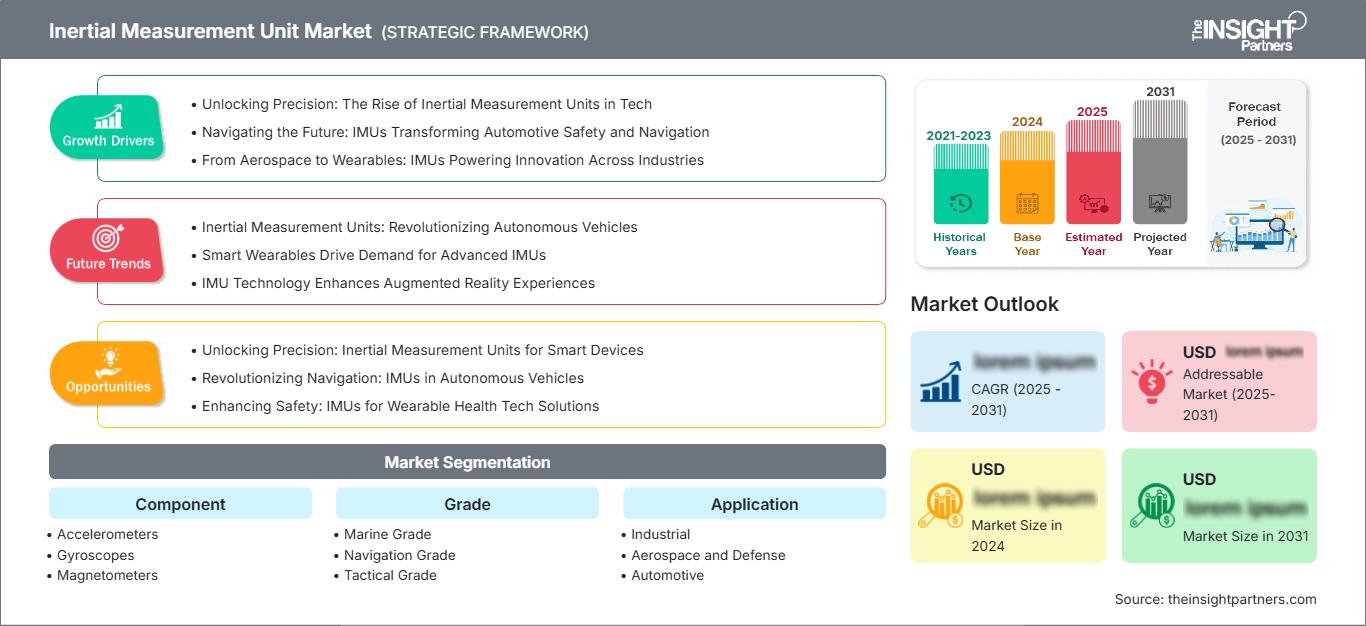
An Inertial Measurement Unit (IMU) is an electronic device that measures and reports an object’s acceleration, angular velocity, orientation, and motion using a combination of accelerometers, gyroscopes, and, in some cases, magnetometers. IMUs are fundamental components in navigation, positioning, stabilization, motion tracking, and control systems across aerospace, defense, automotive, robotics, industrial automation, consumer electronics, healthcare, marine, and unmanned systems. These devices enable precise motion sensing in applications such as autonomous vehicles, drones, aircraft, satellites, wearable devices, smartphones, virtual reality systems, industrial robots, and precision agriculture equipment. Advances in Micro-Electro-Mechanical Systems (MEMS), sensor fusion, artificial intelligence, and miniaturization have significantly improved IMU accuracy, reliability, and power efficiency while reducing size and manufacturing costs. As industries continue adopting autonomous technologies and intelligent motion control systems, IMUs remain essential for delivering accurate navigation and positioning capabilities.
Market Overview
The Inertial Measurement Unit Market size is expected to reach US$ 4.13 Billion by 2034 from US$ 1.61 Billion in 2025. The market is anticipated to register a CAGR of 11.03% during the forecast period 2026-2034. Market growth is driven by increasing demand for autonomous vehicles, expanding drone applications, rising adoption of industrial robotics, growing aerospace and defense investments, and continuous advancements in MEMS sensor technologies. Manufacturers continue developing highly accurate, compact, and energy-efficient IMUs to support next-generation navigation and motion sensing applications.
Key Market Insights
- Market Size (2025): US$ 1.61 Billion
- Forecast Market Size (2034): US$ 4.13 Billion
- CAGR (2026-2034): 11.03%
- Key Growth Driver: Rising adoption of autonomous systems and advanced navigation technologies
- Major Trend: MEMS-based high-performance IMUs with artificial intelligence-enabled sensor fusion
- Forecast Period:2026-2034
Get a Sample PDF of the Report: https://www.theinsightpartners.com/sample/TIPRE00014485
Market Drivers
Growth of Autonomous Vehicles
Autonomous and connected vehicles require highly accurate motion sensing for navigation, vehicle stability, localization, and safety systems. IMUs provide critical real-time movement data that complements Global Navigation Satellite Systems, cameras, and LiDAR, ensuring reliable vehicle positioning even in environments where satellite signals are limited.
Expanding Drone Applications
The increasing use of unmanned aerial vehicles across agriculture, defense, logistics, infrastructure inspection, surveying, emergency response, and aerial photography is significantly boosting demand for advanced IMUs. These sensors provide accurate flight stabilization, orientation control, and navigation required for safe and efficient drone operations.
Increasing Aerospace and Defense Investments
Aircraft, missiles, satellites, naval systems, and military vehicles rely on high-precision IMUs for inertial navigation, guidance, stabilization, and targeting. Growing investments in defense modernization and aerospace innovation continue driving demand for advanced inertial sensing technologies.
Industrial Automation and Robotics
Manufacturing industries are rapidly deploying industrial robots, autonomous mobile robots, automated guided vehicles, and collaborative robots that require precise motion control and positioning. IMUs improve navigation accuracy, equipment stability, and operational efficiency within modern automated production environments.
Market Trends
MEMS Sensor Miniaturization
Continuous advancements in MEMS technology are enabling the production of smaller, lighter, and more energy-efficient IMUs without compromising measurement accuracy. Compact IMUs are increasingly being integrated into wearable electronics, consumer devices, medical equipment, and portable industrial systems.
Artificial Intelligence and Sensor Fusion
Artificial intelligence algorithms and advanced sensor fusion techniques combine IMU data with information from Global Navigation Satellite Systems, cameras, LiDAR, radar, and other sensors to improve positioning accuracy, reliability, and real-time decision-making across autonomous systems.
Edge Computing Integration
Modern IMUs increasingly incorporate edge processing capabilities that enable real-time data filtering, motion analysis, and local decision-making. Edge intelligence reduces latency while supporting high-speed navigation and autonomous operations in dynamic environments.
High-Precision Navigation Systems
Demand for navigation systems capable of operating accurately in GPS-denied environments continues increasing across aerospace, defense, marine, underground mining, and autonomous industrial applications. High-performance IMUs are becoming central components of resilient navigation solutions.
Get the Premium Research Report @ https://www.theinsightpartners.com/buy/TIPRE00014485
Regional Analysis
North America
North America remains a leading market due to strong aerospace and defense investments, autonomous vehicle development, advanced robotics adoption, and extensive research in navigation technologies. The presence of major technology companies and defense contractors continues supporting regional market expansion.
Europe
Europe continues experiencing significant growth driven by automotive innovation, industrial automation, aerospace manufacturing, defense modernization, and increasing investments in autonomous mobility. Germany, France, the United Kingdom, Italy, and Sweden continue strengthening advanced sensor technology development.
Asia-Pacific
Asia-Pacific is expected to register the fastest market growth owing to rapid electronics manufacturing, expanding automotive production, increasing drone adoption, industrial automation, and growing investments in aerospace technologies. China, Japan, South Korea, India, and Taiwan continue leading regional demand for MEMS-based sensing solutions.
Middle East and Africa
The Middle East and Africa are witnessing increasing adoption of inertial measurement technologies across defense, aviation, oil and gas, mining, transportation, and infrastructure monitoring applications. Continued investments in advanced technology and security infrastructure are creating long-term market opportunities.
Competitive Landscape
The Inertial Measurement Unit Market remains highly competitive as sensor manufacturers, semiconductor companies, aerospace suppliers, defense contractors, robotics developers, and navigation technology providers continue investing in MEMS innovation, artificial intelligence, advanced sensor fusion, miniaturization, and precision navigation technologies. Companies are focusing on improving measurement accuracy, reliability, durability, energy efficiency, and integration capabilities while expanding partnerships across automotive, aerospace, industrial automation, defense, healthcare, and consumer electronics sectors.
Key Players
- Honeywell International Inc.
- Bosch Sensortec GmbH
- Analog Devices, Inc.
- STMicroelectronics N.V.
- TDK Corporation
- Safran Electronics & Defense
- Northrop Grumman Corporation
- Murata Manufacturing Co., Ltd.
- Collins Aerospace
- Epson Corporation
Emerging Trends
The inertial measurement unit industry continues advancing through artificial intelligence, MEMS innovation, edge computing, sensor fusion, autonomous mobility, robotics, digital twins, advanced navigation systems, wearable technology, and next-generation aerospace applications. Manufacturers are developing intelligent IMUs capable of delivering enhanced accuracy, predictive diagnostics, real-time analytics, and seamless integration with autonomous platforms. Growing investments in connected mobility, industrial automation, defense modernization, and smart sensing technologies are expected to create significant market opportunities throughout the forecast period.
Future Outlook
The future outlook for the Inertial Measurement Unit Market remains highly promising as industries continue adopting autonomous technologies, intelligent robotics, advanced navigation systems, and connected mobility solutions. Rising demand for drones, autonomous vehicles, aerospace systems, and industrial automation will continue supporting market growth. Future innovations are expected to focus on ultra-compact MEMS sensors, artificial intelligence-enabled motion sensing, quantum navigation research, enhanced sensor fusion, and energy-efficient inertial technologies.
Related Market Research Reports
Wi-Fi Module Market Size, Share & Growth by 2034
Interactive Kiosk Market Size, Share & Trends by 2034
Thin-Film Encapsulation Market Demand, Size & Forecast by 2034
Geo-technical Instruments Market Share, Demand & Growth by 2034
About The Partners
The Insight Partners is a Insight global leader in market research, delivering comprehensive analysis and actionable insights across diverse industries. The company empowers decision-makers with data-driven intelligence to navigate evolving markets and accelerate growth.
Contact Us:
- Contact Person: Ankit Mathur
- E-mail: ankit.mathur@theinsightpartners.com
- Phone: +1-646-491-9876
Also Available in :
