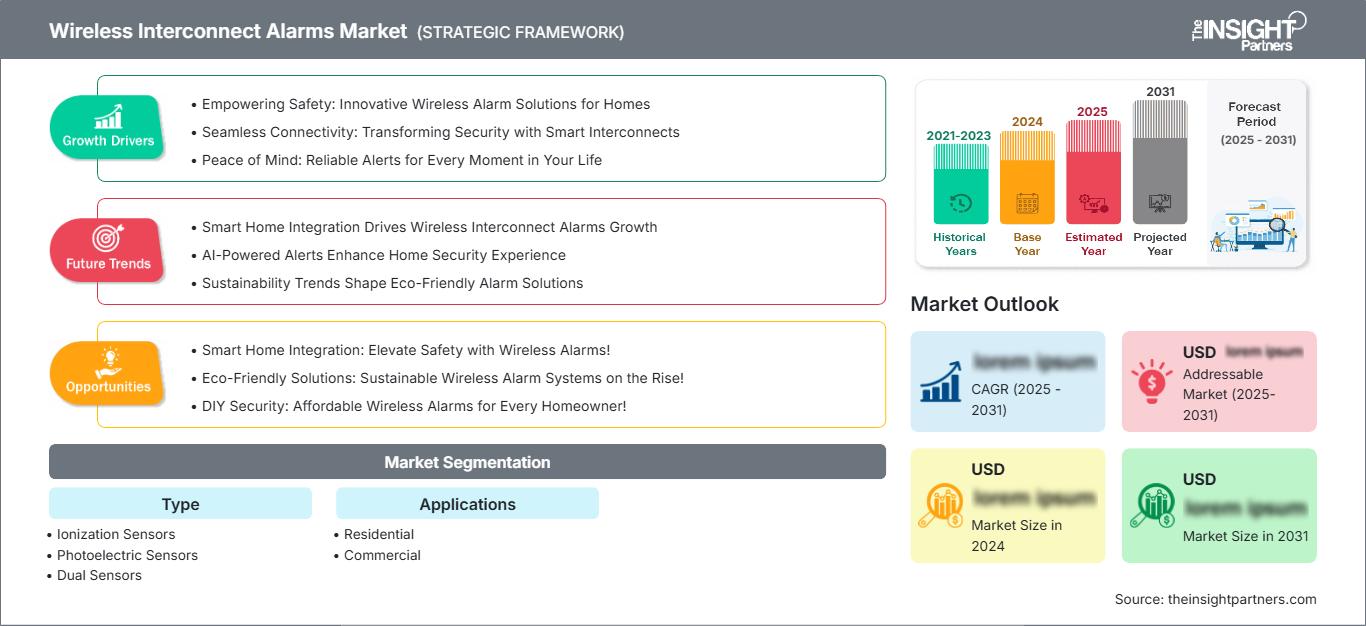
Wireless interconnect alarms are advanced safety devices that communicate with one another through wireless technology, ensuring that when one alarm detects smoke, fire, heat, or carbon monoxide, all connected alarms activate simultaneously. These systems significantly improve occupant safety by providing early warning across residential, commercial, institutional, and industrial buildings without requiring complex hardwired installations. Wireless interconnect alarms are widely deployed in homes, apartment complexes, hotels, hospitals, educational institutions, offices, warehouses, retail buildings, and public infrastructure. Modern systems incorporate wireless radio frequency communication, Internet of Things connectivity, smart home integration, mobile notifications, self-diagnostics, battery health monitoring, and cloud-based management. Continuous advancements in sensor technologies, wireless communication, artificial intelligence, and smart building platforms are improving detection accuracy, installation flexibility, and system reliability. As building safety regulations continue evolving worldwide, wireless interconnect alarms remain a critical component of modern fire and life safety systems.
Market Overview
The Wireless Interconnect Alarms Market size is projected to reach US$ 2.79 Billion by 2034 from US$ 1.62 Billion in 2025. The market is anticipated to register a CAGR of 6.97% during the forecast period 2026-2034. Market growth is driven by increasing adoption of smart home technologies, strengthening fire safety regulations, rising residential construction, growing awareness of occupant safety, and continuous advancements in wireless building safety systems. Manufacturers continue introducing intelligent alarm solutions with enhanced connectivity, automation, and remote monitoring capabilities.
Key Market Insights
- Market Size (2025): US$ 1.62 Billion
- Forecast Market Size (2034): US$ 2.79 Billion
- CAGR (2026-2034): 6.97%
- Key Growth Driver: Growing demand for intelligent residential and commercial fire safety systems
- Major Trend: Internet of Things-enabled wireless alarm networks with remote monitoring
- Forecast Period:2026-2034
Get a Sample PDF of the Report: https://www.theinsightpartners.com/sample/TIPRE00019022
Market Drivers
Strengthening Fire Safety Regulations
Governments and regulatory authorities continue implementing stricter fire safety standards for residential and commercial buildings. Building codes increasingly recommend or require interconnected alarm systems that provide simultaneous alerts throughout properties, improving occupant evacuation and emergency response times.
Growth of Smart Homes
The expanding adoption of smart home technologies is driving demand for connected wireless alarm systems that integrate with home automation platforms, voice assistants, and mobile applications. Homeowners increasingly prefer intelligent safety solutions that provide remote monitoring and instant emergency notifications.
Expansion of Residential Construction
Rapid urbanization and increasing housing development are creating significant demand for modern fire safety systems. Wireless interconnect alarms simplify installation while eliminating the need for extensive electrical wiring, making them particularly attractive for new construction and renovation projects.
Growing Safety Awareness
Increasing public awareness regarding fire hazards, carbon monoxide exposure, and emergency preparedness is encouraging homeowners, businesses, and property managers to invest in advanced interconnected alarm systems that improve overall building safety.
Market Trends
Internet of Things Connectivity
Manufacturers are integrating Internet of Things capabilities into wireless alarms, enabling remote monitoring, mobile alerts, cloud connectivity, automated diagnostics, and centralized device management. Connected alarm systems provide enhanced visibility while improving maintenance efficiency.
Artificial Intelligence-Based Detection
Artificial intelligence algorithms are improving alarm accuracy by reducing false alarms and distinguishing between different environmental conditions. Intelligent sensing technologies enhance fire detection performance while minimizing unnecessary emergency responses.
Long-Life Battery Technology
Advancements in battery technology are extending operational lifespans and reducing maintenance requirements. Long-life lithium batteries provide reliable operation for many years while supporting uninterrupted protection during power outages.
Integration with Smart Building Systems
Wireless interconnect alarms are increasingly integrated with building automation systems, security platforms, emergency lighting, access control, and emergency communication systems, creating comprehensive life safety ecosystems for residential and commercial properties.
Get the Premium Research Report @ https://www.theinsightpartners.com/buy/TIPRE00019022
Regional Analysis
North America
North America remains a leading market due to strict building safety regulations, widespread smart home adoption, increasing residential renovation projects, and strong awareness of fire safety requirements. Continuous investments in intelligent building technologies continue supporting regional market growth.
Europe
Europe continues experiencing significant market growth driven by stringent fire safety standards, expanding smart building initiatives, increasing residential modernization, and growing adoption of connected safety devices. Germany, the United Kingdom, France, Italy, and the Nordic countries continue strengthening fire protection infrastructure.
Asia-Pacific
Asia-Pacific is expected to register the fastest market growth owing to rapid urbanization, expanding residential construction, increasing smart city development, rising disposable income, and growing awareness of building safety. China, Japan, South Korea, India, and Southeast Asian countries continue investing in advanced fire detection technologies.
Middle East and Africa
The Middle East and Africa are witnessing increasing adoption of wireless interconnect alarms across residential developments, commercial buildings, hospitality facilities, healthcare infrastructure, and smart city projects. Continued infrastructure investments and strengthening fire safety regulations are creating long-term market opportunities.
Competitive Landscape
The Wireless Interconnect Alarms Market remains highly competitive as fire safety equipment manufacturers, smart home technology providers, electronics companies, sensor developers, and building automation suppliers continue investing in wireless communication, Internet of Things platforms, artificial intelligence, cloud connectivity, and intelligent detection technologies. Companies are focusing on improving detection accuracy, battery life, cybersecurity, installation simplicity, and system interoperability while expanding partnerships across residential, commercial, and institutional markets.
Key Players
- Honeywell International Inc.
- Kidde Global Solutions
- Siemens AG
- Schneider Electric SE
- Johnson Controls International plc
- Bosch Security Systems GmbH
- ABB Ltd.
- Ei Electronics
- BRK Brands, Inc.
- Hochiki Corporation
Emerging Trends
The wireless interconnect alarms industry continues advancing through artificial intelligence, Internet of Things connectivity, cloud-based monitoring, predictive diagnostics, edge computing, smart building integration, digital twins, advanced wireless communication, voice notifications, and intelligent emergency response systems. Manufacturers are developing next-generation alarm solutions capable of delivering faster hazard detection, remote diagnostics, automated maintenance alerts, and seamless integration with connected safety ecosystems. Growing investments in smart buildings, digital infrastructure, and occupant safety are expected to create significant market opportunities throughout the forecast period.
Future Outlook
The future outlook for the Wireless Interconnect Alarms Market remains highly promising as governments continue strengthening fire safety regulations and consumers increasingly adopt connected home technologies. Rising investments in smart buildings, expanding residential construction, growing awareness of life safety, and continuous advancements in wireless communication technologies will continue supporting market growth. Future innovations are expected to focus on artificial intelligence-enhanced detection, cloud-based safety management, advanced wireless networking, predictive maintenance, and deeper integration with intelligent building platforms.
Related Market Research Reports
E-Scrap and Printed Circuit Board (PCB) E-Scrap Market Trends, Share & Demand by 2034
SAS Hard Disk Drives Market Growth, Demand & Size by 2034
Earbuds Market Size, Trends & Growth by 2034
5G Industrial IoT Market Demand, Size & Forecast by 2034
About The Partners
The Insight Partners is a Insight global leader in market research, delivering comprehensive analysis and actionable insights across diverse industries. The company empowers decision-makers with data-driven intelligence to navigate evolving markets and accelerate growth.
Contact Us:
- Contact Person: Ankit Mathur
- E-mail: ankit.mathur@theinsightpartners.com
- Phone: +1-646-491-9876
Also Available in :
