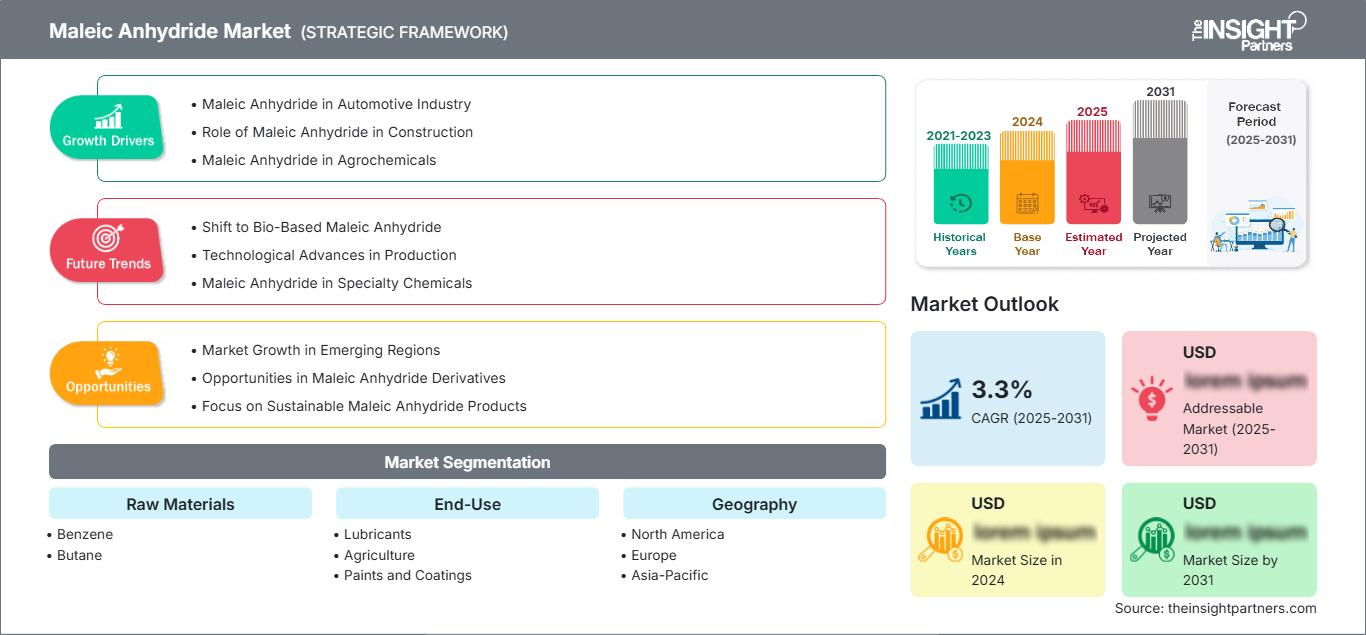
Few petrochemical intermediates touch as many everyday products as maleic anhydride, from the fibreglass boat hull in a marina to the stretchy waistband in a pair of jeans. Valued at US$ 3.29 Billion in 2025, the Maleic Anhydride Market is projected to reach US$ 5.11 Billion by 2034, expanding at a 5.01% CAGR across the 2026 to 2034 forecast period. That growth traces back to construction materials, automotive lightweighting, and a wave of downstream chemistry that few consumers ever think about.
What Is Maleic Anhydride?
Maleic anhydride is a versatile petrochemical intermediate produced primarily from butane or benzene oxidation. It serves as a building block for unsaturated polyester resins, engineering plastics, and a range of specialty chemical derivatives used across construction, automotive, and industrial applications.
Unsaturated polyester resins remain the single largest application for maleic anhydride, consumed heavily in construction materials, marine composites, and wind turbine blade manufacturing. As infrastructure spending picks up across emerging economies and renewable energy installations continue to expand, demand for these resins has climbed steadily, pulling maleic anhydride volumes along with it. What makes this particularly significant is that wind energy growth has quietly become one of the more durable demand drivers for a chemical most people associate with older industrial uses, since turbine blades require large volumes of resin-reinforced composite material.
Request a Sample Copy of the Report: https://www.theinsightpartners.com/sample/TIPRE00005640
1,4-butanediol production represents another major consumption route, feeding into engineering plastics, spandex fibres, and polyurethane applications. Automotive light weighting trends have boosted demand here too, as manufacturers substitute metal components with engineered plastics derived from BDO chemistry to improve fuel efficiency and reduce vehicle weight. Lubricating oil additives and copolymer applications round out the demand base, with copolymers finding steady use in adhesives, coatings, and paper sizing chemistry.
So what is shaping raw material choices across this market? Butane-based production routes have gained favour over benzene feedstock in many regions, largely due to cost advantages tied to shale gas-derived butane availability, particularly in North America. This is not simply a cost story, it reflects a broader feedstock realignment across the petrochemical sector as producers chase the most economical route available in each region. Benzene-based production continues to hold relevance in regions where established infrastructure and feedstock access favour that pathway.
Segments Covered
By Raw Material: Butane-based production leads the market given favourable feedstock economics in key manufacturing regions. Benzene-based production retains a meaningful share where existing infrastructure supports that route.
By Application: Unsaturated polyester resins account for the largest application share, driven by construction, marine, and wind energy demand. 1,4-butanediol follows closely, fuelled by engineering plastics and spandex fibre production. Lubricating oil additives and copolymers each serve steady, specialised demand pools across industrial and coatings applications.
Key Market Players
- Huntsman Corp
- IG Petrochemicals Ltd
- Cepsa
- LANXESS AG
- Mitsubishi Chemical Corp
- Nippon Shokubai Co Ltd
- Polynt-Reichhold Group
- Ruse Chemicals
- Yongsan Chemical Co Ltd
- Zibo Qixiang Tengda Chemical Co Ltd
Sustainability and Innovation Trends
Producers are exploring bio-based feedstock routes for maleic anhydride production, aiming to reduce reliance on petroleum-derived butane and benzene over the long term. Process efficiency improvements in catalytic oxidation technology are also helping cut energy consumption per tonne of output, addressing a historically energy-intensive production step. Several manufacturers are additionally investing in capacity expansions located closer to downstream resin and BDO production facilities, reducing transport-related emissions across the value chain.
Buy Premium Report: https://www.theinsightpartners.com/buy/TIPRE00005640
Regional Outlook
Asia Pacific dominates the market, anchored by extensive construction activity, a large automotive manufacturing base, and expanding wind energy installations across China and India. North America holds a strong position, supported by cost-advantaged butane feedstock and steady demand from construction and automotive sectors. Europe maintains stable demand, driven by its established engineering plastics and composite materials industry, though feedstock cost pressures remain a watch point. South and Central America is showing gradual growth, tied to expanding infrastructure development and a growing manufacturing base across the region.
Related Reports:
Unsaturated Polyester Resin Market
About The Insight Partners
The Insight Partners is among the leading market research and consulting firms in the world. We take pride in delivering exclusive reports along with sophisticated strategic and tactical insights into the industry. Reports are generated through a combination of primary and secondary research, solely aimed at giving our clientele a knowledge-based insight into the market and domain. This is done to assist clients in making wiser business decisions. A holistic perspective in every study undertaken forms an integral part of our research methodology and makes the report unique and reliable.
Contact Us:
If you have any queries about this report or if you would like further information, please contact us:
Phone: +1-646-491-9876
E-mail: sales@theinsightpartners.com
Also Available in: Korean | German | Japanese | French | Chinese | Italian | Spanish
