Aviation safety stands as the cornerstone of global airspace management, relying on complex technologies to eliminate operational risks. Among these critical systems, the Terrain Awareness and Warning System (TAWS) plays a primary role in modern cockpit safety. Designed as an onboard avionics safety technology, TAWS functions to prevent Controlled Flight Into Terrain (CFIT) accidents. CFIT occurs when an airworthy aircraft, under the complete control of the pilot, is inadvertently flown into terrain, obstacles, or bodies of water. By integrating real-time Global Positioning System (GPS) data, precise aircraft flight configurations, and comprehensive pre-loaded digital terrain and obstacle databases, TAWS predicts potential conflicts along the flight path. It delivers critical visual and acoustic aural alerts to the flight crew well in advance, providing them with the necessary reaction time to perform evasive maneuvers.
As global air traffic volumes increase and fleets expand worldwide, the demand for sophisticated safety avionics has driven substantial market expansion. According to a comprehensive market analysis by The Insight Partners, the global Terrain Awareness and Warning System market is entering a phase of sustained growth.
Market Valuation and Growth Trajectory
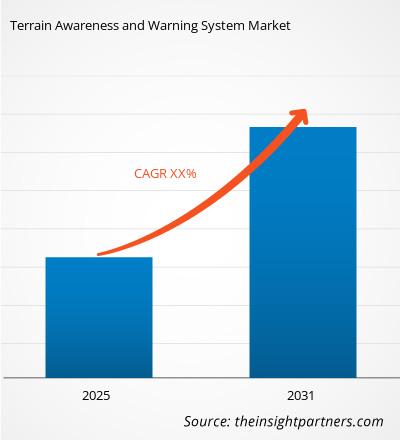
The structural health of the global aviation safety market is reflected directly in its valuation forecasts. The global Terrain Awareness and Warning System Market size is projected to reach US$ 2.46 billion by 2034 from US$ 1.54 billion in 2025. This expansion underscores an extensive industry-wide shift toward mandatory safety modernizations and advanced cockpit technologies. The market is anticipated to register a Compound Annual Growth Rate (CAGR) of 6.00% during the forecast period 2026-2034.
This robust growth curve is propelled by a combination of tight regulatory mandates from global aviation authorities like the Federal Aviation Administration (FAA) and the European Union Aviation Safety Agency (EASA), alongside proactive fleet renewal investments by commercial airlines and defense operators.
Primary Growth Drivers
1. Stringent Aviation Safety Mandates
Historically, the widespread deployment of ground proximity alerting systems has been reactive, heavily shaped by investigative findings from aviation authorities. Today, regulations strictly dictate the baseline requirements for aircraft safety mechanisms. Regulatory bodies enforce mandatory Class A TAWS installations on commercial turbine-powered passenger and cargo aircraft. At the same time, regional authorities are widening these boundaries, pushing for Class B and Class C solutions inside lighter general aviation airframes, corporate business jets, and emergency medical service helicopters.
2. Commercial Air Traffic and Fleet Expansion
The expansion of global air travel serves as a powerful catalyst for the TAWS market. To keep pace with rising passenger and cargo demand, airlines are systematically adding new aircraft to their fleets. Modern commercial aircraft leave production lines with highly integrated, factory-fitted safety avionics platforms. Simultaneously, legacy fleets are undergoing comprehensive glass-cockpit retrofit programs to bring older airframes into full compliance with international safety protocols, creating a steady revenue flow for both Original Equipment Manufacturers (OEMs) and aftermarket distributors.
3. Civil-Military Avionics Modernization
Military defense forces represent a highly active sector within the market landscape. High-stakes combat environments, low-altitude transport routes, and specialized helicopter sorties place extreme demands on pilot situational awareness. Defense operators are upgrading older transport planes, combat jets, and rotary-wing aircraft with digital cockpits that feature terrain-masking capabilities and advanced terrain proximity predictors to ensure survivability during low-visibility, high-risk missions.
Get a PDF Sample– https://www.theinsightpartners.com/sample/TIPRE00005232
Key Market Competitors
The global landscape is highly competitive, featuring established aerospace engineering giants alongside specialized avionics innovators. These entities focus on research and development to optimize database accuracy, decrease false alarms, and integrate modular software suites. Key players operating within the global Terrain Awareness and Warning System market include:
Aspen Avionics, Inc
Collins Aerospace
Elbit Systems Ltd
Garmin Ltd
Genesys Aerosystems
Honeywell International Inc.
L3Harris Technologies, Inc.
Avidyne Corporation
Sandel Avionics, Inc
Thales Group
Get Full Copy of This Report- https://www.theinsightpartners.com/buy/TIPRE00005232
Future Outlook
The future of the Terrain Awareness and Warning System market points toward total architectural integration and predictive intelligence. The industry is rapidly moving away from standalone hardware alert boxes, opting instead for integrated, software-defined avionics suites embedded within centralized flight management systems. This shift reduces structural weight, lowers thermal load, and allows operators to implement seamless over-the-air updates for global terrain and obstacle charts. Technology trends are also heavily steering toward pairing TAWS software with Synthetic Vision Systems (SVS). Instead of relying solely on audio alerts or flat displays, modern flight desks present a real-time, three-dimensional digital rendering of the surrounding topography directly onto the pilot’s primary flight display.
Related Reports-
The Insight Partners is a one-stop industry research provider of actionable intelligence. We help our clients in getting solutions to their research requirements through our syndicated and consulting research services. We specialize in industries such as Semiconductor and Electronics, Aerospace and Defense, Automotive and Transportation, Biotechnology, Healthcare IT, Manufacturing and Construction, Medical Devices, Technology, Media, and Telecommunications, as well as chemicals and Materials.
Contact Us
If you have any queries about this report or if you would like further information, don’t hesitate to get in touch with us:
Contact Person: Ankit Mathur
E-mail: ankit.mathur@theinsightpartners.com
