Key Highlights
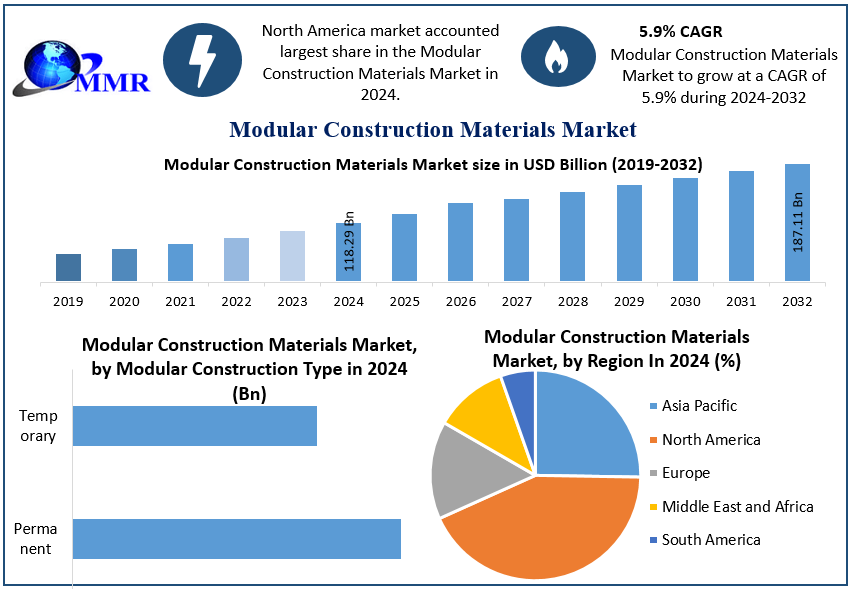
Market size expands from USD 118.29 billion in 2024 to USD 187.11 billion by 2032 at a 5.9 percent CAGR.
Structural steel dominates due to high tensile strength and design versatility for rounded or arched features.
Wood is the fastest-growing framework material, favored for high workability in pre-engineered components.
Escalating raw material shortages drove non-residential building input prices up 17 percent since 2021.
Commercial buildings hold the largest end-user share, driven by rapid hospitality and healthcare projects.
Major structural consolidation redefines capacity ownership, highlighted by a USD 10.5 billion regional acquisition.
Why This Matters Now
Volatile raw material costs and persistent labor shortages force industrial buyers to abandon traditional onsite building methods immediately. Global construction constitutes roughly 13 percent of global GDP, yet stagnant productivity trends demand factory-controlled, prefabricated assemblies to compress schedules. For chemical producers, this structural pivot shifts downstream consumption toward specialized coatings, structural steel, polymers, and cement formulations.
Companies failing to realign procurement with offsite manufacturing timelines risk locking capital into slow distribution channels. Infrastructure budgets are moving rapidly toward modular configurations that eliminate unpredictable weather delays. This macro-level shift forces material suppliers to optimize product portfolios for automated, high-velocity factory lines.
Market Overview
The global Modular Construction Materials Market reached USD 118.29 billion in 2024 and is structured to achieve USD 187.11 billion by 2032. This expansion represents a steady 5.9 percent compound annual growth rate from 2025 to 2032. Rapid population growth, structural housing deficits, and intensifying urbanization create high demand for modern buildings, accelerating factory-built component adoption worldwide.
The market operating framework depends heavily on localized raw feedstock availability, volatile material pricing, and regional construction output indicators. This baseline volume growth provides a highly predictable consumption outlook for global chemical manufacturers, plastic suppliers, and primary material processors.
Key Trends Driving Growth
Offsite fabrication shortens building timelines significantly by allowing structure assembly work to proceed concurrently with offsite site preparation. Developers, architects, and general contractors utilize modular methods because they lower upfront capital expenditures, minimize material waste, and prevent costly weather disruptions. Furthermore, modular buildings are legally treated as relocatable assets, allowing corporate owners to refurbish, expand, or completely relocate structural components to meet new corporate needs.
Conversely, acute supply shortages and sharp pricing spikes present severe macroeconomic headwinds for long-term commercial project planning. Associated General Contractors of America data released in June 2022 shows non-residential construction material prices surged 17 percent within a single year since 2021. Additionally, reliability concerns and engineering limitations in earthquake-prone geographic zones restrict modular application scope, hampering overall material demand in vulnerable territories.
Segment Insights
Dominant Material Segment: Steel held the largest market share in 2024, providing structural rigidity and durability for complex configurations like rounded arches.
Fastest-Growing Material Segment: Wood will expand at a high CAGR, favored for high workability in roof trusses, wall framing, and plywood panels.
Dominant Construction Type: Permanent structures lead the market because prefabricated permanent houses are inexpensive and easy to build.
Growing Construction Type: Temporary structures expand rapidly due to operational flexibility and easy relocation features for industrial applications.
Dominant End-User Segment: Commercial buildings hold the major market share, led by health facilities, colleges, and office infrastructure.
Fastest-Growing End-User Application: Hotels and motels represent the fastest-growing sector as developers seek to minimize time to occupancy.
Regional Growth Story
North America secured the largest market share in 2024 due to widespread modular integration in new residential and commercial project developments. Despite elevated raw material input costs and high interest rates, expanding residential housing outputs sustained positive local market momentum. Federal infrastructure spending programs supplement these gains, injecting tens of billions of dollars directly into public construction and municipal modernization projects.
Asia Pacific will hold a major volume share through 2032, driven by massive population growth, urbanization, and industrial manufacturing investments. Under India’s 2024 federal budget, intensive infrastructure prioritization enables building material segments like cement and wood to post robust growth moving forward. Europe grows via affordable housing needs and government green building mandates, driving high infrastructure expenditures in primary chemical manufacturing hubs like France and Germany.
Competitive Landscape
The market structure is growing highly competitive, attracting new entrants while forcing extensive consolidation among established producers. Major conglomerates are executing cross-border acquisitions and structural carve-outs to protect margins from inflationary input shocks. These capital movements indicate players prioritize local market access, capacity utilization, and raw material feedstock security.
Primary manufacturers are divesting peripheral geographic assets to concentrate capital in high-growth industrial corridors. This consolidation redefines long-term supply arrangements, shifting bargaining power toward integrated suppliers who control raw material processing. Independent modular builders face severe supply friction unless they secure structured procurement agreements with major global producers.
Recent Developments
China Baowu Steel Group Corporation Limited acquired state-owned enterprise Sinosteel in 2022 to consolidate high-volume production capacity.
Nucor purchased a majority stake in California Steel Industries in 2021 to strengthen its regional supply network.
Nucor acquired the insulated metal panel business from Cornerstone Building Products to capture high-margin commercial insulation volume.
Holcim Group exited the Indian material market in 2022 after seventeen years to focus on core global asset performance.
Adani Group acquired Holcim’s Indian assets, including ACC Limited, for USD 10.5 billion to control regional building material supply.
Strategic Implications
These large-scale acquisitions signal an aggressive move toward vertical integration across the building materials value chain. When major steel producers like Nucor acquire downstream insulated panel operations, they reduce merchant feedstock availability for independent fabricators. This structural shift increases the pricing power of large integrated conglomerates while inflating raw input costs for non-integrated builders.
Furthermore, massive asset sales like Holcim’s USD 10.5 billion exit demonstrate that global materials companies are actively de-risking portfolios. Focusing capital on consolidated hubs allows producers to align manufacturing output directly with state-level infrastructure budgets. Procurement organizations must respond by abandoning spot-market purchasing for long-term, indexed supply agreements.
Future Outlook
The global modular construction materials market will increasingly rely on advanced manufacturing automation and low-carbon feedstocks. Traditional material suppliers must immediately adapt product lines to match precise factory tolerances or lose volume to alternative composites. Definitive market advantages will belong to producers building localized supply networks to insulate operations from persistent 17 percent input cost spikes.
Analyst Perspective
“The transition to factory-controlled modular systems represents a fundamental shift in traditional building supply chains,” said Ankita Kagawade, Lead Analyst at Maximize Market Research. “Faced with volatile input costs, chemical and material manufacturers must engineer specialized formulations that accelerate assembly speeds and satisfy strict green building regulations globally.”
About Maximize Market Research
Maximize Market Research Pvt. Ltd. (MMR) is a global market research and consulting company that provides reliable, data-focused, and practical business insights. The firm serves a wide range of industries, including healthcare, pharmaceuticals, technology, automotive, electronics, chemicals, personal care, and consumer goods. Through market forecasts, competitive analysis, strategic consulting, and industry impact assessments, MMR helps organizations understand changing market conditions, identify growth opportunities, and make informed business decisions for long-term success.
2nd Floor, Navale IT Park Phase 3
Pune Banglore Highway, Narhe
Pune, Maharashtra 411041, India
+91 9607365656
sales@maximizemarketresearch.com
