Key Highlights
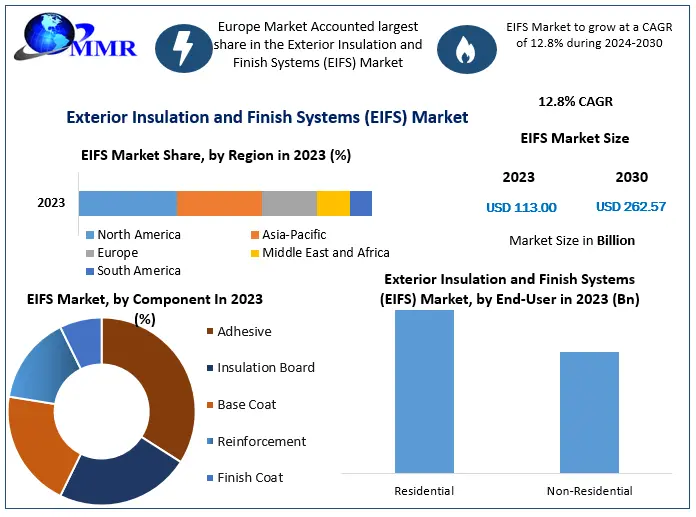
Market Valuation: USD 113.00 Billion in 2023.
Projected Valuation: USD 262.57 Billion by 2030.
Growth Rate: 12.8% CAGR (2024–2030).
Dominant End-User: Non-residential construction.
Fastest-Growing Type: Polymer-Based (PB) EIFS.
Fastest-Growing Material: Expanded Polystyrene (EPS).
Regional Leader: Europe.
Why This Matters Now
The construction sector is no longer prioritizing aesthetic exterior cladding alone; thermal regulation has moved to the boardroom agenda. With building regulations increasingly penalizing high energy consumption, EIFS has transitioned from a specialized finish into a core structural requirement. Manufacturers ignoring the integration of superior adhesive chemistries and moisture-resistant insulation boards will find their market access restricted by new energy compliance standards. Procurement leaders who fail to secure supply chains for these materials face significant project delays as demand for energy-efficient building components continues to outpace production capacity.
Market Overview
EIFS are now among the most rigorously tested and researched claddings in the global construction industry. These systems, characterized as non-load-bearing, provide essential continuous insulation, water resistance, and design versatility. The Exterior Insulation and Finish Systems Market is currently capitalized at USD 113.00 Billion, with a clear trajectory toward USD 262.57 Billion by 2030. This growth is underpinned by the essential function of EIFS in meeting international building codes and ASTM requirements, effectively forcing a structural shift in how buildings are insulated and protected against environmental degradation.
Key Trends Driving Growth
The primary driver of the EIFS market is the convergence of sustainability regulations and the expansion of the non-residential construction sector. Modern commercial and institutional building designs require high-performance thermal envelopes to maintain occupancy comfort while minimizing HVAC expenditure. Simultaneously, technological advancements in adhesive applications are eliminating the risk of galvanic corrosion in multi-material building interfaces—a common failure point in legacy construction. As developers demand systems that offer both design flexibility and energy code adherence, EIFS manufacturers are responding by shifting toward high-purity polymer formulations.
Segment Insights
Dominant End-User: Non-Residential Construction. This segment has long been the primary driver for EIFS, consistently absorbing high volumes of cladding for offices, hospitals, and infrastructure projects where thermal performance is tied to long-term operational cost reduction.
Fastest-Growing Type: Polymer-Based (PB) EIFS. This segment is accelerating due to its superior thermal insulation properties and cost-effectiveness. By utilizing closed-cell Expanded Polystyrene (EPS) and versatile attachment methods, it allows for enhanced impact resistance, a requirement for high-traffic commercial zones.
Fastest-Growing Material: Expanded Polystyrene (EPS). EPS is becoming the industry standard due to its closed-cell structure, which is comprised of approximately 98% air, offering exceptionally low thermal conductivity and non-hygroscopic performance that prevents moisture absorption.
Regional Growth Story
Europe currently holds the largest market share, driven by aggressive regional mandates for thermal insulation and a robust pipeline of infrastructure modernization. Countries like Italy and Poland are emerging as critical expansion zones, where the integration of EIFS into both retrofitting and new construction is becoming the standard for carbon reduction. While the non-residential sector remains the primary consumer, the residential market is scaling at the second-highest rate, suggesting that the regional shift toward energy-neutral housing is providing a secondary, resilient revenue stream for manufacturers with localized production footprints.
Competitive Landscape
The competitive environment is defined by a race to standardize high-performance components. Major players, including BASF, Saint-Gobain, Wacker Chemie, and Sika Corporation, are not merely supplying materials; they are providing comprehensive wall systems that reduce liability for developers. Acquisitions and strategic investments are currently focused on vertical integration, particularly in the production of proprietary adhesives and reinforcement meshes. Companies that possess the internal capacity to test and certify their EIFS under evolving building codes are gaining significant pricing power, as specifiers increasingly de-risk their supply chains by favoring established, large-scale manufacturers.
Recent Developments
Polymer-Modification Shift: Leading suppliers are prioritizing the refinement of Polymer-Modified (PM) and Polymer-Based (PB) chemistries to increase system durability and impact resistance in extreme climates.
Advanced Adhesive R&D: Industry focus has shifted to adhesives capable of joining disparate substrates—glass, metals, and ceramics—without causing galvanic corrosion, directly addressing the structural challenges of modern mixed-material facades.
Strategic Expansion: Key manufacturers are expanding production capacities in response to the high projected CAGR, signaling a belief in the long-term endurance of the EIFS segment despite potential short-term macroeconomic volatility.
Strategic Implications
The shift toward high-performance EIFS necessitates a departure from the “commodity-supplier” mindset. Manufacturers must now act as technical partners to architects and engineers, providing systems that ensure compliance with energy-neutral building standards. For investors, the EIFS market offers a hedge against general construction volatility, as the move toward energy-efficient retrofitting provides a steady demand base even when new-build activity fluctuates. The winners will be those who control the chemistry of the adhesive and finish coats, as these components determine the longevity and thermal performance of the entire system.
Future Outlook
The EIFS market is entering a phase of technical consolidation where material science, specifically in polymer chemistry and cellular insulation, will determine market leadership. Investors should anticipate a decade of intensified competition where only those who successfully integrate high-performance insulation boards with superior, non-corrosive adhesive systems will command the premium pricing required to sustain a 12.8% growth rate. Firms that fail to align their product roadmaps with stringent thermal-efficiency benchmarks risk obsolescence in an increasingly decarbonized built environment.
Analyst Perspective
“The global EIFS market is currently moving beyond standard cladding applications into a phase of precision engineering,” says Ankita Kagawade, Analyst at Maximize Market Research. “As energy efficiency becomes the primary metric for asset valuation in the construction industry, the demand for high-performance EIFS will dictate the structural standards for both new and retrofitted buildings worldwide.”
About Maximize Market Research
Maximize Market Research Pvt. Ltd. (MMR) is a global market research and consulting company that provides reliable, data-focused, and practical business insights. The firm serves a wide range of industries, including healthcare, pharmaceuticals, technology, automotive, electronics, chemicals, personal care, and consumer goods. Through market forecasts, competitive analysis, strategic consulting, and industry impact assessments, MMR helps organizations understand changing market conditions, identify growth opportunities, and make informed business decisions for long-term success.
2nd Floor, Navale IT Park Phase 3
Pune Banglore Highway, Narhe
Pune, Maharashtra 411041, India
+91 9607365656
sales@maximizemarketresearch.com
