Key Highlights
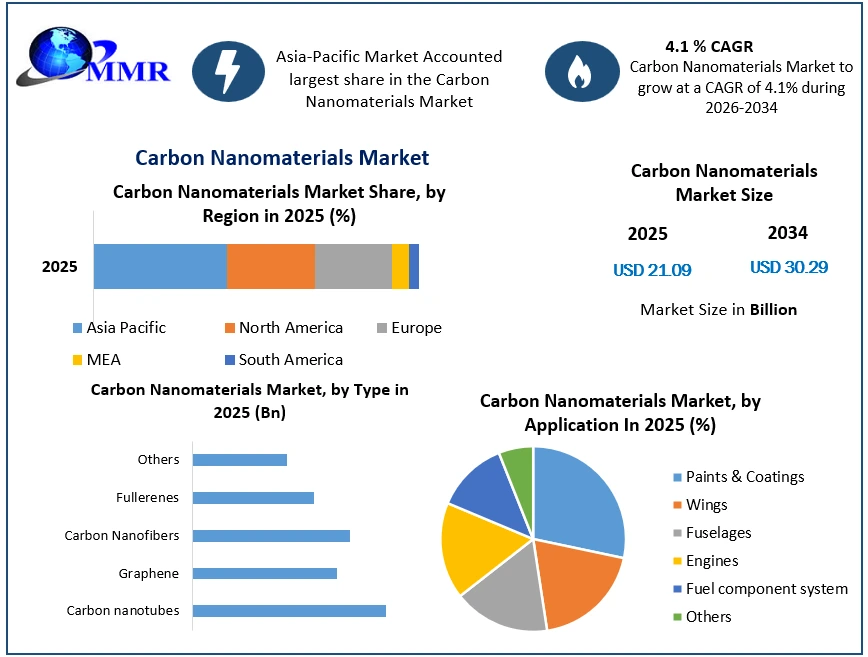
Market Valuation: USD 21.09 billion in 2025; projected to reach USD 30.29 billion by 2034.
Growth Rate: 4.1% CAGR through the 2026–2034 forecast period.
Dominant Method: Chemical Vapor Deposition (CVD) leads production throughput.
Fastest-Growing Segment: Electrical & Electronics end-use industry.
Regional Leader: Asia-Pacific.
Core Drivers: Integration into EV batteries, lightweight automotive design, and aerospace composite optimization.
Why This Matters Now
The transition toward next-generation battery technology and high-performance lightweight engineering has moved carbon nanomaterials from the laboratory to the industrial production floor. Chemical manufacturers and procurement leaders must acknowledge that the scale-up of production methodologies, particularly Chemical Vapor Deposition (CVD), is no longer an R&D goal but a competitive necessity. Firms failing to secure access to these high-purity additives risk marginalization as major automotive and energy OEMs standardize these materials for mission-critical applications.
Market Overview
The Global Carbon Nanomaterials Market stands at a valuation of USD 21.09 billion in 2025, with a trajectory toward USD 30.29 billion by 2034. This sector is undergoing a transition from niche specialty material status to a foundational element of industrial performance. The market is defined by the demand for materials that offer superior electrical conductivity, mechanical strength, and thermal management. As production volumes increase, the industry is shifting toward more batch-efficient processes, marking a departure from labor-intensive synthesis toward scalable, high-throughput manufacturing.
Key Trends Driving Growth
The automotive sector remains the primary anchor for market demand, utilizing carbon nanomaterials to optimize lithium-ion battery performance—specifically to decrease charge times and improve tensile strength. Beyond batteries, the aerospace industry is integrating these materials into structural components, from engine parts to aircraft interiors, to maximize weight reduction without sacrificing safety.
Furthermore, the electronics industry continues to demand high-purity carbon materials for electromagnetic interference (EMI) shielding and sensor fabrication. The ability of these nanomaterials to modify the electrical resistance of nano-metals and ceramics makes them indispensable for next-generation optoelectronics and memory storage components.
Segment Insights
Dominant Method: Chemical Vapor Deposition (CVD). CVD holds the largest share due to its superior throughput, cost-efficiency, and batch-processing capability. Unlike physical vapor deposition, it does not require extreme vacuum conditions, making it the preferred method for the semiconductor and optoelectronics sectors.
Fastest-Growing End-Use: Electrical & Electronics. With a projected high growth momentum, this sector utilizes the unique electrical and magnetic properties of carbon nanomaterials to revolutionize sensor fabrication, EMI shielding, and superconductivity applications.
Regional Growth Story
Asia-Pacific maintains its market dominance, fueled by the massive electronics and automotive manufacturing footprints in China, Japan, and South Korea. Japan is the largest supplier, effectively setting the technological standard for production purity, while China and India drive the expansion of industrial application. North America and Europe are concentrating their efforts on defense research and high-performance automotive engineering, respectively, creating a localized demand for specialized, high-purity graphene and carbon nanotube additives.
Competitive Landscape
The market is characterized by aggressive industrial integration. Recent corporate developments signal a move toward vertical integration within the EV supply chain. Companies are not merely selling additives; they are developing localized battery anode material (BAM) infrastructure and slurry coating plants. This shift indicates that pricing power is increasingly migrating toward firms that control the raw material source—such as natural gas-derived graphene—and the downstream application technology.
Recent Developments
Battery Integration: Birla Carbon has integrated its Nanocyl range of multi-walled carbon nanotubes (MWCNTs) to accelerate the commercialization of conductive additives for EV batteries.
Production Capacity: Graphene Manufacturing Group (GMG) has finalized its Gen 2.0 production project, securing a 10-tonne-per-annum capacity for high-purity graphene derived from natural gas.
Strategic Joint Ventures: Northern Graphite Corporation and Obeikan Investment Group have initiated a USD 200 million Battery Anode Material (BAM) facility in Saudi Arabia to localize supply chains.
Corporate Consolidation: First Graphene Limited’s acquisition of MITO Material Solutions Inc. integrates graphene-based polymer additives directly into industrial composite manufacturing.
Regulatory Commercialization: GMG successfully commenced US commercial deployment of graphene-based thermal management coatings (THERMAL-XR) following regulatory clearance.
Strategic Implications
The market structure is rapidly moving away from commodity carbon black toward high-performance engineered carbon nanomaterials. Procurement leaders must prioritize supply chain resilience by partnering with firms that possess established CVD infrastructure. The high entry barrier, dictated by both technical complexity and increasing regulatory standards, suggests that companies currently in the R&D phase may struggle to compete with firms already demonstrating bulk commercial export capability.
Future Outlook
The convergence of battery technology, aerospace lightweighting, and electronic miniaturization will define the market’s trajectory over the next decade. Strategic winners will be companies that move beyond raw material production to offer functionalized, application-ready solutions, while laggards face the risk of obsolescence as the industry standardizes on high-purity, scalable carbon nanomaterial inputs.
Analyst Perspective
“The carbon nanomaterials market has successfully crossed the bridge from theoretical promise to industrial-scale integration,” says Ankita Kagawade, Analyst at Maximize Market Research. “The current investment focus on battery anode material infrastructure and high-throughput CVD manufacturing signals that the industry is no longer waiting for demand—it is actively building the supply chain required to power the global transition to high-efficiency electrification.”
About Maximize Market Research
Maximize Market Research Pvt. Ltd. (MMR) is a global market research and consulting company that provides reliable, data-focused, and practical business insights. The firm serves a wide range of industries, including healthcare, pharmaceuticals, technology, automotive, electronics, chemicals, personal care, and consumer goods. Through market forecasts, competitive analysis, strategic consulting, and industry impact assessments, MMR helps organizations understand changing market conditions, identify growth opportunities, and make informed business decisions for long-term success.
2nd Floor, Navale IT Park Phase 3
Pune Banglore Highway, Narhe
Pune, Maharashtra 411041, India
+91 9607365656
sales@maximizemarketresearch.com
