Key Highlights
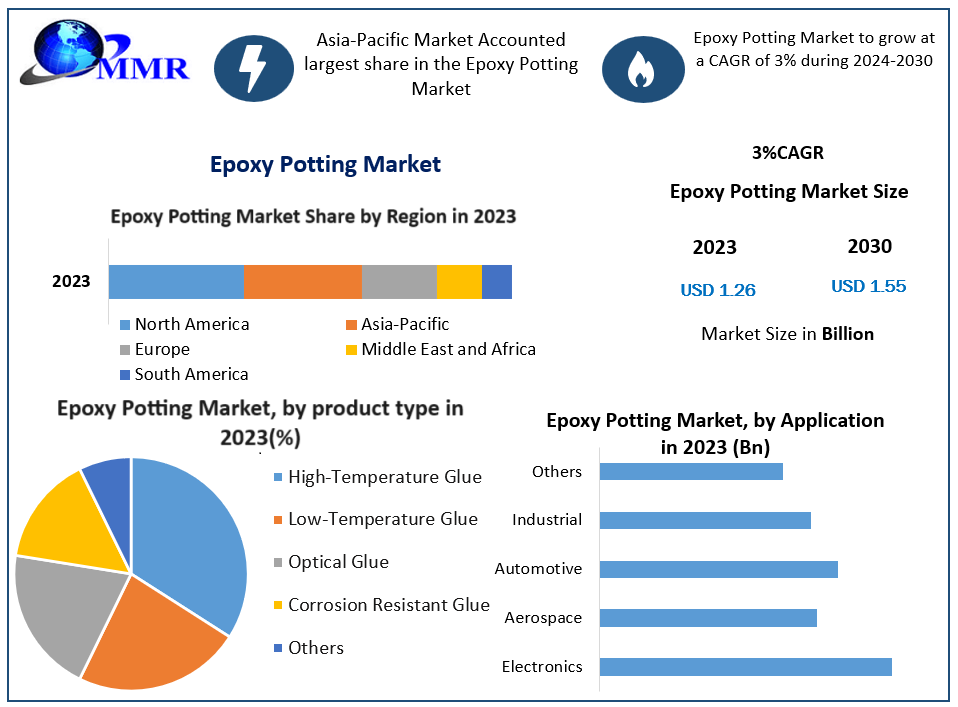
2023 Market Valuation: USD 1.26 Billion.
2030 Projected Valuation: USD 1.55 Billion.
Forecast CAGR: 3% (2024–2030).
Dominant Application: Electronics.
Dominant Product Type: High-Temperature Glue.
Dominant Regional Market: Asia-Pacific.
Why This Matters Now
Modern electronics are increasingly deployed in harsh environments—from automotive engine bays to industrial IoT sensors—where traditional shielding is insufficient. Epoxy potting provides a rigid, chemically resistant barrier that protects sensitive circuitry from moisture, vibration, and thermal cycling. For procurement managers, the bottleneck is no longer raw material availability, but rather the selection of formulations that balance curing time with long-term mechanical stability. Companies that prioritize high-dielectric and thermally robust epoxy solutions are gaining a competitive advantage in the high-reliability electronics supply chain.
Market Overview
Epoxy potting compounds function as the “invisible shield” for modern electronics, encapsulating components to prevent environmental degradation and electrical failure. In 2023, the global Epoxy Potting Market reached a valuation of USD 1.26 billion. Projections indicate steady expansion to USD 1.55 billion by 2030, as manufacturers seek out materials that exhibit minimal cure shrinkage and superior adhesion to diverse substrates. The market is evolving from basic insulation to high-precision performance, where potting compounds must now manage heat dissipation while maintaining structural integrity.
Key Trends Driving Growth
The explosive growth of the consumer and commercial electronics market, coupled with the rapid integration of automation and IoT (Internet of Things), is accelerating demand. Components such as transformers, solenoids, and capacitors require consistent encapsulation to prevent phenomena like corona discharge and corrosive chemical ingress. As electronics become smaller and more power-dense, the potting material itself has become an essential thermal management tool, forcing a shift toward specialized formulations that combine insulation with efficient heat transfer.
Segment Insights
Dominant Application: Electronics. This segment leads the global market as circuit boards and intricate electronic components increasingly require concealment and protection to maintain operational uptime.
Dominant Product Type: High-Temperature Glue. Holding a 35% market share as of recent analysis, this segment is favored for its thermal robustness, enabling electronic components to function reliably in demanding environments.
Fastest-Growing Segment: Industrial & IoT Electronics. With the proliferation of sensors and automation systems, these sectors are rapidly adopting potting resins to safeguard their massive investments in remote hardware.
Regional Growth Story
Asia-Pacific leads the global potting compound market in both value and volume. The region’s dominance is anchored by large-scale manufacturing centers in China, India, Japan, South Korea, and Malaysia, which serve the global demand for consumer electronics and transportation systems. Rapid industrialization and the expansion of domestic automotive sectors in these countries create a localized “production-consumption loop.” Emerging markets, particularly Singapore, Indonesia, and India, are currently the fastest-growing zones, showing sustained investment in electronic assembly capabilities that will remain strong through 2030.
Competitive Landscape
The market is characterized by a concentrated set of major players including Henkel, Dow, ELANTAS Beck, and 3M, who command market share through long-standing R&D and established distribution networks. Competition is currently focused on product differentiation: firms are vying to reduce cure times without sacrificing the mechanical hardness or low shrinkage that defined the industry’s success. Recent competitive shifts suggest a trend toward “application-specific” development, where companies collaborate directly with OEMs to tailor epoxy rheology and thermal properties, effectively raising the barrier for entrants who rely on generic, one-size-fits-all potting solutions.
Recent Developments
Increased Thermal Management Focus: Leading manufacturers are prioritizing the development of potting compounds that act as both electrical insulators and heat sinks.
Supply Chain Localization: Key players are expanding production footprints within the Asia-Pacific region to better support the automotive and electronics hubs in South Korea and India.
Automation Compatibility: R&D efforts are heavily concentrated on creating potting compounds that are compatible with high-speed automated dispensing and robotic assembly lines.
Strategic Implications
For investors and industrial buyers, the 3% CAGR represents a steady, reliable growth trajectory rather than a speculative bubble. The strategic priority should be the supply chain stability of high-temperature-rated resins, as these are increasingly critical to the electrification of the automotive and industrial sectors. Companies that fail to differentiate their offerings by providing better technical support for the potting process—specifically addressing curing time and dispense accuracy—will find it difficult to compete against the established technical leaders.
Future Outlook
The epoxy potting market will favor players who pivot away from simple volume-based supply toward becoming technical partners in thermal management. Future market success will be defined by the ability to offer formulations that survive more extreme temperature ranges and faster assembly cycle times, creating clear winners among firms that invest in advanced R&D.
Analyst Perspective
“The epoxy potting market is entering a phase of technical maturity where the focus is shifting from basic protection to active performance enhancement,” says Ankita Kagawade, Analyst at Maximize Market Research. “As modern electronics continue to shrink and power-density rises, the potting compound will serve as the final gatekeeper for product longevity, making the selection of high-temperature and thermally conductive resins a strategic necessity for global manufacturers.”
About Maximize Market Research
Maximize Market Research Pvt. Ltd. (MMR) is a global market research and consulting company that provides reliable, data-focused, and practical business insights. The firm serves a wide range of industries, including healthcare, pharmaceuticals, technology, automotive, electronics, chemicals, personal care, and consumer goods. Through market forecasts, competitive analysis, strategic consulting, and industry impact assessments, MMR helps organizations understand changing market conditions, identify growth opportunities, and make informed business decisions for long-term success.
2nd Floor, Navale IT Park Phase 3
Pune Banglore Highway, Narhe
Pune, Maharashtra 411041, India
+91 9607365656
sales@maximizemarketresearch.com
